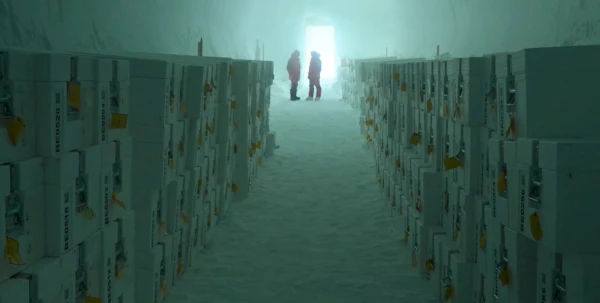
Researchers have announced the creation of the world's first ice storage facility, built on the icy continent. Samples preserving the history of Earth's climate have already been placed in it, writes Focus.
This week, scientists placed ancient blocks of glacial ice into the first of its kind storage facility in Antarctica. Researchers hope this will help preserve the rapidly disappearing evidence of the planet's climatic past for centuries, writes Science Alert.
The first samples placed in the storage were two ice cores extracted from the European Alps. They will now be stored in a specially constructed cave on the icy continent. Moreover, it is believed that this site will one day become a repository for invaluable archives of samples from around the world.
The ice storage is known to be located at the Concordia Station at an altitude of 3,200 meters in the heart of Antarctica. The local conditions will protect the collection in a natural cold storage at a temperature of -52 °C without the need for refrigeration.
According to researchers, the ice cores are an important asset as they shed light on climatic conditions over millennia. The samples are also thought to help scientists in the future unravel the mysteries of Earth's glaciers long after they have been erased from the face of the Earth.
Swiss climatologist and chairman of the Ice Memory Foundation, Thomas Stocker, stated that this ambitious project has been in development for nearly 10 years and addresses not only logistical but also unprecedented diplomatic challenges.
The storage facility is known to be a cave 35 meters long, with a height and width of 5 meters. The cave was built about 10 meters below the surface in dense snow, thus maintaining a sub-zero temperature. In the coming decades, scientists intend to supplement the archive with glacial ice from alpine regions such as the Andes, Himalayas, and Tajikistan.
<iframe width="560" height="315" src="https://www.youtube.com/embed/O08c83qKigM?si=P1JAIRFavXEGQYMQ" title="YouTube video player" frameborder="0" allow="accelerometer; autoplay; clipboard-write; encrypted-media; gyroscope; picture-in-picture; web-share" referrerpolicy="strict-origin-when-cross-origin" allowfullscreen></iframe>It is noted that the ice cores obtained by drilling from deep within the bedrock contain dust and other climatic indicators that can reveal ancient weather conditions on the planet.
For example, a layer of clear ice indicates a warm period when the glacier melted and then refroze, while a layer of low density indicates dense snow rather than ice, which can help assess the amount of precipitation. Meanwhile, fragile samples with cracks indicate snowfall on semi-melted layers that then refroze.