He intended to find out what would happen to him if nothing happened for weeks.
What is time and why does it flow so differently? Experiments by geologist and chronobiology researcher Michel Siffre (1939-2024), conducted in complete isolation and darkness, showed how our sense of time is distorted. Our consciousness lives at its own rhythm, dependent on events, memory, and attention. That is why one hour can stretch endlessly while another flies by in an instant.
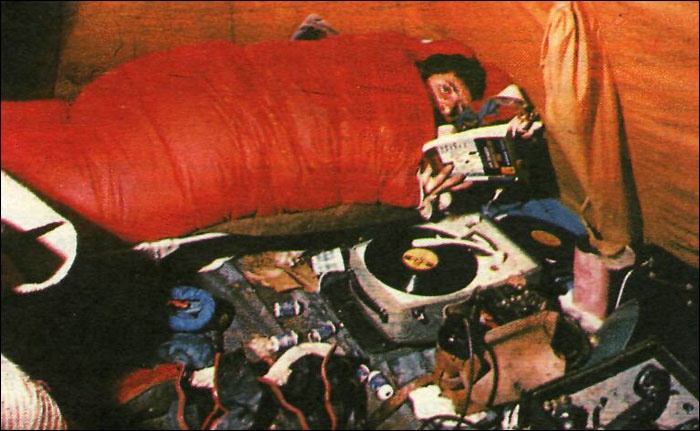
The French geologist was 23 years old when on July 16, 1962, he descended into a glacial cave in the Maritime Alps without taking a watch. He intended to find out what would happen to him if nothing happened for weeks. In the cave, 130 meters deep, he set up camp, brought in about a ton of food and supplies, and pitched a tent. A battery-powered lamp provided some light so Siffre could navigate and take notes. But batteries are precious, and they must be conserved. Therefore, most of the time the scientist spent in complete darkness, sitting on a folding chair.
The only living creature he encounters is a spider. Siffre befriends it and talks to it. But when he gets the idea to share a meal from a can with the spider, it dies. Now Siffre is completely alone.
The tent and clothing quickly became soaked through, with the thermometer just above zero. His assistants took the ladder up: Siffre did not want to succumb to temptation and break the experiment. The field phone was his only means of communication with the outside world. With it, the scientist reported when he woke up, when he went to bed, and how long, in his estimation, he had been sitting in the dark.
Siffre loses his sense of time. "When I call to the surface and say what I think the time is, I am sure that only an hour has passed between getting up and breakfast. But it is quite possible that four or five hours have gone by," he notes in his diary, "and what is difficult to explain is the fact that my sense of time is formed at the moment of the call. If I had called an hour earlier, I would have given the same time."
With anxiety, he realizes that although he still feels the passage of time, this feeling deceives him. "I feel that I am motionless, but I am still carried away by the continuous flow of time. I try to grasp it somehow, but every evening I notice again that I have failed."
But what does the word "evening" mean? In complete darkness, the concepts of day and night are meaningless. Siffre's life has lost its rhythm — at least, that is how it seems to the "cave" man. He estimates the difference between the moment he wakes up and the start of breakfast to be 10 minutes, while in reality, half an hour passes. Once, after a meal that he thought was lunch, Siffre felt tired and lay down. Upon waking, he was sure he had only dozed off briefly. In reality, more than eight hours had passed.
Life without a sense of time exhausts him. Siffre brought a battery-operated record player and plays Beethoven's symphonies on it. The record plays for 45 minutes. But this does not help him much. As soon as silence returns, he feels lost again. In despair, he even considers using the gas stove as a clock. The researcher knows that the contents of the gas cartridge last exactly 35 hours. But then he would no longer be able to make himself even tea to keep warm.
The anticipation of falling asleep becomes his only joy, even though he can no longer distinguish sleep from wakefulness immediately. "I looked into the darkness with my eyes wide open and hesitated for a long time, asking myself if I was asleep or not. I hoped I was still asleep, but very soon I realized that I was awake. Then I irritably reached for the switch, crawled out of the sleeping bag, and began to turn the dial on the phone."
However, the confusion existed only in his mind. Siffre's body worked with a clear rhythm. The scientist's friends, who recorded each of his calls, noted how meticulously his body managed time. A "cave" man's day usually lasts 24.5 hours, of which he is awake for 16.
When on September 14 a rope ladder is lowered into the underground camp and jubilant friends appear with champagne to congratulate the scientist on the successful completion of the experiment, Siffre protests. In his diary, the date still reads August 20, as he had agreed with his friends to last much longer. The scientist could not imagine that 25 days had simply slipped away from him. Where did that time go?
Hidden Time
Siffre repeatedly repeated his experiment. In 1972, in Texas, under the supervision of NASA scientists, he spent 205 days underground. That time, his memory was short by a full two months.
Siffre gained followers. Among them was Frenchwoman Véronique Borel-Le Guen, who set a record among women by spending 111 days underground. The experiment had tragic consequences. According to her psychiatrist, the trial of isolation and loss of sense of time plunged the adventurer into deep depression when she emerged to the surface. A year later, the woman took her own life.
Less unpleasant and dangerous were other experiments conducted simultaneously with Siffre's first descent into the cave. This took place in a bunker in the village of Andechs, near Munich. Researchers from the Max Planck Institute of Behavioral Physiology organized cozy apartments underground, where for a year hundreds of students lived in complete isolation for weeks. (Many of them were attracted by the opportunity to eliminate any distractions from exam preparation.) The only contact with the outside world occurred through a hatch, where the leaders of the testing group delivered food at different times, sometimes letters, and collected urine samples from the apartments to measure hormone levels. Sensors were installed on the beds underground that automatically recorded every period of rest for the voluntary prisoners.
All these experiments led to the same result as Siffre's underground experience. After a short adaptation, the isolated individuals unconsciously began to follow their own rhythm. Their day lasted a little longer than usual — for most participants in the experiment, it was approximately 24.5 hours, for some 26 or even more. That is why the participants went to bed later than usual, and therefore, when they left their confinement, it seemed to them that several days had disappeared from their lives.
We have invisible clocks ticking in our heads. They regulate all processes in the body, guiding us clearly through day and night. Time in the human body regulates blood pressure, hormones, and gastric juice, making us feel fatigue and alertness. Our biological clocks and the most sophisticated mechanical ones work with impeccable synchrony, as our natural chronometer is a marvel of precision. Over decades of life, they are off by at most a couple of minutes! Therefore, the body knows external time with almost second accuracy.
Through his experiments, Siffre and his colleagues demonstrated to the public the biological clocks of the human body. Few researchers have the fortune of such a significant discovery. Such a result more than compensated Siffre for the weeks in isolation. The further results of the experiments turned out to be even more exciting. Although the time of our body governs our existence, it is not the time we feel. Our consciousness creates its own time — internal. This is the pulse of our soul. By it, we measure everything we interact with, think about, and feel.
Internal time does not depend on the flow of mechanical and biological clocks. For Michel Siffre, the body's clocks ticked perfectly, yet his sense of time was completely different from that of his friends. We encounter daily the fact that our brain does not allow us to create our own time. Otherwise, we would not need to use a device on our wrist to know what time it is.