
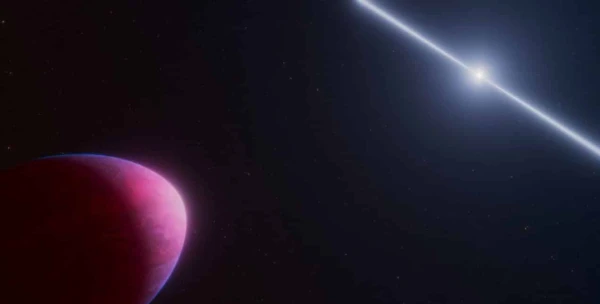
Such stars have a mass similar to Jupiter.
The remnants of supernova stars with a certain mass often become neutron stars — with a mass similar to the Sun but a diameter of about 20 kilometers. Occasionally, such ultra-dense 'dead stars' are found to have quite unusual planets. Some of them are even considered potentially habitable by scientists. New observations from the James Webb Space Telescope helped discover that one of these planets possesses the most exotic of all known gas envelopes. It is so unusual that it may have snow made of diamonds.
An international group of astronomers, using the James Webb Space Telescope, analyzed the spectra of a planet orbiting the neutron star PSR J2322–2650. It turned out that the atmosphere of PSR J2322–2650 b contains molecular carbon. This has never been encountered before and indicates that the chemistry of the planet is drastically different from everything known previously. How a body with such a composition could have formed is still unclear. The work on this was published in The Astrophysical Journal Letters.
The exoplanet PSR J2322–2650 b was discovered in 2017, but at that time, there was no powerful instrument like the James Webb. Since the planet is not situated against the backdrop of very intense radiation from its star (neutron stars emit little, plus they are much smaller than their planets), it can be observed in greater detail than many other objects.
However, this time the observations caused great bewilderment among astronomers even after they were double-checked. In the atmosphere of this body, with a mass of about 0.8 Jupiter and a radius of 1.25 Jupiter radii, traces of molecular carbon C2 and C3 were found. This is an exceptionally rare form of carbon (including on Earth) because carbon in molecular form easily reacts with other elements — for example, oxygen. Such reactions occur particularly effectively at elevated temperatures.
According to observations, the atmosphere of PSR J2322–2650 b has temperatures of about +630 degrees Celsius on the night side and over +2000 on the day side. This planet must always face its star with one side, as the distance between them is only 1.6 million kilometers, more than 90 times less than that between the Earth and the Sun, leading to tidal locking, similar to the Moon in the Earth-Moon system.
At such temperatures, molecular carbon can exist only in one scenario: when there are simply no other elements nearby that could react with it chemically. The authors of the new work calculated that the ratio of carbon to oxygen in the atmosphere of this planet is greater than 100 to one, and the ratio of carbon to nitrogen is more than 1 to 10,000. These are extreme ratios, practically unattainable for planets formed in all known astronomical scenarios. There is also little hydrogen in the atmosphere: this is clear since researchers failed to find reliable traces of hydrocarbons.
The main mass of the planet is likely composed of helium, which virtually does not react with carbon. It is probable that in the lower layers of the atmosphere of this body, molecular carbon may condense into diamond snow or haze.
It is clear that the planet did not form like Jupiter or Earth. Normal planets simply cannot have such a composition, as they depend on the composition of their parent star, and a main-sequence star does not have such a ratio of carbon to oxygen/nitrogen.
A 'black widow' scenario is more likely. This refers to a system where there is a very rapidly rotating neutron star — in thousandths of a second — and a low-mass ordinary companion star. Typically, the neutron star pulls mass from this companion with its gravity, while spinning up due to the energy from the material falling onto it from its neighbor. Then, the remnants of the companion are subjected to powerful X-ray radiation from the neutron star. About 50 such systems are known, but in reality, there are quite a few; they are just difficult to observe from Earth.
The black widow scenario, devouring its companion, has the problem that all known planets around such neutron stars are nothing like PSR J2322–2650 b. That one has a density of about 1.8 tons per cubic meter, roughly like Jupiter. In contrast, the other planets in black widow systems have densities ranging from 20 to 40 tons per cubic meter, several times higher than that of Earth. This is logical, as prolonged heating has stripped such bodies of all their outer, lighter layers, leaving only a super-dense core.













Leave a comment