The most famous comet of the year 3I/ATLAS has once again drawn attention.
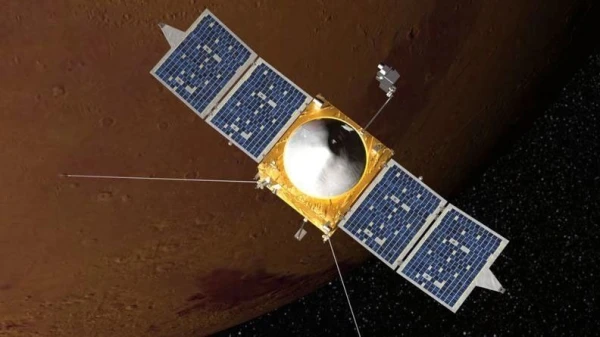
NASA's MAVEN orbital spacecraft is no longer communicating with Earth after an unknown "anomaly." After photographing 3I/ATLAS, the spacecraft moved to the far side of the Red Planet, and when it "emerged" from the "gray zone," it no longer transmitted any data. Scientists currently do not know what happened.
The most famous comet of the year, if not the last couple of years, 3I/ATLAS has once again drawn attention. The interstellar wanderer has consistently remained the main object of observation since its discovery in July 2025, both from the scientific community and from proponents of conspiracy theories, who, prompted by Harvard professor and astrophysicist Avi Loeb, saw signs of extraterrestrial technology in it.
Recently, with the emergence of more new data that has allowed scientists to get a little closer to understanding the unusual comet, debates about the theories of its origin have somewhat quieted down. Although the eccentric Loeb has fueled the fire of conspiracy, presenting his interpretation of scientific discoveries.
However, the incident involving NASA's MAVEN orbital spacecraft, which previously captured the mysterious 3I/ATLAS, has caused a real tsunami among conspiracy theory enthusiasts.
NASA's Mars Atmosphere and Volatile EvolutioN (MAVEN) spacecraft has, it turns out, stopped communicating with Earth after an unknown "anomaly," which caused it to disappear from the Deep Space Network (DSN) radar.
The DSN is a global network of radio telescopes and communication facilities created by NASA to contact spacecraft at great distances.
The last signal from the spacecraft was sent when it was moving to the far side of the Red Planet on December 6. But when MAVEN "emerged" from the "gray zone," it no longer transmitted any data to NASA's ground stations. According to the agency's telemetry, all systems of the orbital spacecraft were functioning normally until it disappeared behind the planet during a routine orbit.
Scientists are puzzled and do not know what caused the incident. It is also unclear whether MAVEN can be restored to operational status.
"The spacecraft teams and operators are investigating the anomaly and trying to understand the situation," NASA stated.
In general, the "anomaly" that caused MAVEN to lose contact could be due to various factors. Spacecraft operating so far from Earth regularly face harsh conditions: radiation, extreme temperatures, and dust storms. All of this can affect performance. Additionally, there could be power failures, antenna malfunctions, or interference from solar wind. The exact cause is currently being determined.
What Makes the MAVEN Mission Unique
The spacecraft began its journey to Mars in November 2013 and entered its orbit in September 2014, starting its mission to study the planet's upper atmosphere, ionosphere, and the interaction of the atmosphere with solar wind.
Throughout its time, MAVEN has reliably conducted measurements and transmitted data to Earth via the Deep Space Network. Its work has been quite successful. It played a key role in showing that Mars, having lost its atmosphere, subsequently lost water. The spacecraft also helped map Martian winds, classify clouds, and even discovered an invisible magnetic "tail."
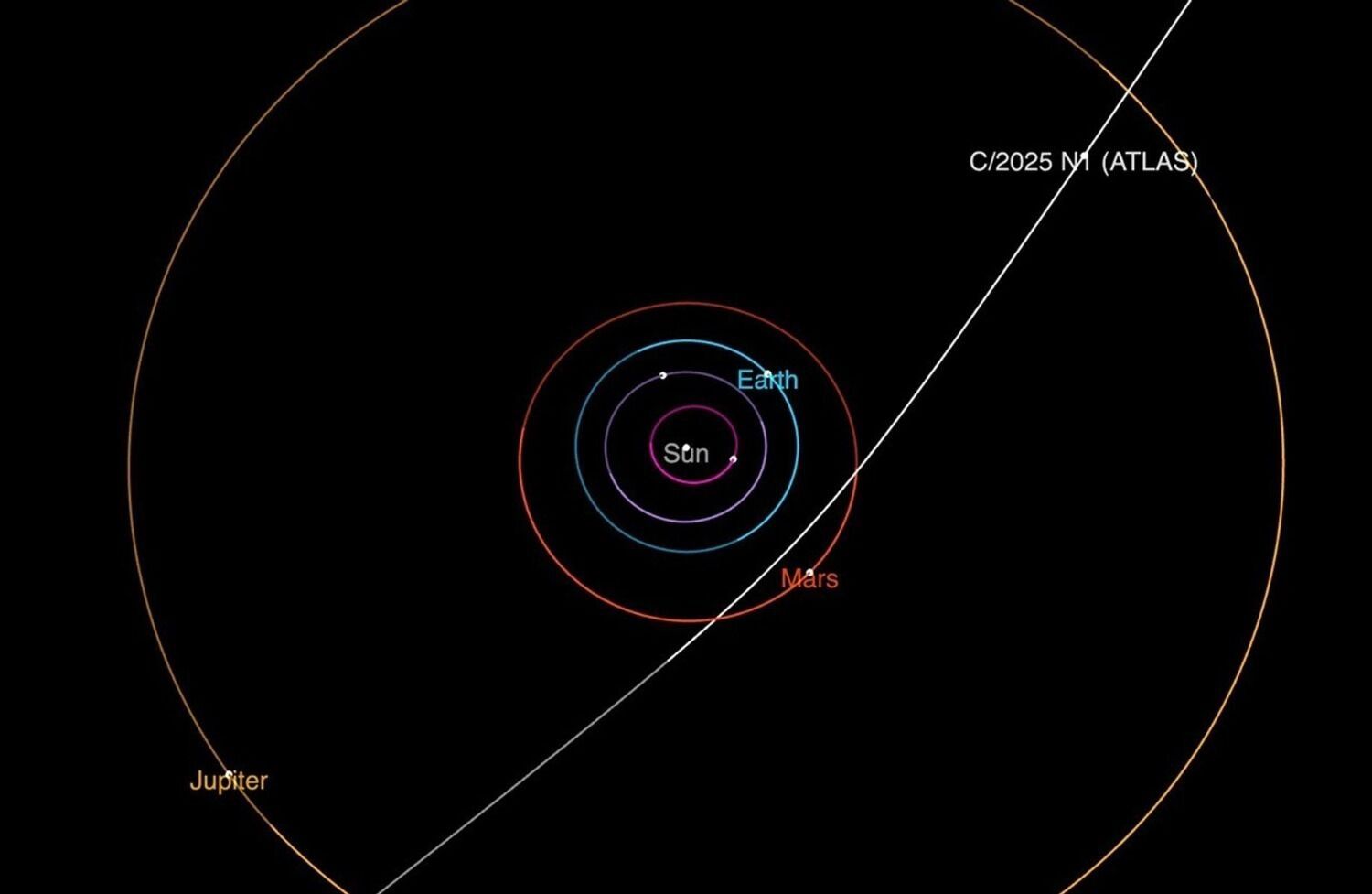
Initially, the mission was supposed to end in 2022, but a decision was made to extend it until September 2025. However, even after that, MAVEN continued to function and even took a picture of the interstellar comet 3I/ATLAS as it was approaching its closest point to Mars.
However, immediately after it disappeared behind the Red Planet, all communication with NASA's ground stations was lost.
In addition to collecting data about Mars' atmosphere, the orbiter is also used as a communication relay for other spacecraft — Curiosity and Perseverance. However, in this case, MAVEN can be replaced by the Mars Reconnaissance Orbiter, which performs the same function.
It is worth noting that losing contact with interplanetary and deep-space spacecraft is not uncommon, and contact is usually restored. There is hope that the same will happen with MAVEN. Otherwise, this could end more than a decade of scientific work in orbit around Mars.
"Aliens Seem to Have Tried Again"
The fact that the event occurred shortly after 3I/ATLAS passed by Mars in October of this year has reignited the debate about the nature of the object's origin. On social media, people speculate about what could have happened to the American space agency's spacecraft and admit — this coincidence is too strange.
"There could be many reasons, including the intervention of an alien ship that didn't want NASA to get more data. That's my opinion."
"3I/ATLAS took it."
"Aliens seem to have tried again."
"Too many cover-ups for this to be just coincidences."
"I don't believe they 'lost' contact."
"MAVEN, the probe that was able to observe the interstellar object 3I/ATLAS from Mars' orbit... just disappeared without explanation. Coincidence? Or did it see something it shouldn't have? The silence from Mars now feels particularly ominous."
"Well, aliens have taken out one of the satellites! Apparently, they don't want us to see how they're getting closer to us!"
"3I/ATLAS blocked communication with NASA's Martian orbiter! This is definitely alien technology."
"3I/ATLAS, solar storms, and loss of contact with MAVEN. I love all these space dramas and mysteries."
Loeb Suggested the Existence of an 'Elon Musk' from Another Civilization
Amid these debates, astrophysicist Avi Loeb stated that if it is aliens, then the comet would not be the first extraterrestrial object in our Solar System — and that some "Elon Musk" from another civilization, a "space entrepreneur," could have already sent ships here, possibly even with unfriendly intentions.
.jpg)
"Imagine there is an empire that, like Spain or Britain, sends ships to seek new territories. First, they send small boats, and then much more powerful ships," he speculates.
In his opinion, denying the version that 3I/ATLAS could be an artificial object is "arrogant."
"My counterargument is simple: humanity has launched technological objects into space, so extraterrestrial forms of life could have done the same," the controversial professor believes.
He added that it is statistically quite likely that in some of these star systems, their own "space entrepreneurs" have emerged, and one of them may have launched 3I/ATLAS.
Discussing the incident with NASA's spacecraft in a recent interview, he pointed out that the U.S. National Intelligence leadership has presented more than three reports to Congress in recent years stating, "that there are objects in the sky whose nature we do not understand — we simply do not have enough data to determine what they are."
"If they were produced by American companies, we would know. The Director of National Intelligence would not have mentioned this — but she did. And that means I have to assume that the government has a national security issue. One should not expect the Pentagon to disclose information," he noted.
<iframe width="560" height="315" src="https://www.youtube.com/embed/kjaOvRbKoaI?si=DxTaiLgNk95DxXVR" title="YouTube video player" frameborder="0" allow="accelerometer; autoplay; clipboard-write; encrypted-media; gyroscope; picture-in-picture; web-share" referrerpolicy="strict-origin-when-cross-origin" allowfullscreen></iframe>