
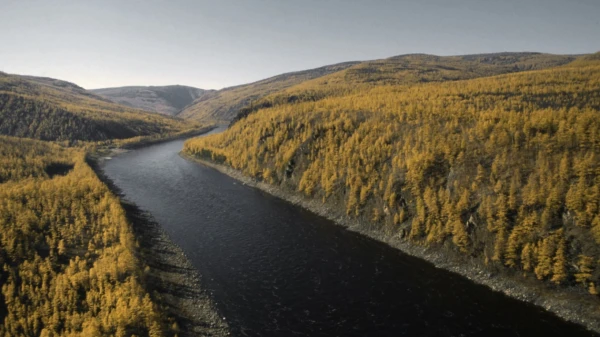
The volume of investments could amount to hundreds of billions of dollars.
The Department of Earth Sciences of the Russian Academy of Sciences (DESRAS) has proposed to revive the Soviet mega-project of 'redirecting' Siberian rivers, which was attempted in the 1970s but was halted in the late 1980s after scientists concluded that it would lead to an ecological disaster.
According to RBC, the decision to 'develop the scientific component' of the new 'river diversion' project was made at the October meeting of the scientific council of DESRAS. Scientists identified two options as the most promising. The first largely repeats the Soviet plan: it is proposed to redirect part of the flow of the Ob River to the Aral region on the border of Uzbekistan and Kazakhstan.
The second option suggests directing Siberian rivers to 'new regions' of the Russian Federation that are experiencing a shortage of fresh water. To achieve this, the flows of the Pechora and Northern Dvina rivers are proposed to be redirected to the Volga basin and further to the Sea of Azov.
Unlike the Soviet era, the project now appears more feasible from both technical and economic perspectives, stated RAS Academician Robert Nigmatulin. According to him, the proposal suggests using only part of the flow of Siberian rivers — from 20 to 70 cubic kilometers per year, and the extraction of 'excess water resources' from Siberia will help slow down the melting of the Arctic and permafrost.
'This step will simultaneously solve the problem of water scarcity in Central Asia and reduce the thermal load on the Arctic,' said Nigmatulin, adding that the project could also become 'the basis for deepening Eurasian integration.'
Unlike the Soviet project of an open canal, which proposed the transfer of 24.3 cubic kilometers of fresh water, this time the water is planned to be pumped through plastic pipes. In the first phase, such a system could annually pass about 5.5 billion cubic meters of Ob water, and if necessary, its capacity could be increased fourfold, scientists believe.
The volume of investments in such a project could start from $100 billion, but the final figure could be significantly higher, estimates Dmitry Sozonov, head of projects at the consulting company 'IES Engineering and Consulting.' 'The largest expenses will be for electricity for dozens of pumping stations, maintenance, and ensuring the safety of thousands of kilometers of pipeline,' he explains. The minimum timeframe for creating key capacities, according to Sozonov, will be 10 years.
In the USSR, the 'diversion' project of Siberian rivers was developed for two decades, and the decision to start it was made by the 25th Congress of the Communist Party of the Soviet Union in 1976. Ten years later, the Politburo of the Central Committee of the CPSU decided to halt the work after five divisions of the Academy of Sciences presented negative conclusions and reported errors in calculations, and a group of academicians led by Alexander Yanshin sent a letter to the Central Committee warning of 'catastrophic consequences' of the river diversion. According to Yanshin, the project could lead to water shortages in Siberian cities, including Omsk and Novosibirsk, a decrease in fish populations in rivers, drying up of swamps, and consequently, peat fires, as well as extinction of animals.















Leave a comment