
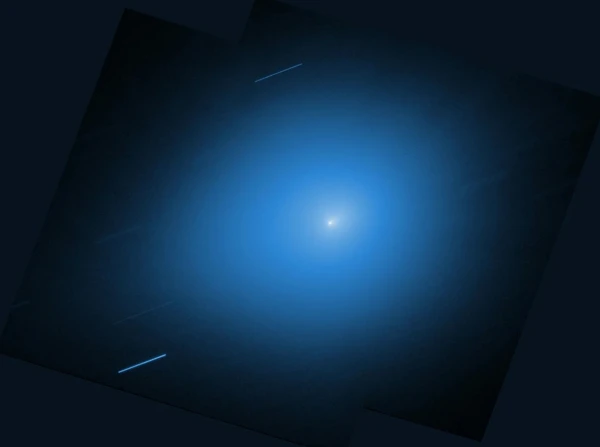
NASA's Hubble Space Telescope has captured a high-quality photograph of interstellar object 3I/ATLAS for the second time since its discovery, Focus reports.
Interstellar object 3I/ATLAS, according to the latest data from NASA, is, despite controversial theories that it may be alien technology, a comet that has come under the gravitational influence of the Sun and found its way into the Solar System. For the first time, the third interstellar object in history was discovered in early July of this year. Soon it will be at its closest distance to Earth, and for now, the new photograph from the Hubble Space Telescope is one of the best ahead of the comet's upcoming approach to our planet. The new image of 3I/ATLAS has been published on NASA's website.
The Hubble Space Telescope first photographed the interstellar object 3I/ATLAS in July of this year, shortly after its discovery in the Solar System. Now, the Hubble telescope has taken a new image of the visitor from another star system. At the time of the shooting, on November 30, the interstellar comet was at a distance of 286 million kilometers from Earth. The background stars in the photograph appear as streaks of light. Calculations show that 3I/ATLAS is leaving the Solar System at a speed of over 200,000 km/h. However, it is still unknown where this object came from and where it is heading next.
When the Hubble telescope first photographed 3I/ATLAS, the interstellar comet was about 400 million kilometers away from us.
The new image of 3I/ATLAS is clearer than what the Hubble telescope captured in July. However, NASA has not yet provided any details about the results of the new observation. At the same time, it can be concluded that the interstellar object 3I/ATLAS looks different.
3I/ATLAS will reach its closest point to Earth on December 19, when the comet will be approximately 270 million kilometers away from us. Ground-based and space telescopes are expected to continue observing the mysterious object.
In March of next year, 3I/ATLAS will approach Jupiter at a distance of about 50 million km, and then it will leave the Solar System forever.
Scientists still cannot accurately determine the size of 3I/ATLAS, although some estimates suggest that the comet's nucleus may be over 5 kilometers in size. If this is the case, then 3I/ATLAS is the largest interstellar object among those known.
Some astronomers believe that comet 3I/ATLAS originated in another star system 7-10 billion years ago. This means that it began its journey through our Milky Way galaxy long before the Solar System came into existence.
At the same time, there is a theory that 3I/ATLAS is not a comet, but an alien spacecraft. According to this theory, this "ship" may release exploratory probes near Jupiter.















Leave a comment