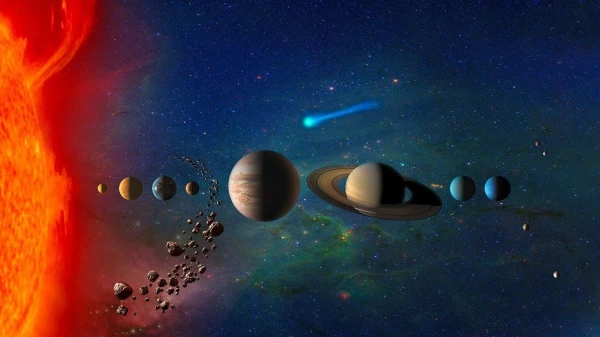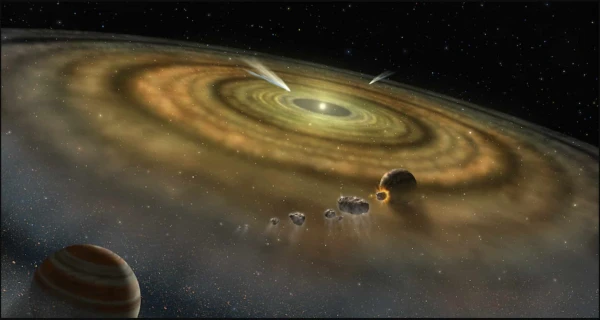
The giant planet left chemical traces in space.
By analyzing the results of more than 100 studies dedicated to various types of meteorites, scientists have reconstructed the events that occurred in the first million years after the birth of the Solar System and determined how Earth and other worlds came into being.
Although each meteorite that falls to Earth contains valuable information about the origin of our planetary system, scientists are particularly interested in calcium-aluminum inclusions (CAIs) — the very first solid materials in the Solar System.
The results of the scientific work, published in the journal Space Science Reviews, showed that CAIs were born in the protoplanetary disk about 4.567 billion years ago and "preserved" the chemical and isotopic signatures of the earliest processes. Within the first few hundred thousand to one million years after their appearance, chondrules began to form — the "grains" or "building blocks" of future worlds, which are estimated to constitute up to 80% of the material in primitive meteorites.
This conclusion was reached by scientists led by Maria Schönbächler from the University of Zurich (Switzerland), who combined the results of over a hundred scientific papers dedicated to the isotopic analysis of primitive chondrites and iron meteorites. The meta-analysis also included data from several hundred samples collected over the past 20 years. Such a large sample allowed for the construction of a chronology of the first million years of the Solar System's existence and clarified when exactly planetesimals — the "embryos" of future planets — and their metallic cores began to form.
It turned out that the processes of accretion and differentiation — the merging of dust particles and their melting into large bodies — began less than a million years after the formation of the first inclusions (CAIs) and continued for only a few million years. A particularly important role in this process was played by the short-lived radioactive isotope aluminum-26, which served as a source of internal heat for early planetesimals. Its uniform distribution across the protoplanetary disk indicated that young bodies were heated and melted almost simultaneously in different regions — from what would become Earth to the outer asteroid belt.
Researchers also confirmed the existence of two isotopic reservoirs of material in the early Solar System — the inner (non-carbonaceous, NC) and outer (carbonaceous, CC). The first included drier, heated materials from which Earth and Mars formed, while the second consisted of material enriched with volatile elements, water, and organic compounds — precursors to bodies like comets and gas giant planets.
Both regions apparently existed separately for several million years, and their isolation was likely ensured by early Jupiter, whose gravity created a "barrier" preventing the mixing of material between the inner and outer zones.
Analysis of the isotopic composition of iron meteorites — remnants of the metallic cores of ancient planetesimals destroyed in collisions — showed that the separation of iron and silicates occurred in the first one to three million years after the birth of the Solar System. This means that many celestial bodies underwent a melting stage and formed cores before the radioactive heat of aluminum-26 dissipated.
The conclusions of Schönbächler and colleagues align with the results of modeling previously conducted by scientists from Rice University (USA): both studies paint a consistent picture in which Jupiter emerged as the main "architect" of the Solar System. It was this gas giant that defined the boundaries from which the inner rocky worlds and the outer belt of icy bodies grew.
The authors of the article noted that further study of the isotopic composition of rare meteorites and samples from asteroids delivered by the Hayabusa-2 and OSIRIS-REx missions will help clarify exactly where in the protoplanetary disk Earth and its neighbors originated.
<iframe width="560" height="315" src="https://www.youtube.com/embed/LEcBf5GQsCk?si=BSiF_xbWx6L8tG6I" title="YouTube video player" frameborder="0" allow="accelerometer; autoplay; clipboard-write; encrypted-media; gyroscope; picture-in-picture; web-share" referrerpolicy="strict-origin-when-cross-origin" allowfullscreen></iframe>