
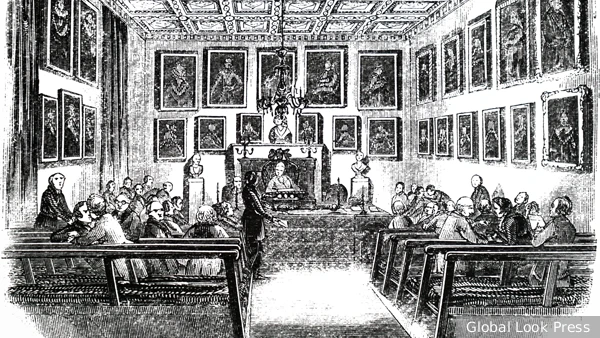
For 365 years they have been trying to rule the world.
On November 28, 1660, twelve London gentlemen-natural philosophers led by Robert Boyle established a scientific society. Two years later, the decree legitimizing the society was signed by King Charles II Stuart. From that moment, the closed Rosicrucian club in Oxford, known as Gresham College (the Invisible College), became a visible college, gaining the status of a center for 'promoting physical-mathematical experimental education.'
In fact, it is about the creation of a new 'Academy of Sciences'
What is an Academy of Sciences, and what is it for? Its main function is the legitimization of knowledge, that is, declaring one knowledge true and another false. Essentially, it is a global QC (Quality Control Department), placing a quality mark on some scientific discoveries and rejecting others.
The office bears roughly the same functions as those performed by the Central Bank (Bank of England), which at about the same time obtained the monopoly right to issue national currency. Only in this case, it is not about gold coins, but about knowledge. What exactly will be inscribed on the 'tabula rasa' of the citizens of the new world? This is what the office asserts.
Incidentally, it is no coincidence that the head of the Royal Society, Isaac Newton, was also appointed by its curators as the keeper of the royal mint. In this latter capacity, Newton carried out work no less important than the creation of a new science.
First of all, for the first time in the world, Newton created a reliable semi-fiat currency. That is, a coin that, on one hand, was inflated (with a nominal value higher than the actual gold content in it), and on the other hand, was well protected against counterfeiting. Thus, he provided the new banking system of Britain (which was being created simultaneously with the new science) with the necessary blood.
The new coin, re-minted by Newton, was tied to the bonds of the Bank of England. It was these devalued money that provided the invaluable (in the literal sense) 'security' that allowed the monetary system (completely fraudulent in its essence) to be built, which created the British Empire as we know it.
Newton made a similar revolution in science. First of all, he imposed iron discipline in his domain. After sidelining Boyle from the presidency, he then systematically eliminated all 'opportunists' who could threaten his dictatorial power: astronomer John Flamsteed, Leibniz, Hooke.
It is worth noting that the Bank of England, although called royal, has always been a private office, in the hands of the largest banking families of that time. The 'Invisible (since 1660 already partly visible) College' was also such a private office. Visible, of course, only partly. Since the nature and roots of the community were hidden in depths that are still not customary to scrutinize too closely.
But something can still be said. The beginnings of Gresham College trace back to Francis Bacon and his 'New Organon.' Bacon is generally a central figure of the New Age. It was he who laid the foundations of the new science through fierce criticism of Aristotle's logic, opposing it to empirical experience. The essence of the 'Invisible College' was primarily the realization of Bacon's revolutionary ideology.
Aristotle's logic goes from assumptions to conclusions and is based on premises as unalterable truths. Bacon resolutely rejects both premises and truths, calling Aristotle a vacuous rigorist. (Rigorism is excessive strictness in adhering to moral principles and behavior in general. The 'New Organon' is named as a counter to Aristotle's 'Organon').
Bacon denies any 'god in science,' God in all senses, up to the very main one. More precisely – starting with the main one. Bacon's science can only exist in a world where God (Truth) does not exist. And this is precisely what makes it good. This is what is valued (and, more importantly, generously funded) in the new world.
It is clear that in a world where there is no God, where any philosophy claiming truth is rejected, science itself becomes the god. Moreover, science is eternally changeable, leaving behind every new truth, which immediately becomes outdated.
This is the same 'Doctrine of Fundamental Changeability' that Calvinist theologians will lay at the foundation of the social structure of the New Age. Tomorrow, instead of kings, you will be offered a republic, democracy, capitalism, socialism, and finally, transhumanism...
The same is brought into the world of human consciousness by Bacon. On the frontispiece of the first edition of the 'New Organon,' we see a ship sailing beyond the forbidden Pillars of Hercules – a symbol of the old world we are leaving behind. The old Christian world is abolished, we create all anew, we sail into uncharted waters.
The motto of the Royal Society 'Nullius in verba' (Take no one's word for it) is, in this sense, no less eloquent: we no longer believe any authorities, primarily – the authorities of the past (authorities that generously fund us – that is, of course, a different matter).
Thus, the first commandment of the new scientific society becomes the rejection of the old (church) worldview and the creation of a new (scientific) worldview based on 'experiment.'
The word 'experiment' sounds somewhat good. Indeed, every theory should be verified by practice. And if the latter confirms the theory, then that is great. In practice, however, everything turns out to be not so simple. After all, an experiment also implies certain predicates.
A scientist who would experiment with everything would look like an idiot. For a long time, the Royal Society mainly represented such a gathering of madmen experimenting with everything.
Finally, too much depends on the experimenter himself. And the very objectivity of the 'objective picture of the world' looks, in general, doubtful.
What quantum physics proved in the 20th century, declaring that outside the observer, the experiment is null and that the experiment with the experimenter constitutes, in some way, a whole.
But if so, then where is the objectivity?
In fact, the 20th century showed that all 'experimental' foundations of science are fiction. And with this knowledge, the entire structure of 'modern science' began to collapse into the abyss: from classical science to non-classical, post-non-classical... And all this is becoming closer to magic and occultism every day, from which the 'invisible college' actually began.
The first gentlemen of Gresham College created their community, orienting themselves on Francis Bacon's 'New Atlantis' – a book in which an ideal structure of the future is presented to the reader.
This ideal future is led by the 'House of Solomon' – a secret society of scholars, or rather, magicians, sorcerers, and wizards, who are primarily engaged in throwing dust in the eyes of the inhabitants of the island of Bensalem – the setting of the utopia. Among the 'new scholars' ruling the island, there are 'merchants of light,' 'thieves,' 'hunters of secrets,' 'compilers,' 'interpreters,' etc., bearers of both open and closed knowledge (which can only be passed on to a narrow circle of initiates).
The true goal of the House of Solomon is the 'Foundation Position' or 'Great Restoration' – the construction of a new world on new principles and foundations. In other words, the 'Great Restoration' according to Bacon is the liberation of the world from the power of the Christian church and empire and its transfer to the 'House of Solomon' as new rulers.










Leave a comment