
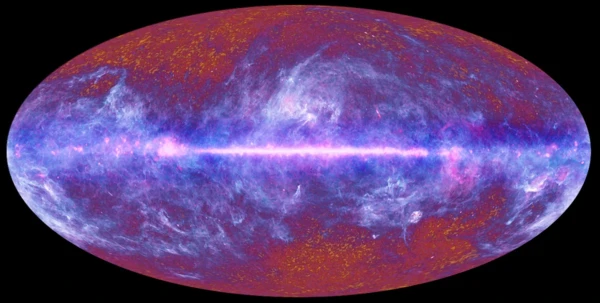
Scientists studied the latest data release from the Atacama Cosmology Telescope and made an important discovery about the Hubble constant, reports Focus.
From October 2007 to mid-2022, the Atacama Cosmology Telescope (ACT) explored the universe. It discovered many unusual objects, but its main focus was on the cosmic microwave background radiation. This is the light echo of the Big Bang, the first light that freely traveled through the universe. This radiation is crucial for our understanding of the universe. Astronomers analyzed the latest data release from ACT and found that it confirms there is something fundamentally wrong with our understanding of the universe. The study is published in the Journal of Cosmology and Astroparticle Physics, reports IFLScience.
As is known, the universe has been expanding since the Big Bang 13.8 billion years ago. The rate of expansion of the universe is indicated by the Hubble constant. It can be measured in several ways. However, the most accurate results come from measurements of the cosmic microwave background radiation, as well as observations of variable stars in galaxies in the local universe that are moving away from us. But there is a major problem: these measurements yield different values for the Hubble constant. This is known as the Hubble problem.
It would seem that any method of measuring the rate of expansion of the universe should yield roughly the same results. But the method of measuring starlight and cosmic microwave background radiation gives vastly different values for the Hubble constant. New data from the ACT telescope confirms this and only deepens the mystery. This means that something is wrong with our understanding of the universe.
According to scientists, the new data indicate an even greater discrepancy in the values of the Hubble constant.
Previously, astronomers attempted to resolve this contradiction using alternative models of the standard cosmological model that describes the universe since the Big Bang. These are known as extended cosmological models of the cosmos. But new data show that these models do not work.
New observations at new scales and with new polarization have virtually eliminated the possibility of alternative models, scientists say.
Polarization is a property of light. Light is polarized if its electromagnetic field oscillates in a specific direction. The polarization of cosmic microwave background radiation is very important as it provides new insights into the early universe. It also allows for better and more precise testing of cosmological models.
The results of the study expand our knowledge of the earliest stages of the universe's existence, as the cosmic microwave background radiation was released just 380,000 years after the Big Bang. But the mystery of the Hubble problem remains unsolved.














Leave a comment