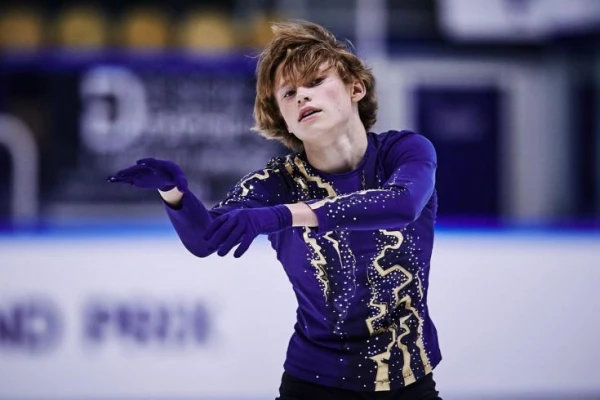
At the Olympic Games in Italy, only 13 Russians are allowed to compete under a neutral status. But Russia's 'shadow fleet' at the Olympics turned out to be much larger. Who are these former Russians and athletes with Russian roots competing for other countries?
At the Winter Olympics in Italy, Russia is officially unrepresented. Following Russia's invasion of Ukraine in February 2024, Russian athletes lost the opportunity to represent their country in international competitions. Gradually, they began to be allowed to compete under a neutral status, and in some cases, fully - with the anthem and flag.
Only 13 Russian athletes have qualified to compete under a neutral status at the 2026 Olympics. But in reality, there are many more. Many have changed their sporting citizenship - both before and after the war in Ukraine. However, there are also those with Russian roots. In total, there are about 40 former Russians, half of whom are in figure skating.
Figure Skating
Diana Davis and Gleb Smolkin (ice dance). The daughter of renowned coach Eteri Tutberidze and the son of actor Boris Smolkin got married in 2022 and have represented Georgia since 2023. At the 2026 Olympics, they placed 13th.
Karina Akopova and Nikita Rakhmanin (pair skating) changed their sporting citizenship in 2025 and became the first to represent Armenia on the ice. They are a couple in real life as well.
Anastasia Metelkina and Luka Berulava (pair skating) were born and train in Russia, but represent Georgia and have already made a strong impression at the Olympics in Italy. In the team event, they finished just shy of the podium, placing 4th. In the individual event, they are among the medal contenders.
Anastasia Golubeva (pair skating) also began her journey on the ice in Russia in singles. Since 2022, she has been competing in pairs with Hector Muro for Australia.
Nikita Volodin (pair skating) competed for Russia until 2023 and has represented Germany since the 23/24 season in a pair with Minerva Fabien Haze. They are the main contenders for Olympic gold.
Daria Danilova and Mikhel Tsiba (pair skating) are also vying for an Olympic podium. Danilova obtained Dutch citizenship in February 2024. Her partner has Russian-Ukrainian roots.
Maria Pavlova and Alexey Svyatchenko (pair skating) are representing Hungary at the Olympics for the first time, having changed their sporting citizenship in 2021 and 2022.
Pavel Kovalev (pair skating) has been competing for France since 2014 in a pair with his wife Camille Kovalev.
Evgenia Lopareva (ice dance) obtained French citizenship in 2022 and competes in a pair with Joffrey Brisso.
Ekaterina Kurakova (women's singles) changed her sporting citizenship in 2017 and has been competing successfully for Poland.
Vladimir Samoylov (men's singles) has also been competing for Poland since 2021. After changing his sporting citizenship, the Russian Figure Skating Federation banned Vladimir from training in Russia, and he was forced to leave coach Victoria Butsaeva.
Now competing under different flags are Sofia Samodelkina (Kazakhstan), Maria Senyuk (Israel), Vladimir Litvintsev (Azerbaijan), Anastasia Gubanova (Georgia), and Victoria Safonova (Belarus, competing under a neutral status).
Figure Skaters with Russian Roots
Perhaps the most prominent "Russian" name in the world of figure skating is Ilia Malinin, who competes in men's singles for the USA. His parents competed in the USSR and Russia, representing Uzbekistan in international competitions before moving to the USA, where their son was born, continuing the sporting dynasty. His grandfather lives in Novosibirsk, and he has never been to his historical homeland.
Malinin himself calls himself the "quad god" (of quadruple jumps). Ilia became the first in the world to perform seven quadruple jumps in one free program. His mindset for his first Olympic Games was combative. After winning gold in the team event and confidently winning the short program in the individual competition, he announced one of the most difficult jumps in his free program - a quadruple Axel. Almost all of his main competitors fell in their free programs, seemingly clearing the way for Malinin to the top of the podium. But an unspoken rule in figure skating played a role - a favorite never wins Olympic gold. Ilia was no exception. He practically failed his complex free program in every sense and ended up not only without a medal but barely clinging to the top 10, finishing 8th. The winner, to everyone's surprise, was another "Russian," born in Almaty and competing for Kazakhstan, Mikhail Shaidorov.
Commenting on his failure at the Olympics, Malinin said:
"I didn’t expect this. I felt that before these competitions… I just felt ready when I stepped onto the ice. Maybe I was too confident that everything would go well. I can’t comprehend what happened.
I messed everything up. Honestly, that’s the first thing that came to my mind. It can’t be that it just happened like that. I prepared all season. I was so confident in my program. To go out and do that… there are no words, to be honest.
I think it’s definitely a psychological issue. The Olympic atmosphere is incredible. It’s unlike any other competition. It’s really something else. I’m very grateful for the opportunity to have done all this work to get here, but it was obviously not the performance I wanted."
Malinin is not the only Russian-speaking representative of the USA in men's figure skating. Maxim Naumov qualified for the Olympics, tragically losing his parents-coaches and former figure skaters Vadim Naumov and Evgenia Shishkova in a plane crash in Washington in January 2025. At the Olympics, Maxim finished in 20th place.
Also competing for the USA in the men's event was Andrew Torgashev, the son of figure skaters Ilona Melnychenko and Artem Torgashev, who competed for the USSR in ice dance and pair skating, respectively. Andrew, like Malinin and Naumov, speaks Russian fluently. In Milan-Cortina, he finished 12th.
Speed Skating
Vladimir Semirunniy competed for Russia until December 2024 but then changed his sporting citizenship to Polish. In Milan, he won a silver medal in the 10,000 meters, bringing Poland its first Olympic medal in this event.
Elizaveta Golubeva and Kristina Silaeva also changed their sporting citizenship and now represent Kazakhstan.
Biathlon
Alina Stremous, Maxim Makarov, and Pavel Magazeev have been competing for Moldova since 2020. They did not achieve notable results at the 2026 Olympics.
Dmitry Shamaev (since 2021) and Anastasia Tolmacheva (since 2020) compete for Romania.
Ekaterina Avvakumova has been competing for South Korea since 2020.
The most notable former representative of Russia in biathlon at the 2026 Olympics was Anastasia Kuzmina, who has been competing for Slovakia since 2008. She has three gold medals from previous Olympics, but she has not yet achieved notable results at the games in Italy.
Alpine Skiing
Anastasia Skorokhodova has been competing for Kazakhstan since 2022. At the 2026 Olympics, she placed 37th in the giant slalom.
Maria Shkanova has been competing for Belarus since 2008 and is competing under a neutral status in Milan.
Short Track
Daniil Eybog changed his sporting citizenship in 2024 and competes for Uzbekistan. At the opening ceremony of the 2026 Olympics, he was the flag bearer for his team. He finished 14th in the 1500 meters.
Cross-Country Skiing
18-year-old skier Elizaveta Khlusovich, competing for Moldova, was accused of publicly supporting Russian authorities. The Biathlon Federation and the Ski and Bobsleigh Federation defended her, calling the accusations fake.