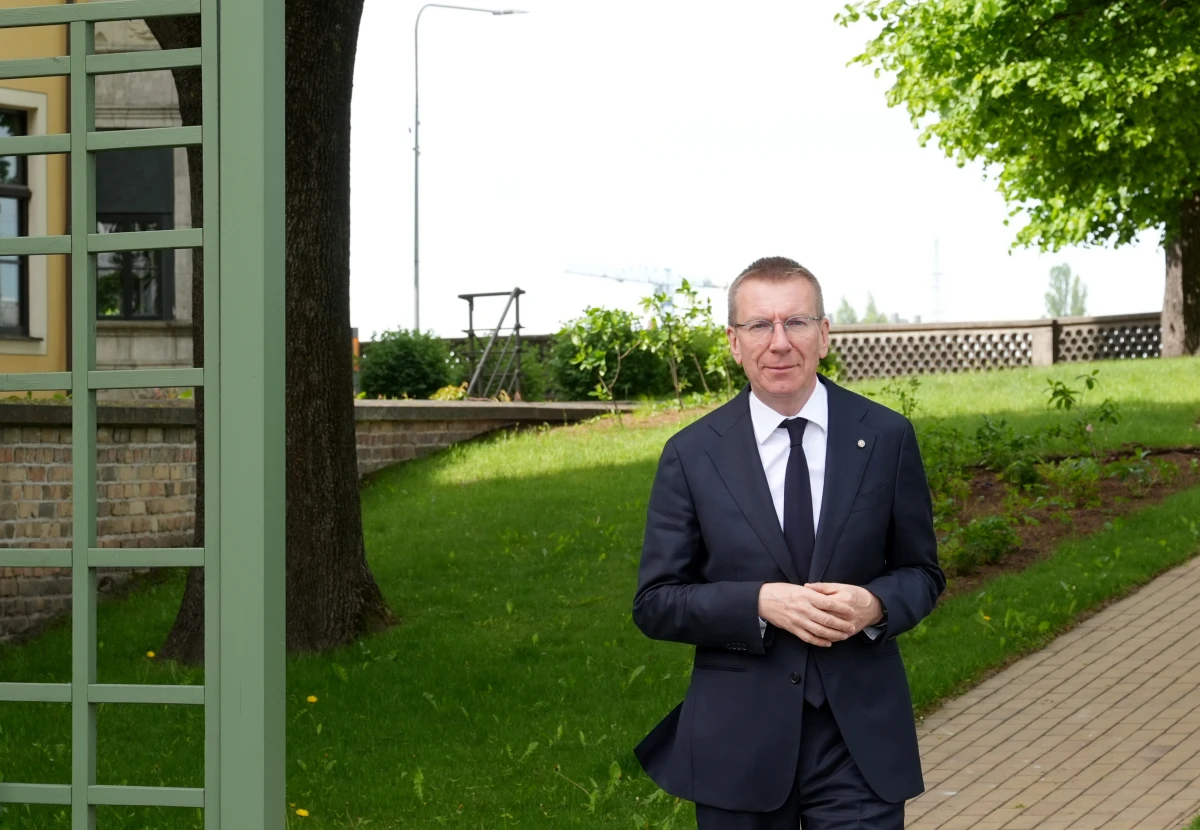
These days, Edgars Rinkēvičs marked the three-year anniversary of his tenure as head of state. He celebrated it quite symbolically and loudly, deciding to return to the Saeima a politically very sensitive Immigration Law.
Pleasing All Politicians
To some extent, this law is even more important than the Citizenship Law, as it touches not only on politics and ideology, determining to some extent the future ethnic composition of the population, but also on the financial sphere. In general, it was not very wise to pass this law on the eve of elections, especially considering that the bill was submitted to the current Saeima... back in November 2022, at the very beginning of this parliament's term.
But let’s return to Rinkēvičs and his decision, which was effectively timed to coincide with the three-year anniversary of his tenure as head of state. The Immigration Law, adopted by the Saeima in mid-June, did not satisfy the right, left, nationalists, or centrists. On the one hand, this law allowed for attracting foreign investors, but on the other hand, it deprived the country of the opportunity to earn "out of thin air," namely: offering residence permits for property purchases.
As a result, the president demonstrated political wisdom—he did not proclaim the law, allowing the deputies to amend the hastily adopted document before the summer recess.
In doing so, Rinkēvičs once again managed to please all political forces—both supporters of a strict immigration policy, including regarding wealthy immigrants, and supporters of attracting affluent citizens from third countries.
Record-Breaking Lawmaker
Throughout these three years, Rinkēvičs, contrary to predictions, has been very active in the legislative sphere, although, given his previous career (he headed the Ministry of Foreign Affairs for over 11 years), one might have expected the current president to be more active on the international stage.
The current president has submitted 18 bills and amendments to the Saeima. Thus, he has already accomplished more in the legislative sphere than his two predecessors as president—Raymonds Vējonis and Egils Levits—combined!
It is noteworthy that the majority of Rinkēvičs' initiatives have been supported by the current Saeima; however, one politically "dangerous" idea of the head of state was decided to be "paused" or, more precisely, effectively buried, as it is unlikely that the parliament will manage to pass this bill of Rinkēvičs in September, a month before the elections. This concerns his initiative to simplify the procedure for launching a referendum.
As is known, since 2013, referendums in Latvia have been practically eliminated, as gathering about 152,000 signatures from citizens of Latvia at the initial stage is virtually impossible.
How Many Latvians Support Rinkēvičs?
Sociologists from SKDS, commissioned by Latvian TV, conducted a survey to find out how Latvians assess the activities of the head of state. In total, 53% of respondents rated Rinkēvičs' work as very good or rather good.
19.1% of respondents rated Rinkēvičs as "satisfactory," while 23.4% of Latvians believe that the president is performing very poorly or rather poorly.
It is noteworthy that those Latvians who speak Latvian at home mostly assess Rinkēvičs' work positively. Specifically, 66% of Latvian-speaking respondents rated the president as "rather good" or "very good."
Among Russian-speaking respondents, only 32% had a positive attitude towards Rinkēvičs! 40% of respondents with Russian as their native language rated Rinkēvičs' activities negatively.
This is not surprising— the president demonstratively ignores the residents of Latvia for whom Russian is their native language. Rinkēvičs does not congratulate them on Orthodox Christmas and Easter, the Russian language has disappeared from the president's internet page. Moreover, Rinkēvičs, who speaks Russian fluently, has not uttered a word in this language in recent years. At least not publicly.
In general, many non-Latvians relate to Rinkēvičs in the same way that Rinkēvičs relates to them— that is, they ignore each other.
Youthful Statesman
Looking at the survey results from the perspective of the respondents' ages, young people perceive Rinkēvičs particularly positively: 82% of respondents aged 18 to 24 rated Rinkēvičs positively.
Interestingly, in the category of 45 to 54 years, only 38% rated the head of state positively.
Youth is evidently attracted to Rinkēvičs' activity on social media. In turn, the sympathies of mature individuals cannot be won over with pictures of kittens.
Above the Fray
There have been no significant failures, let alone scandals, for Rinkēvičs over these three years. He skillfully avoided attempts by politicians to involve him in inter-party disputes, genuinely remaining "above the fray". At the same time, he did not miss the opportunity to demonstrate "closeness to the people"— here he is talking with ordinary residents of the provinces, here he is taking pictures with a kitten, here he is having lunch in a simple eatery in Riga or in some small town during his regional visits...
On the other hand, such skillful actions by Rinkēvičs in the presidential office are dictated by his biography—he is indeed not an accidental person in power and has spent most of his career in public administration.