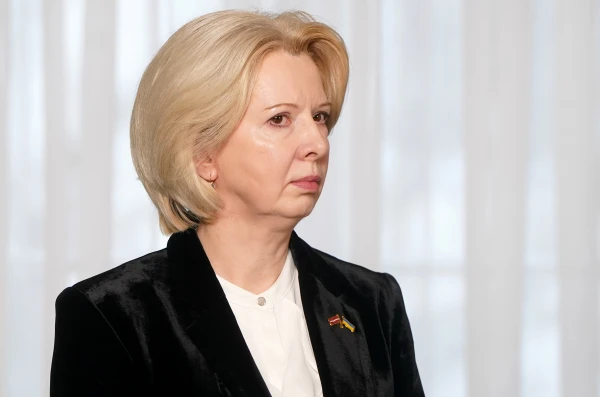
The loss of spatial orientation relative to the horizon line is a very dangerous condition for pilots when instruments fail and it is necessary to determine the aircraft's position relative to the ground. This condition – only in politics – happened to Evika Silina, who "lost orientation," and as a result, brought down her government.
Rumors are circulating in political circles that, firstly, she did not inform the leadership of "New Unity" about her revolutionary ideas – she acted largely independently. Secondly, she was confident that the "Progressives," in order to remain in government, would swallow yet another bitter pill in the form of the dismissal of their Minister of Defense Andris Sprūds and the nomination of Silina herself as a candidate for the ministerial position "from the outside."
With such confidence, she went to meet the "Progressives" in the Saeima last Wednesday, bringing along the candidate for the Minister of Defense – the current Colonel of the National Armed Forces Raivis Melņis.
To jump ahead, it is noted that this demarche with the colonel greatly angered the president. The head of state is also the Supreme Commander-in-Chief and, by unwritten tradition, prime ministers first coordinate the candidate for the Minister of Defense with him. It is noteworthy that Rinkēvičs, after Silina's resignation, publicly stated that the head of the defense ministry should be a representative of civil society, not an active military officer.
Shock from the "Progressives"
In any case, last Wednesday, Silina and her entourage experienced a real shock: the "Progressives," contrary to all predictions, did not swallow their resentment, and after nearly an hour of communication with the prime minister, made the decision... not to support her anymore! "If the opposition submits a proposal for the prime minister's dismissal, we will vote for it," said Silina's former allies.
Soon after, the opposition, represented by the United List and the National Alliance, announced that they were gathering signatures for an initiative to express no confidence in the prime minister, and thus, according to the Constitution, in the entire government.
After this, Evika Silina should have resigned herself to avoid a public whipping from the podium of the Saeima the next day.
It is said that on Wednesday evening, at an emergency meeting of the board of "New Unity," party members urged Silina to resign immediately. But she categorically refused – apparently hoping for a miracle...
It did not happen – by around 8:30 on Thursday, it became clear that everything was prepared in the Saeima for the removal of the prime minister and the entire government. After that, Evika Silina called the Speaker of the Saeima, Daiga Mierina, and asked her... to postpone the Saeima meeting by an hour so that she could arrive at the parliament at 10:00 and announce her resignation.
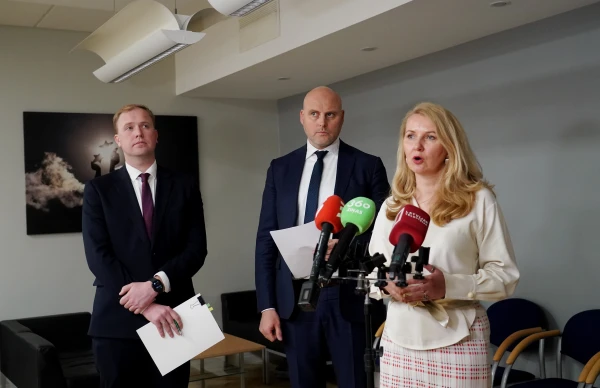
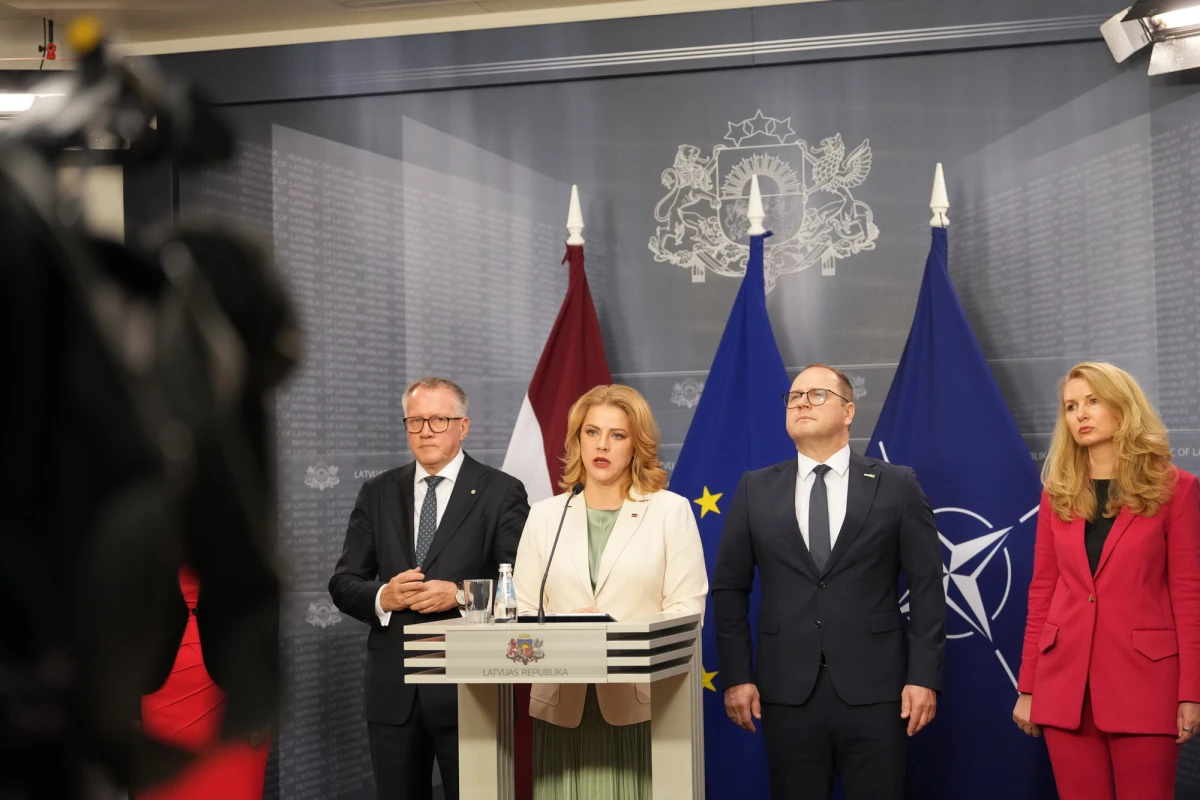
But here too, Silina deceived – at 10:00 she did not go to the Saeima, instead scheduling a press briefing for 10:30, where she announced her decision to resign. Notably, behind her at the briefing stood all the ministers from "New Unity" with such sour faces that "you could carry out saints," as the classic said.
Silina Leaves, but... Not Quite?
It was evident that even the experienced politicians of "New Unity" were bewildered, and they clearly had no plan B. Unless one counts the illusory hopes that the competitors would not manage or would be unable to form a government, thus allowing Silina and Co. to serve until the elections. Yes, the Constitution does not provide for a power vacuum, and the government, even after resignation, continues to perform its duties – until the Saeima approves a new government.
However, the right-wing opposition decided to try to steer the country – hoping that even after the elections, they would be able to maintain the coalition model constructed before the elections.
Interestingly, this approach was unexpectedly supported by Rinkēvičs! Why? There are two reasons:
-
Firstly, the outgoing technical government can hardly pass anything through the Saeima – there simply are not enough votes. Moreover, this outgoing government lacks two ministers – the Minister of Defense and the Minister of Agriculture. Agree, in a situation where drones fly over Latgale almost every night, living without a head of the military department is not easy...
-
Secondly, Rinkēvičs is already thinking about his elections, that is, about being elected for a second term in May next year. And he, as an experienced politician, is already trying to secure the support of those parties that have real chances of gaining many votes in the next Saeima.
The Fastest Nomination
It is no coincidence that Edgars Rinkēvičs, on Saturday, while nominating a candidate for prime minister, particularly emphasized: in the current situation, he deemed it right to propose forming a government by a representative of the opposition.
By the way, Rinkēvičs set a kind of record – never before in recent history have presidents named a candidate for prime minister just 48 hours after the previous prime minister's resignation! Rinkēvičs's haste is quite understandable – there are only 4.5 months left until the elections, and there can be no delay in approving a new government.
Thus, the head of state entrusted the formation of the government to the prime ministerial candidate from the United List, Saeima deputy Andris Kulbergs. Why him?
A Suitable Opposition Figure
After the inglorious end of Silina's government, Rinkēvičs came to the logical conclusion that the "temporary" government (with a term of about 5-7 months, until the new government is formed – after the elections) should be headed by a representative of the opposition. And Andris Kulbergs was quite a prominent figure in parliament – he led two parliamentary investigative commissions, including one on Rail Baltica, which means he knows the problems of the project of the century, so to speak, from the inside.
Moreover, the United List represented by Kulbergs refused to draw "red lines" before forming the government, thus not rejecting cooperation with either "New Unity," "Progressives," or "Latvia First," which allows for maneuvering.
Finally, 46-year-old prime ministerial candidate Kulbergs had been an entrepreneur for many years before being elected to the current Saeima, meaning he understands economics and finance. This is extremely important, as there will be no time for a learning curve or "training" for the pre-election government.
By the way, Kulbergs received his education (in Tallinn) in English and truly masters this language brilliantly, which is significant for the prime minister of an EU country.
To Make It Before Monday
In any case, the president gave the prime ministerial candidate very little time to form a government – until May 25 inclusive. Kulbergs needs not only to create a government but also to ensure that it receives a mandate of confidence in the Saeima.
Notably, Kulbergs's birthday is on May 26. Soon we will find out if he can gift himself the premiership.
I Believe – I Don’t Believe
"This is an impossible mission," political scientist Iveta Kažoka is convinced that Kulbergs will not be able to form a government.
This time, we dare to disagree with this expert. Surely a government will be formed. The only question is whether it will be a government with a stable majority in the Saeima or a minority government. The second option is not the most desirable for Kulbergs, as having limited opportunities in the Saeima, this government will hardly differ from Silina's dismissed Cabinet of Ministers.