
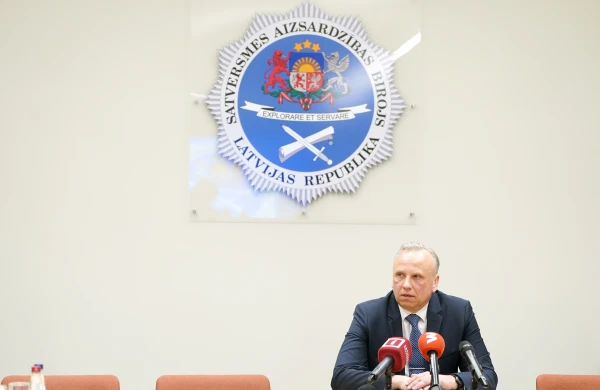
According to Russian institutions themselves, Western sanctions are causing and will continue to cause losses to Russia amounting to several hundred billion USD, operational information from the Bureau for the Protection of Satversme (BZS) indicates, writes LETA.
The public report by the Bureau for the Protection of Satversme (BZS) on Russia's losses from Western sanctions shows that, despite public statements from Russia claiming that it is successfully coping with their impact, internal, non-public calculations by Russian institutions confirm that sanctions are causing and will continue to cause Russia damage amounting to hundreds of billions of dollars.
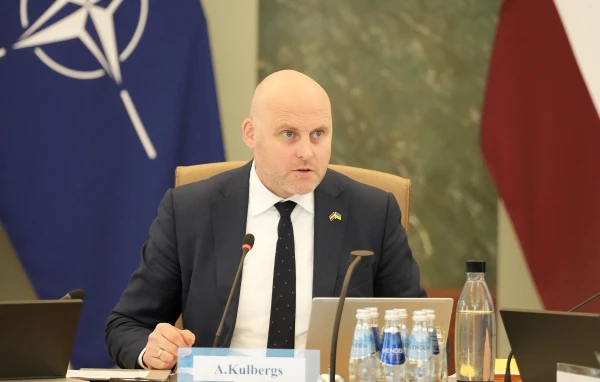
BZS Director Egils Zviedris noted that the report utilized intelligence information obtained through operational means regarding how Russian government bodies internally assess the impact of sanctions on the economy and its future development.
"This conclusion is quite harsh — sanctions are already having an impact and will significantly affect the development of the Russian economy in the future," emphasized Zviedris.
Although the Russian regime typically does not openly discuss problems and challenges, intelligence data indicates that Russian institutions are conducting non-public assessments of the damage from sanctions. Such assessments are usually carried out when evaluating trends in various sectors of the economy, according to the BZS report.
Since the invasion of Ukraine, Russia has lost about 130 billion USD (approximately 32.5 billion USD per year) — this is the amount Russia has been forced to spend on acquiring goods bypassing sanctions that it could previously purchase from Western countries at lower prices before the war. The calculation does not include losses arising in situations where Russia cannot ensure necessary imports.
Due to sanctions, several sectors in Russia have lost significant markets in Western countries, and over four years, they have not managed to replace them with alternative markets. For example, compared to 2021, iron ore exports have decreased by 40%, black metals by 20%, chemical products by 35%, and timber and pulp by 50%.
Non-public forecasts from Russian institutions suggest that these sectors will not be able to recover their lost positions within the next five years, while public statements from Russian officials convey the opposite.
Intelligence information indicates that Russia is assessing not only the losses already incurred from sanctions but is also attempting to forecast future risks to its economy. For instance, according to estimates from Russian institutions, due to various risks, including restrictions from Western countries, Russia's foreign trade could decrease by approximately 175.5 billion USD by 2030 (about 35 billion USD per year or roughly 5% of the current volume of foreign trade annually).
Russia's risk assessments show that the largest risks — around 136 billion USD — are associated with such restrictions from Western countries as direct sanctions against Russian companies and sectors, secondary sanctions against Russia's trading partners, trade embargoes, and U.S. trade tariffs.
Intelligence information indicates that, according to Russia's estimates, significant damage to its foreign trade — at least 70 billion USD — could be inflicted by European countries if they continue to refuse to trade with Russia, including not purchasing Russian products and limiting exports to Russia.
Russia is also particularly concerned about the pressure from Western countries on its trading partners — secondary sanctions, tariffs, and other restrictions that hinder Russia's ability to redirect trade to alternative markets, for example, due to restrictions on the use of infrastructure.
Although Russia does not publicly acknowledge this, its officials are aware that many trading partners consider Russia to be toxic. According to Russia's assessment, the restrained attitude of so-called friendly countries towards trade with it is one of the key factors exacerbating potential economic losses, the report states.
While Russia's own calculations show losses amounting to hundreds of billions of dollars, BZS estimates that these assessments are quite optimistic, and the actual impact of sanctions is significantly higher.
Such estimates only consider direct costs to mitigate the effects of sanctions or potential losses in individual sectors but do not encompass the entire economy, for example, they do not account for the decrease in tax revenues to the Russian budget and the rise in prices for consumer goods.
For instance, according to Russia's estimates, increased pressure from Western countries solely on the energy sector will lead to losses of 216.5 billion USD over five years, or approximately 43.3 billion USD annually.
In Russia's view, such losses will occur if the European Union imposes a complete embargo on Russian energy resources, and countries like China, India, and Turkey reduce their imports of Russian oil and natural gas.
This forecast exceeds the losses that Russian institutions predict for all foreign trade as a whole, confirming the conservativeness of overall estimates.
Potential risks to Russia's economy also significantly depend on the situation in global markets, and various trends can either increase or decrease these risks. For example, currently, high prices for oil and natural gas, caused by the conflict surrounding Iran and the crisis in the Strait of Hormuz, provide Russia with additional income from oil exports, which, at least in the short term, gives financial breathing room, including for reducing the budget deficit.
However, this does not change the structural problems of the Russian economy caused by the war in Ukraine and sanctions, which will continue to create losses and new risks in the long term.
Assessments prepared by Russia show that most representatives of the Russian regime, including high-ranking officials, understand that the war in Ukraine and the subsequent Western sanctions create serious problems for Russia's economy and negatively affect its development prospects in the long term, according to the BZS report.
At the same time, intelligence information indicates that Russian institutions are preparing information about the state of the economy, relying primarily on official propaganda theses, to make their work appear more effective.
For example, any assessment of the state of the Russian economy begins with such basic statements: "The Russian economy is successfully overcoming sanctions"; "Russia is strengthening as one of the great powers of a multipolar world"; "Russia is managing to replace lost Western markets with other countries."
There is a high probability that distorted information about the state of the economy, dominated by theses of successful development, reaches the main decision-maker — Vladimir Putin, while problems and risks are not emphasized, concludes BZS.
Such messages likely reinforce Putin's conviction that the losses from sanctions are secondary compared to his desire to establish control over Ukraine. This means that even when faced with serious economic problems, Putin will not be willing to change the current aggressive foreign policy course.
This is understood by Russian officials responsible for the economy, so they proceed from the premise that they cannot or do not want to change the situation and must continue to work under conditions of confrontation and sanctions.
Russian institutions continue to analyze losses and potential risks to the economy; however, even at the internal level, they do not question the main cause of the losses — the war in Ukraine. Instead, Russian officials are developing plans for modernization and diversification of the economy, fully aware that the main obstacle to their implementation is Putin's foreign and military policy.
Russia's assessments confirm that Western sanctions and other economic restrictions are an effective tool for containing Russia — they have a significant impact on its economy, causing losses of at least hundreds of billions of USD.
Moreover, the sanctions have not yet exhausted their potential and can be expanded, continuing to limit Russia's economic opportunities.
At the same time, the goal of the sanctions policy of Western countries should be realistic — sanctions in the short term will not compel Putin to change his confrontational foreign policy and stop the war in Ukraine. However, sanctions are one of the most effective means of reducing Russia's financial resources, allowing it to limit its ability to finance the war and, in the long term, to build military potential, including for new conflicts, including against NATO.
Sanctions alone cannot change Russia's aggressive intentions, but they already affect the extent to which Russia is able to realize them. Russia has been trying for a long time, in various ways, and currently especially in the context of diplomatic negotiations regarding the war in Ukraine, to achieve the easing of sanctions and other restrictions imposed against it, notes BZS.
According to BZS, the easing of sanctions will significantly increase the threat posed by Russia, not only to Ukraine and Europe but also on a global scale.
Even a partial lifting of sanctions will give Russia the financial means to accelerate its armament pace, increase resources for conducting various influence operations worldwide, and support unfriendly states towards the West, such as Iran, North Korea, Venezuela, and Cuba, or maintain paramilitary groups in Africa, destabilizing security situations in various regions of the world.






Leave a comment