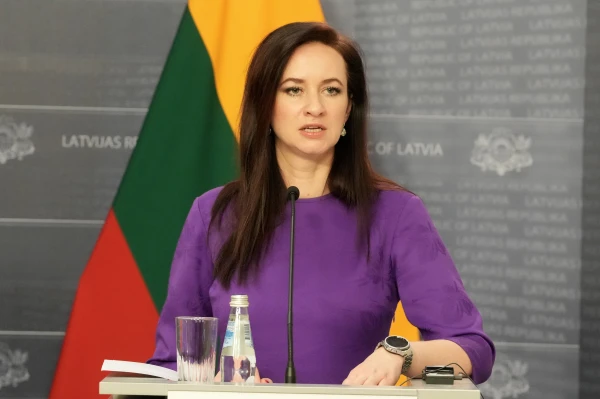
In Latvia, a targeted disinformation attack against NATO is once again taking place, said Latvian Foreign Minister Baiba Braže, commenting on the information that has emerged about the memoirs of former NATO Secretary General Jens Stoltenberg.
According to her, the claims being circulated are largely based on an interpretation from a blog in Estonia, whose author read Stoltenberg's book and wrote a review about it, reports tv3.lv.
<iframe src="https://www.facebook.com/plugins/post.php?href=https%3A%2F%2Fwww.facebook.com%2Fpermalink.php%3Fstory_fbid%3Dpfbid02v3D6e9Huy1MvBewYa4wMxY52mxhb9wbPNCcWdjZnQSpUQL89XipDxW1ngpwfCKS5l%26id%3D61572507223557&show_text=true&width=500" width="500" height="323" style="border:none;overflow:hidden" scrolling="no" frameborder="0" allowfullscreen="true" allow="autoplay; clipboard-write; encrypted-media; picture-in-picture; web-share"></iframe>"This is our information environment before the elections," noted Braže, adding that what is happening resembles last year's campaigns based on Russian narratives.
Earlier, it was reported that the former NATO chief allegedly negotiated with the Kremlin without informing the most vulnerable countries of the alliance and met with Russian Foreign Minister Sergey Lavrov in 2021, where the idea of a buffer zone between NATO and Russia was discussed.
Stoltenberg himself stated that anyone who has read his book in full can see: the meeting with Lavrov during the UN General Assembly in September 2021 was neither secret nor related to NATO's proposals for buffer zones. According to him, it was Russia that proposed limiting military activity on the border with NATO.
"My proposal was to hold a Russia–NATO Council meeting, which, of course, would involve all allies, including the Baltic states and Poland. My goal was to find ways to de-escalate the dangerous situation caused by Russia's military presence, which I discussed with Lavrov," explained Stoltenberg.
In January 2022, NATO responded to Russian proposals with a letter agreed upon by all allies, stating readiness to discuss a range of issues, including risk reduction, transparency, and arms control.
"We also made it clear that we cannot and will not deviate from the fundamental principles on which Euro-Atlantic security is based. The Russia–NATO Council met at the end of January, but — as I clearly state in my book — Russia was not ready for an honest dialogue and a few weeks later decided to launch a full-scale invasion of Ukraine. I was the NATO Secretary General who first ensured the deployment of combat-ready allied troops in the Baltic states and Poland after Russia's illegal annexation of Ukraine in 2014, as well as ensured the deployment of NATO forces on the rest of the eastern flank after Russia's full-scale invasion of Ukraine. History shows that I have always been personally committed to defending our Baltic allies, all allies, and supporting Ukraine," emphasized Stoltenberg.
Former Latvian Ambassador to NATO: We need to assess facts, not interpretations
The former Latvian ambassador to NATO from 2019 to 2023, Edgars Skuja, also emphasized that "publicly available information does not lead to any conclusions about betrayal or surrender of positions. We need to assess the facts."
During Stoltenberg's tenure as NATO Secretary General, a decision was made to deploy alliance forces and battle groups in the Baltic states, which have been continuously strengthened, especially after Russia's invasion of Ukraine, noted Skuja.
At the end of 2021, NATO received a Russian ultimatum regarding the withdrawal of military presence from the eastern flank. It was discussed among member states and unanimously rejected. Instead, it was decided to convene a Russia–NATO Council, as some allies advocated for this, explained the former Latvian ambassador to NATO.
At this meeting, Russia's demands for troop withdrawal were rejected, and member states had a firm position and demands regarding Russia's actions towards Ukraine. Latvia's position at this meeting was very firm. The Council meeting did not change Russia's position.
"The fact that Russian demands were rejected was confirmed by Secretary General Stoltenberg. The decision-making procedure in NATO stipulates that the Secretary General represents the views of member states, his mandate comes from their meetings, and he expresses the position they have agreed upon. Now we need to assess the facts, not the interpretations spread by certain media or commentators," emphasized Skuja.
Other reactions
A Romanian journalist, who was the chief press representative of NATO at the time, stated that the information being circulated is misleading, and it was Russia that made proposals for a buffer zone, not the other way around.
<script async src="https://platform.twitter.com/widgets.js" charset="utf-8"></script>Dear @LRTenglish this is misleading. I was on the #NATO team in the meeting w/Lavrov in Sept 2021 & the proposals referred to were made by Russia. NATO’s position was agreed by consensus including Baltic allies & Stoltenberg was key to stronger defence in the east. Read the book. https://t.co/8a5EAZWa85
— Oana Lungescu (@LungescuOana) April 3, 2026
A similar position was expressed by the former Minister of National Defense of Lithuania, Linas Antanas Linkevičius. On Facebook, he wrote:
<iframe src="https://www.facebook.com/plugins/post.php?href=https%3A%2F%2Fwww.facebook.com%2Flinas.linkevicius.5%2Fposts%2Fpfbid02EHg6Fd5m9yXcxv3s4ZVM9k8iVbyjRRziHUFdGDSe2TJMqgs9tZHBRdwWEKDfc8Eul&show_text=true&width=500" width="500" height="250" style="border:none;overflow:hidden" scrolling="no" frameborder="0" allowfullscreen="true" allow="autoplay; clipboard-write; encrypted-media; picture-in-picture; web-share"></iframe>"I must admit that I was surprised by the report and its alleged acknowledgment of intentions to 'hand' us over to the Russians as a 'buffer zone.' I know Stoltenberg quite well and do not recall him informally considering anything like that. I can only confirm that he consistently and persistently spoke about the need for dialogue with Russia. He regularly raised this issue during internal discussions. In any case, he always, albeit cautiously, took a firm and correct position."
Linkevičius further explained that "if such intentions existed, they would have no chance of even making it to the alliance's agenda," as the Secretary General does not manage the alliance but represents it internationally, leading discussions and meetings. The Secretary General is not authorized to publicly comment on matters that have not been discussed and on which no consensus has been reached in the Council.