
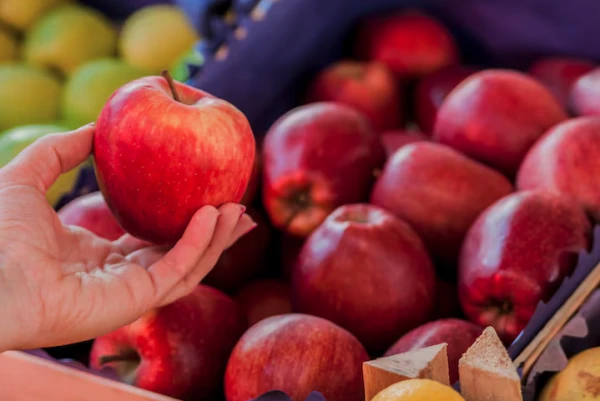
Soviet and American scientist Sergey Lopatnikov shared his observations about the decline in product quality in stores.
Professor Sergey Lopatnikov writes, quote: "Here’s an interesting nuance. When I talked about the USA, I repeatedly wrote that fruits and vegetables in the USA are absolute, conditionally edible CRAP. 'Crap' - in all capital letters.
I, for example, am a fan of apples and in Russia, during the season, I ate apples like an elephant - literally by the buckets. And then, you bring a box of Antonovka from the dacha - the entire Moscow apartment is infused with the apple spirit.
In the USA, apples are like 'wood', with a plastic painted oak skin (I would say, a peel) without any smell and either slightly sweet or slightly sour. In the USA, I even stopped looking at them. After all, I’m not a wood-boring beetle to feed on wooden things.
In practical terms, this wood can only be used in cooking - in apple pie (American ones - with a wild amount of cinnamon, which replaces the absence of apple spirit and taste) - or when preparing duck in the oven. Therefore, I classify them in the vegetable category, alongside potatoes.
The same applies to cucumbers, of which there is exactly 1 (one) type - the so-called 'salad' cucumbers, as long as a banana overgrowth and practically tasteless - just water, with a hint of cucumber smell. Even toilet deodorant smells better.
And to tomatoes and cherries.
In the last decade, oranges and tangerines have also spoiled. Florida ones used to be very tasty. But some calamity has passed, the trees died, and they were replaced by the next semi-plastic products. Well, and two, rarely three types of grapes, which sometimes are even semi-edible.
I recall with pain the Tashkent markets with their ten types of grapes, amazing melons... And about my native suburban dacha with gooseberries, black currants, real cherries, which do not exist as a class in the USA, paperberries, millet, Antonovka, bumpy cucumbers, and somehow it makes you think: 'WHY'? And the answer is simple: 'The market has decided.'
I found out with interest that in the West, BOOKS are dedicated to studying and economically justifying this phenomenon.
In the 'optimization of cultures', especially through genetic modification methods, the last thing that was paid attention to was taste qualities. Optimization was based on the following parameters:
- resistance to pests
- storage duration (a year is normal!)
- synchronization of ripening and standard size and appearance of fruits.
And taste? - 'The gnomes' will eat it anyway. They don’t know - they don’t want to.
By the way, this also applies to flowers. There is a species - there is no smell. Magnolia - the very magnolia, one tree of which in Gelendzhik can be found by smell on the other side of the city (a slight exaggeration) does not smell at all in the USA. Roses - without smell. Lilacs - where there are - without smell... Yes, the market has decided.
This is an example of another phenomenon studied in economic literature, the existence of which the 'market people' have kept silent about: the market ALWAYS leads to a deterioration in quality to the limit. This is a very interesting effect: the fact is that the consumer, being a non-professional, does not notice a slight deterioration in quality. But it allows lowering the price so that profit still grows. As a result, quality decreases faster than the 'decreasing' price.
The only thing that can counteract this is government standards. But they do not exist in the usual Soviet sense. There is some regulation. It is remarkable. For example, Standards of Identity. They establish what a product must contain to be called a certain way.
For example - I quote - 21 CFR §131.110 — Milk defines that milk is a product obtained from cows, with a specific composition. After all, who knows what a cow produces. Let’s not confuse it by taste. Well, like, apples are what is produced by apple trees, not by bees. That’s how we live.
P.S. Here a familiar Uzbek woman - recently from Uzbekistan - told me that in Tashkent everything is the same: Uzbek fruits are sold somewhere, while stores are filled with the same... products as in the USA."
Sergey Lopatnikov is the head of the American laboratory of mathematical modeling methods at the University of Delaware (USA), and previously a leading researcher at Moscow State University (MSU). He has lived in the USA since the early 2000s.














Leave a comment