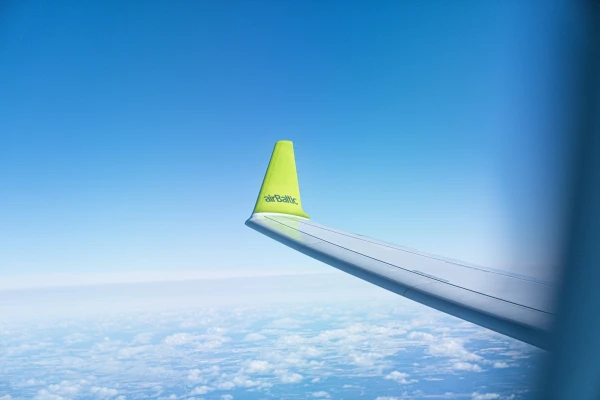
The Minister of Transport called for this issue to be discussed directly at today's government meeting.
As expected, the conflict in the Persian Gulf has exacerbated the already dramatic financial situation of the Latvian national airline. Just now, the Ministry of Transport issued a press release:
"The Latvian national airline airBaltic officially approached the Ministry of Transport at the end of March this year, informing the shareholder about the impact of external factors on the financial and operational activities of the enterprise. The military conflict in the Middle East has led to a significant increase in aviation fuel prices, which, in turn, increases the company's costs and affects profitability.
"Having received and assessed airBaltic's letter regarding the need for a short-term loan as one of the possible preventive tools for stabilization, I proposed this issue for consideration at today's Cabinet meeting. It is important to ensure the continuous operational activities of the enterprise at a time when external factors are particularly affecting the aviation industry," said Minister of Transport Aitis Švinka.
The enterprise continues to provide flights according to the planned program, and a possible loan, if granted, could help maintain a stable flight network, avoiding sharp changes and absorbing the pressure of rising fuel prices.
At the same time, the Ministry of Transport emphasizes that no decisions regarding the allocation of possible funding have been made at this time. The issue will be considered in accordance with regulatory requirements, and the decision on possible funding will depend on further assessment and obtaining all necessary decisions and approvals.
For security reasons, airBaltic had previously been forced to suspend flights to Tel Aviv and Dubai, which reduced revenue and affected the efficiency of the route network. At the same time, aviation fuel prices in the Gulf region – which accounts for about a third of the global market – have significantly increased under the influence of the conflict, sometimes even approaching a doubling of prices.
The airline is actively implementing measures to stabilize the situation: reviewing route profitability, optimizing capacity, and flexibly managing the fleet, also using a hybrid business model based on scheduled flights and ACMI-out services.
At the same time, work is underway to develop a new business plan, which is expected to be completed in the summer of this year. A possible short-term loan, if granted, could help the enterprise stabilize its operations until the new plan is implemented."
It should be noted that the possible provision of a loan was not discussed at the last coalition council and, apparently, today the government partners are unlikely to support any specific decision on this matter. We dare to assume that the ruling parties will return to the issue of the loan after the holiday. It is likely that this could involve a loan from the State Treasury under government guarantees, although from a legal standpoint, this is a rather questionable option.
airBaltic is an important driving force in the economy of Latvia and the Baltic region: the enterprise directly employs about 3,000 workers and indirectly creates thousands of jobs in related industries. With more than 130 direct routes and cooperation opportunities in over 300 destinations, airBaltic provides critically important connectivity, fostering investment, export, and tourism development, while significantly strengthening Latvia's competitiveness.