The new Saeima will have to amend the law that currently regulates the languages of public media broadcasting.
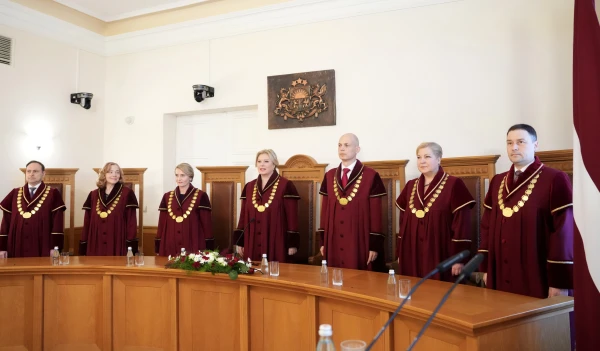
Today, the Constitutional Court issued a ruling on the lawsuit filed by members of the Saeima from the right-wing opposition - the National Alliance and the United List, regarding the language regulation of public media broadcasting. Recall that the deputies challenged the constitutionality of those provisions of the law on public media that required the state to finance broadcasts in minority languages, including Russian.
From the verdict announced today, it follows that the court indirectly recognized the validity of the plaintiffs' claims.
"The court indicated that the foundations and national-cultural identity of the Latvian state are defined by the Latvian language as the only state language, without which the existence of the state enshrined in the Constitution is impossible. Latvia is the only place in the world where the existence and development of the Latvian language can be guaranteed, and, as a consequence, the indigenous nation through the ages.
The Constitutional Court emphasized that the constitutional mission of public media is to strengthen the values characteristic of a democratic state, including caring for the Latvian language, thereby fostering a sense of belonging among the population to the Latvian state. The essence of public media is to provide the public with reliable information, especially on issues significant to society. From the essence of the constitutional identity of the Latvian state, it follows that the content of public media should primarily be in the Latvian language so that it truly serves as a common language for communication and democratic participation of the entire society, including national minorities. A deviation from this principle is allowed solely to fulfill other obligations of the state arising from the Constitution and only to the extent that does not threaten the status and functions of the state language.
At the same time, Latvia as a democratic rule of law state respects national minorities and their right to preserve and develop their language and culture, enshrined in Article 114 of the Constitution. The state must take appropriate measures to ensure access of national minorities to media, to enhance tolerance and cultural diversity. However, the scope of state obligations regarding the rights of national minorities depends on the actual situation of a particular national minority in the country, such as numerical composition, language prevalence, media accessibility, willingness and ability to independently ensure access to information in their language, as well as other circumstances.
In the case at hand, the Constitutional Court noted that the Russian language in Latvian media is self-sufficient — commercial media in Russian are still widely available. Furthermore, there are printed, audiovisual, and digital media, as well as dozens of programs created by electronic media from other countries that offer content in Russian. Thus, the existence of the corresponding minority language and the preservation and development of national identity are not under threat, and individuals belonging to the Russian national minority are able to effectively exercise their rights in the media space without significant state support.
The Constitutional Court pointed out that there are also national minorities whose language is not self-sufficient. The state has a constitutional obligation to facilitate access for such national minorities, especially smaller ones, to public media so that they can preserve and develop their language, culture, and national identity. However, for public media to provide content in the languages of such national minorities, it is important for them to have the desire to preserve and develop the mentioned values, as well as to participate within their capabilities in achieving this goal. Moreover, in fulfilling the state's obligation to facilitate such access for national minorities to public media, it is necessary to assess whether the relevant national minorities have access to media in their language.
In assessing the constitutionality of the contested provisions, the court emphasized that it is necessary to consider the constitutional obligation of the state to care for its security, as only in this way can the existence of the Latvian state and its democratic structure be guaranteed. The awareness of each individual about important issues of state life is fundamental to state security and aimed at forming a cohesive society. Public media play an important role in the context of state security, which includes the obligation to provide objective and independent information in the languages of national minorities on important issues of state processes.
This also applies to a national minority whose language is self-sufficient in the media in Latvia, namely the Russian language. Conducting aggressive and hostile activities for war propaganda and disinformation is one of the main directions of Russia's activities directed against Latvia and the Baltic states. It is expected that Russia will continue such measures. Therefore, in cases where, for example, it is necessary to protect society from propaganda and disinformation, it is public media that have the task of providing fact-based objective information and clarifying its political, legal, and social context. In the interests of state security, the provision of information in the languages of national minorities, including Russian, must be proportionate to the threat to state security, targeted and justified by objective necessity, and must not threaten the status and functions of the Latvian language.
The Constitutional Court concluded that the content of the contested provisions is too broad. They allow for the possibility that through the mediation of Latvian public media, the rights of national minorities whose language is not self-sufficient in the media and needs special protection may not be ensured. In turn, regarding the rights of a national minority whose language is self-sufficient in the media in Latvia, the contested provisions allow for an unjustified deviation from the principle that the content of Latvian public media should primarily be formed in the Latvian language. It is unacceptable that the rights of individuals belonging to national minorities are exercised at the expense of the state language.
Considering the aforementioned, the contested provisions do not ensure the appropriate balance between the obligations of the state established by the Constitution to protect the Latvian language, the rights of national minorities, and state security. The contested regulation has been declared invalid as of May 1, 2027, giving the Saeima a reasonable time to assess what legal regulation in the process of forming the content of public media will most fully balance the aforementioned state obligations.