
Studying the life of the neighborhoods of my hometown, your author continues to be amazed by the changes — a new park appears, a public transport stop near the railway station, a 12-story residential building has risen in 9 months. However, upon closer examination, it turns out that no one plays in the playground, public transport routes have not been established in the "mobility point," and luxury apartments have been built in the intra-block space, blocking sunlight for themselves and others.
Everything is Going According to Plan
The Urban Development Committee of the Riga City Council recently reviewed the action plan for the metropolitan area. It was adopted with 6 votes in favor and one abstention. The capital region encompasses a significant part of Latvia, which has already formulated its goals until 2030 — including the long-term development goals of the UN and the EU's green course... In general, we are all in the same trend.
By the committee's decision, led by Edgars Bergholcs ("United List"), Riga residents can familiarize themselves with the documents on the resources riga.lv and rdpad.lv. Active participation from both the population and entrepreneurs is expected in voluntary initiatives for thematic, local, and detailed planning.
Looking to the future, the Riga City Council "defines the vision for the long-term development of the territory, strategic goals..." for a long-term perspective of 25 years. The program should "focus the work of the municipality and the use of project-oriented public investments." At the same time, medium-term priorities are established, a set of activities for the next 7 years, which is intended to serve as "a tool for public investments and the agenda of municipalities."
Territorial planning in Riga is approved in the form of mandatory rules - "and they must be fully adhered to by everyone in the administrative territory of the municipality — residents, businesses, municipal institutions."
Promising districts, expanded airport, new crossing over the Daugava
Studying the Map
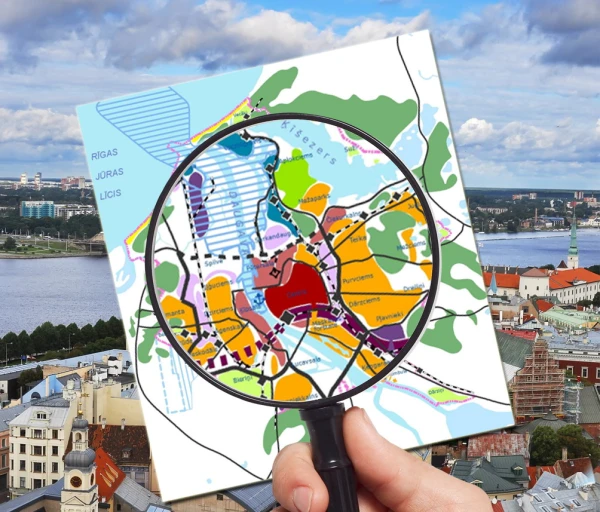
We are studying the map - "Structural Plan of Riga" for the next five years.
The "Core of the City" is shaded in carmine red, Latvian Red color, representing the historical center. This is clear. Dark yellow marks almost all "sleeping" areas, now referred to as "Revitalized Residential Outskirts." But there are also blue areas, which are priority districts — Bolderāja, Vecmilgrāvis, Sarkandaugava, Magnūlsala.
By the way, at the City Council meeting held on Wednesday, E. Bergholcs announced the long-awaited ferry service on the route Vecmilgrāvis-Bolderāja. Locations for passenger boarding and vehicle loading are currently being sought; it is expected to also be a charming tourist route. Skeptics from the opposition, however, point out that primarily freight trucks will be able to take advantage of this alternative option.
In any case, on the 2030 plan, there is a dashed line - "possible crossing of the Daugava," apparently somewhere near the island of Kundziņsala, which is already effectively connected to the city's road network by a powerful system of bridges and interchanges, soon to be launched. To the south, a small marine anchor promises a sea terminal.
The "Riga" airport is expected to be expanded almost twice, however, no longer within the capital's territory — but in the Marupe municipality. Well, for cooperation with the entities of the surrounding metropolis, we have a whole vice-mayor, Maris Sprindžuks, also from the "United List."
A few more nuances — there are still industrial zones in the city, although not many. Opposite Kengarags, across the railway; on the northern island of Krievu sala; south of Ziepniekkalns. So the indignation of some residents when an industrial facility is built near their neighborhood is understandable, but unfortunately, it is explainable. Thus, according to the plan.
Inventing the Bicycle
Studying the infographic of 19 priorities that Riga is to focus on, the eye immediately falls on the first circle - "Mobility." It depicts, for a moment, a bicycle. Well, it is clear that our urban planners do not favor cars — but even the not environmentally friendly tram-trolleybus is not included. It can be assumed that the young authors-developers judge by their physical conditions and do not consider that hundreds of thousands of people live in the capital who, unfortunately, are unable to move on two-wheeled transport.
Next, we have: "Urban Environment," "Environment and Climate," "Education," "Housing," "Management," "Society," "Competitiveness," "Culture." All sections are divided into priorities.
The national economic block, i.e., what our Riga plans to earn from, is based on:
- Convenient international accessibility;
- Favorable business environment and high economic activity;
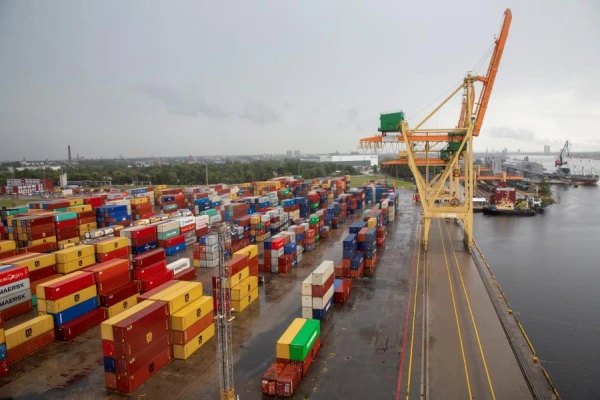
- Growing multifunctional port;
- Targeted tourism offerings.
Here, however, a reasonable question arises — how will our port become "growing" against the backdrop of the actual halt of both trade and transit with the Russian Federation and Belarus? It is no secret that since the Middle Ages, Riga has been tied to cargo flows from Rus, as it was in the First Republic and in the first 30 years of regained independence.
And what about the high role of Riga as a regional financial center? Okay, banking for non-residents has passed after "capital repairs," but in recent years, the prospects of our city as a capital of cryptocurrencies, blockchain, and other modern trends have been repeatedly outlined.
We Have Become Less Than 600,000
From 2021 to 2025, the population of Riga decreased from 614,618 to 595,053 people; at the same time, Vilnius's population increased from 556,490 to 607,667 people. The Lithuanian capital has also become the largest city among the three Baltic states — an area of 401 sq. km compared to 304.6 sq. km in Riga. However, much of the neighbors' success is explained by the annexation of the surroundings to Vilnius — which, by the way, has led to a low population density, which is 54% higher in Riga.
As for investments, here we have fallen significantly behind Vilnius — foreign direct investments in 2024 amounted to 28.825 billion euros there; while in Riga, only 9.903 billion. Although, it would seem — the Lithuanians have no port, and the border with problematic neighbors is significantly closer.
However, geography currently works in favor of the Lithuanian capital — a train ticket to Warsaw costs 20 euros. Apparently, being within walking distance of a European megacity creates a synergy effect. The same applies to interactions along the Tallinn-Helsinki axis. Unfortunately, we have no similar "anchor" ally. Therefore, in the CIMI ranking ("Cities in Motion"), Riga ranks only 88th, Vilnius — 85th, Tallinn — 73rd. The leaderboard is topped by the most dynamic: London, New York, Paris, and Tokyo.
But in the European Top-10 for medium-sized cities, we are seventh, between Polish Wrocław and Łódź. Again, Vilnius tops the list!




Leave a comment