The past weekend was troubling for representatives of the right wing, primarily for the politicians of the National Alliance, who once proclaimed themselves the main defenders of the Latvian people against "aliens" and "foreigners."
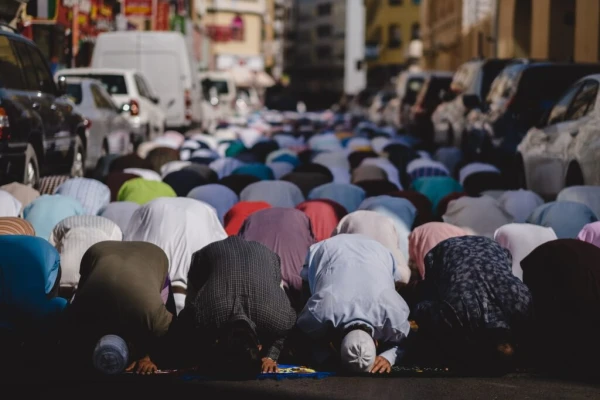
Yes, all weekend short videos "from the scene" circulated on social media - on one of the streets of the Plavnieki neighborhood, dozens of Muslims were performing namaz on the sidewalk in honor of the end of the Ramadan holiday. Members of the Saeima from the National Alliance also "shared" videos on their accounts under the rubric "Islamization of Latvia," but in response received angry comments like - "What are you looking at?! Why are you doing nothing?!"
The reality is that for the last three decades, nationalists of all stripes, led by TB/LNNK-National Alliance, have been fighting… against their own residents whose native language is Russian. It must be acknowledged: in this struggle, nationalists have indeed succeeded, especially after 2022, when a real campaign against the use of the Russian language in all public spheres unfolded "under the laws of wartime." They also dealt very quickly and effectively with the elderly who, at one time, obtained a Russian passport to receive their pension earlier — thousands of people simply left the country, either failing the Latvian language exam or not even attempting to undergo such a test in their old age.
Meanwhile, while all the forces and energy of politicians were directed at local residents, guests… arrived in Latvia. In large numbers. And this was inevitable. Firstly, as the saying goes, a holy place is never empty — if about 300,000 people have left the country in the last 15 years, it is obvious that at least partially they will try to attract newcomers (both for work and study). Secondly, let’s be realistic: although salaries in Latvia lag behind the European average, in many sectors they are already significantly higher than even in quite economically developed countries of the third world. And thirdly, migrant workers from India, Sri Lanka, Pakistan, and other countries do not come here to take the places of doctors, scientists, engineers — they perform the work that local residents are not eager to do. There are very few Latvians willing to "grind" on a bicycle with a huge bag on their back all day long, in any weather, and this is a pan-European trend where migrants perform the heaviest, thankless, and not very well-paid jobs.
In any case, the number of citizens from third countries in Latvia is steadily growing. The number of residence permits issued has sharply increased, especially after COVID. In 2019, 10,418 temporary residence permits were issued, while in 2022 — 18,477, a year later — 27,266, and last year, 15,739 primary temporary residence permits were granted.
Currently, there are 82,569 people in the country with temporary residence permits. Of these, 17,881 received a residence permit as employees, and 5,631 have a residence permit based on studying at a university.
To be fair, it should be noted that this group of individuals with temporary residence permits also includes citizens of Ukraine who have received temporary protection status, meaning they are essentially refugees forced to leave their homeland due to the war.
But in any case, nationalists believe that the number of foreigners in the country has already exceeded what they consider the permissible limit. After all, it should not be forgotten that foreigners with residence permits in another EU country or those who have received a multiple Schengen visa can enter Latvia through the internal borders of the EU. It is possible that there are also illegal migrants who have entered Latvia from another EU country...
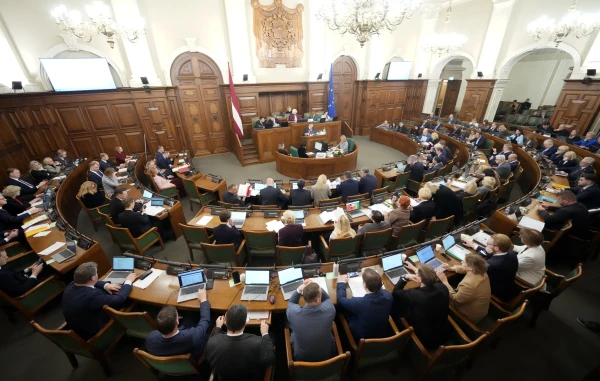
Let us remind you that a parliamentary investigative commission on migration was recently created in the Saeima at the initiative of the National Alliance and has already begun its work. The commission has set three main tasks — to identify the "weak" points in migration legislation, propose options for tightening migration policy, and "detect" violations in the actions of officials when issuing residence permits and in controlling migrants.
Nationalists believe that we are dealing with a mass influx of migrants in Latvia. The chairman of the parliamentary investigative commission, Jānis Dombrava, warned that if the number of migrants in Latvia continues to grow at the current pace, given the low birth rate, "immigrants may simply replace Latvians."
It should be noted that the Ministry of the Interior is already preparing a whole series of proposals for a new Immigration Law, which has been under consideration by the parliament for a long time, tightening the rules for the entry and stay of foreigners in the country for educational purposes. From now on, if a foreigner is expelled from a university or voluntarily stops studying, they will not be able to immediately "jump" to another university in Latvia — they will first have to return to their home country and then apply again for admission to a university and obtain a new student visa. In addition, the requirements for the level of English proficiency for potential foreign students in Latvia will be tightened. Students will also need to have a certain amount of money in their account in case they have to return home, interrupting their studies.
But let’s return to the events of the past weekend — nationalists, fearing that voters would turn away from them for their "softness" and unwillingness to fight against foreigners, promised to raise the issue of completely halting migration from third countries.
"I have proposed amendments to the Immigration Law that provide for the restriction of immigration from certain countries. Latvia was founded to ensure the existence of the Latvian nation, not to become a small Uzbekistan or Russia," said Saeima member Edvins Šnore from the National Alliance.
His party mate Arturs Butans lamented that today the immigration policy in the country is determined not by the government, but by the migrants themselves - they come as much as they want.
Let us remind you that the Latvian government, unlike the governments of Estonia and Poland, failed to defend its right to an "exemption" in Brussels, and according to the regulation, our country is supposedly obliged to accept a certain number of refugees based on the principle of redistribution. And if it refuses, it will have to pay compensation for each unaccepted refugee. However, representatives of the Latvian government assure that all this is nonsense and no one can force us to accept refugees if we do not want to...
It is clear that, on the one hand, it is too early to panic — after all, the number of migrants in Latvia is still very small. On the other hand, the experience of several EU countries, including Sweden, which is close to us, shows that mistakes in migration policy, loss of vigilance, and the pursuit of economic gain ultimately lead to very big problems — radicalization of society, increase in crime, creation of migrant enclaves, and attempts by migrants to dictate the rules of the game to authorities and local residents!