
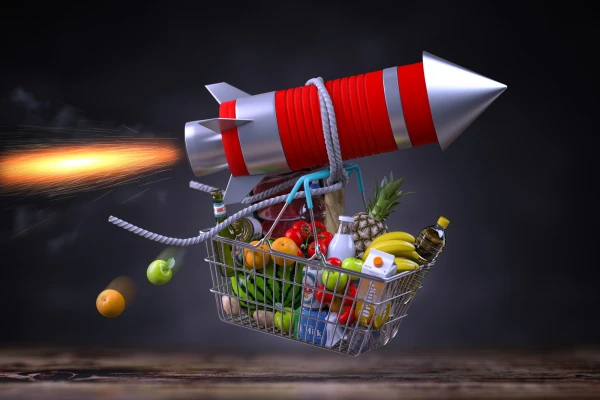
How fleeting everything is in our time! Just at the beginning of March, Minister of Economics Viktor Valainis (Union of Greens and Farmers) announced the signing of an additional agreement this month with representatives of retail trade - within the framework of the memorandum, which, he reminded, appeared almost a year ago with the aim of achieving a reduction or at least stabilization of prices for essential food products. A so-called basket of low prices was even formed.
Plans and Reality
"An agreement has been reached that there will be more products in this basket of low food prices," the head of the Ministry of Economics optimistically promised again in early March.
What Memos Are Here!
Then the war in Iran began, spilling over into the entire Persian region. Due to the blockade of the Strait of Hormuz, fuel prices skyrocketed, and if they are not stopped, prices for food and services will start to rise in a chain reaction. Apparently, the question of signing amendments to the memorandum is hanging in the air... Let us assume that it is unlikely that traders (read - major retail chains) will take on additional commitments in a completely unclear geopolitical situation! Especially against the backdrop of reports that if the oil crisis is not resolved within a month, it will lead not only to a new wave of inflation but also to a decline in economic growth and even an economic crisis.
However, let us not panic prematurely and recall the fight against prices that the Ministry of Economics began in the spring of last year. The first results of this struggle are mentioned in the report of the Ministry of Economics, which the government will review.
30% of Income Spent on Food
"In Latvia, there have been persistently high prices for food products on store shelves for a long time. As a result, a significant portion of household expenses went towards purchasing food products - among less affluent residents, food expenses exceeded even 30% of total household expenditures, leading to low purchasing power for consumers. Food prices significantly affect the well-being of residents of Latvia and particularly impact households with lower incomes.
Given this situation, the Minister of Economics made it a priority to ensure that everyday food products are accessible to the public at reasonable prices in accordance with the purchasing power of the residents of Latvia, using locally produced food as a significant tool to achieve this goal," the Ministry of Economics stated in a press release.
The signed memorandum forced retail chains, primarily the largest among them - MAXIMA Latvija SIA, SIA RIMI LATVIA, and Lidl Latvija SIA - to, firstly, regularly report their prices on essential food products (which ensures greater transparency and helps consumers orient themselves), and secondly, to create a so-called basket of low prices: in each segment of the main types of food, at least one product is offered at the lowest price.
What’s in the Basket?
Let us recall what products are included in this basket of low prices:
-
White bread, black bread, unleavened bread
-
Pasteurized milk
-
Cheese, cottage cheese, butter, sour cream, kefir
-
Fresh vegetables: potatoes, onions, carrots, garlic, beets, tomatoes, cucumbers, cabbage, cauliflower, lettuce, pumpkin, zucchini, potatoes
-
Fresh fruits: apples, pears, berries (strawberries, cranberries, currants, blueberries, raspberries)
-
Fresh and chilled meat: pork, ground pork, poultry, ground poultry, beef, veal, lamb, sheep and goat meat
-
Fresh and chilled sea and freshwater fish
-
Flour, other grain flours: wheat flour, whole grain flour, buckwheat
-
Chicken eggs
-
Vegetable oils: olive oil, rapeseed oil, sunflower oil
Traders also include additional products from other food categories that are not part of the 10 main categories in the low-price baskets, thus making the assortment of products in the basket more accessible and wider for consumers.
It should be noted that on at least one online platform, it is possible to monitor food prices daily and choose which product and in which store to buy cheaper today. Such price comparisons are very convenient, for example, for residents of Riga, as stores from the three main retail chains are located close to each other in almost every neighborhood of the capital.
Retail Chains Have Moderated Their Appetites
"In terms of food prices, we have finally done what should have happened many years ago - we introduced specific oversight tools, ensured greater transparency, and moved from discussions to facts. The sharp rise in prices has been halted, the rate of growth is decreasing, and in the low-price segment, we are already seeing a real decline. This is the result of targeted work, and we will continue to work to make prices more affordable not only in specific product groups but overall," stated Minister of Economics Viktor Valainis.
To be fair, if it has not been possible to actually lower prices (and the numbers indicate that no real decrease is observed), at least traders have somewhat moderated their appetites "out of fear," and prices have indeed begun to rise more slowly. Noticeably more slowly. And now the Competition Council has also gotten involved, already suspecting two major retail chains of collusion.
The planned reduction of the VAT rate from 21% to 12% on essential food products starting July 1 should also help tame prices...
Let’s Just Hope It Doesn’t Get Worse
However, all these efforts by the Ministry of Economics will go to waste if the situation in the Persian Gulf is not resolved quickly.
In any case, there is no hope for a decrease in prices. The main thing now is that it doesn’t get worse!










Leave a comment