
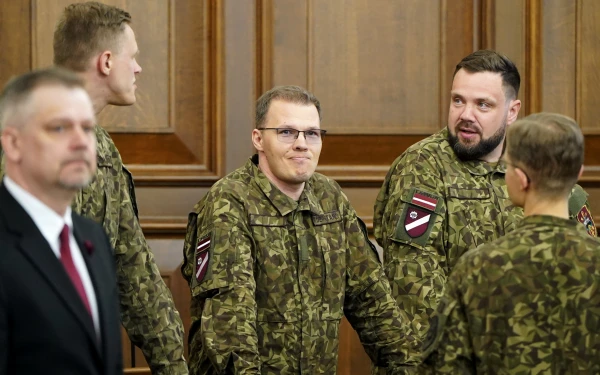
Well, who said that Latvian nationalists can’t do anything? They can... stick to their line, and that is quite enough in the current political circumstances in Latvia!
Politics in Opposition Mode
In any case, they continue to define the political agenda. Moreover, this opportunity to push their ideological decisions and positions has not diminished and certainly has not disappeared even after the National Alliance and its satellite—the United List—went into opposition.
It is clear that as the elections approach, the nationalists will become increasingly radical and aggressive, while the ruling parties will become more afraid... of being accused of insufficient national patriotism and almost of harboring pro-Russian sentiments.
This fear among the three ruling parties will inevitably ensure support for various initiatives from both the National Alliance and the United List. Or, at the very least, the ruling parties will pass certain projects to the Saeima committees.
Competition Among the Main Radicals
Moreover, there is a high probability that certain deputies from "New Unity," especially those elected from districts with a significant nationalist electorate, will themselves propose radical initiatives. For example, a deputy from the ruling "New Unity" submitted an amendment to the law that will lead, in a few years, to the complete cessation of commercial television and radio broadcasting in Russian.
Several extra-parliamentary parties are also vying for the votes of nationalist-minded voters—such as the newly formed party "Rising Sun" and Hermanis's party "We Change the Rules."
One does not need to possess prophetic abilities to guess that in the less than 7 months remaining before the elections, a kind of competition for the title of the coolest nationalist will begin.
However, even now, there are initiatives in the Saeima committees that, to put it diplomatically, are far from democracy, human rights (including the rights of national minorities and European standards), and... common sense. The authors of the lion's share of such initiatives are deputies from the National Alliance.
Ban on Communicating in Russian
Judge for yourself. In the Saeima committees, proposals are waiting for consideration:
-
on banning advertising in Russian on private television and radio stations,
-
on gradually ceasing broadcasting in Russian,
-
on banning Russian subtitles in cinemas,
-
a draft resolution instructing the government to develop amendments to the law prohibiting the use of the Russian language in schools—including in communication between students.
It should be noted that recently the parliament already supported amendments to the Education Law that prohibit teachers from communicating with each other and with students in any language other than the state language while performing their official duties.
Also, before the elections, the Saeima committee may consider a draft instruction to the Cabinet to develop a regulatory act prohibiting employees of state and municipal institutions from communicating with each other and with visitors in any language other than Latvian.
The Seller Will Choose the Language of Communication
But if all these initiatives are currently on pause, the "language amendments" proposed by National Alliance deputy Nauris Puntulis are already close to adoption.
Recall that this proposal involves adding a special section "Language of Communication" to the Consumer Rights Protection Law. At the second reading, Puntulis's amendments were supported, which effectively require the buyer to communicate exclusively in Latvian, while the seller or other person providing services is essentially prohibited from communicating in any language other than Latvian, even if the seller knows that other language.
Interestingly, by the third reading, Puntulis himself corrected his own amendments and proposed a different version:
4.3 Language of Communication
(1) A consumer in Latvia has the right to receive services in the state language. The service provider is obliged to ensure the realization of this right.
(2) The service provider is not obliged to serve the recipient of the service in any language other than the state language.
Now at least the seller, if they speak, for example, Russian and/or English, will be able to communicate with the buyer in that language without fear of punishment. At the same time, if such an amendment is adopted, the shop owner will not even be able to ask the seller or another service worker what other languages they speak besides Latvian.
And a Boycott of Russian Goods
Alongside the language initiatives, the politicians of the National Alliance have tried to push various projects through the Saeima instructing the government to cease any economic relations with the Russian Federation and Belarus in the present and future. These include:
-
a project calling for the dismantling of railway tracks in the direction of Russia,
-
a call to ban bus passenger transport to Russia and Belarus (this idea will soon be implemented),
-
a proposal to ban the import of all types of goods from Russia and Belarus...
Just at the last plenary session of the Saeima, a green light was given to a bill that provides for the introduction of a 30% tax on all imported Russian and Belarusian goods.
Foreigners Do Not Belong Here
Nationalists understand perfectly well that they need to expand the front of struggle—primarily through the "migration issue." This includes tightening the conditions for obtaining student visas for citizens of third countries, and tightening the conditions for obtaining visas and residence permits for citizens of third countries...
And this list of initiatives, of course, is not closed—it will be supplemented with new and new projects.
"Speak in Rīga!"
Alongside political initiatives, terrifying stories are being circulated on the internet that are supposed to shape the necessary public opinion.
For example, there is a story about how an unknown Russian-speaking person terrorized a Latvian saleswoman, which was very timely shared on social media by a certain man-reemigrant, Davis Vilyums, who lived in London for 12 years. He writes about his sister, who worked in a clothing store in Rīga. According to his sister, a customer brought a defective jacket to return it: "Then he started mumbling something in Russian about how the receipt was in his pocket."
The employee asked him to explain in Latvian. Allegedly, the dissatisfied customer with the defective jacket became very angry: "How can you live and work in Rīga and not know Russian? It’s the language of Rīga!"
The employee countered: "Sorry, but I am Latvian and do not know Russian very well."
The man allegedly became even angrier, began to insult her and said that she was incompetent and should not work there, demanding to call management.
To avoid escalating the situation, colleagues served the customer in Russian. As a result, the man left relatively calmly, although he continued to condemn the employee and said that such people should not work in such places and that he was "judged because of his nationality."
"Although I did not judge anyone. But let it be so. A funny fact—at the end he said goodbye in Latvian, like a little sun," recalls the saleswoman, who ultimately could not withstand the stress and resigned from the store.
Interestingly, amendments to the legislation requiring communication with sellers in the Latvian language are currently being considered in the Saeima. And here appears a detailed story about an anonymous customer who refused to speak in Latvian. Well, how can one not vote for tightening the laws?











Leave a comment