
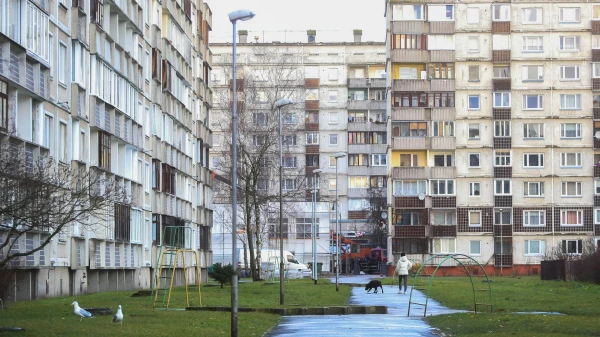
Riga has many vacant buildings and free housing owned by the state. Economist Guntars Vītols believes they should be transferred to private owners, as the state is unable to manage them effectively. "A private owner will always perform better; public servants have no profit incentive, their salary does not depend on results. The state should not engage in property management."
The Soviet legacy is so outdated that during renovation, the primary focus should be on the safety of buildings rather than insulation — this opinion was expressed on the TV24 program "Naudas cena" by Elina Treija, chairwoman of the Housing Policy and Environment Committee of the Riga City Council and chairwoman of the Board of the Association of Large Families of Latvia.
She was supported by Aigars Šmits, chairman of the board of the Latvian Association of Real Estate Transactions (LANĪDA) and chairman of the board of Arco Real Estate, and economist Guntars Vītols.
Housing prices are rising, the demand for apartments remains stable, and, as is known, not everyone can afford housing in new buildings or take out a loan to build a private house. The market for pre-war houses and buildings from the Soviet era remains. However, as experts note, many of them require significant capital investments, and this is not just about updating the facade. Nevertheless, a significant portion of apartment owners decides on renovation, prioritizing insulation. According to Elina Treija, this is the wrong approach.
"If renovation is carried out solely for the purpose of insulation, then it is not worth doing. It makes sense if it also concerns safety. We have now reached a stage where the Soviet legacy has become so old that we need to think more about the safety of buildings rather than insulation."
Aigars Šmits holds a similar opinion: "There is no point in insulating an old house if it requires more serious repairs — it’s like giving an elderly aunt plastic surgery, tightening the skin on her face, and saying that she can live comfortably for another 50 years." In his opinion, there is no economic justification for insulating a building, as the costs are compounded by a long-term loan. At the same time, Šmits believes that it is beneficial for the state to "put a person on credit," as this means that throughout the loan repayment period, the state can count on them as an economically active resident, since "you can never relax at any moment," he added.
Housing issues, according to Treija, are a pressing concern for residents across Europe.
"A significant factor in the demographic decline is that the generation that is now supposed to start families is struggling to acquire property. A recent study showed that 30% of the population stated that they never hope to become homeowners."








Leave a comment