
The Riga municipality is enthusiastically engaged in "revitalization."
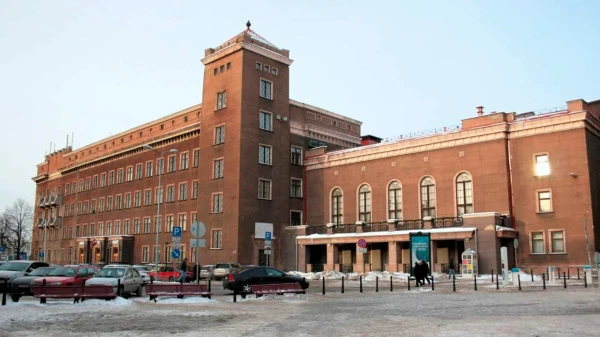
Anyone moving towards Vecriga across the Stone Bridge cannot help but glance at the classical building resembling a defensive fortress. For about 40 years, it displayed a light advertisement, as one would say today, social advertising: "Communism is the future of humanity," exclusively in the state language (which was still in the project stage at that time). Now the former Polytechnic does not shine.
I remember all your cracks
Last week, the Riga City Council's Property Committee, led by Dainis Locis (National Alliance), reviewed the situation, as noted in the minutes, of the block between Kalku, Maza Jauniela, Jauniela streets, and the November 11 embankment. There is currently an empty building of the Riga Technical University (RTU).
Member of the board of the municipal company Rīgas nami, Marcis Budlevskis, pointed out that his enterprise is currently working on the site only as a service provider, not as an owner, and therefore performs a limited scope of maintenance work.
He noted that "management is currently mainly limited to maintaining the external territory and certain urgent technical works that arise periodically."
Commenting on the repeated technical conclusion, M. Budlevskis emphasized that it did not state "unexpected or new risks."
The board member noted that the most urgent tasks from the operator's side are currently the restoration of deformation monitoring, especially regarding crack formation, regular supervision of verticality and foundation settlement, reducing safety risks, including the dismantling of loose or damaged facade elements.
The house on the embankment… will relieve the center of cars
Then the floor was given to the chief architect of Riga, Peteris Ratans. The architect admitted that "radically new solutions have not been developed since the last discussion, however, there have been reflections on possible progress." He emphasizes that the main goal of the project is "to activate a specific part of the urban environment, to bring life back to the territory and spatially tidy up the Latvian Riflemen's Square and Town Hall Square." P. Ratans believes that "one of the important ideas is the construction of underground parking lots that would relieve the embankment of vehicles while simultaneously improving the quality of the urban environment."
He emphasizes that in the current situation, the status of the buildings of the Riga Technical University as architecturally valuable is "defining, and a clear justification of public benefit is necessary for its change or flexible interpretation."
We don’t need this
Vestards Rosenbergs, a board member of the Latvian Association of Real Estate Transactions (LANĪDA), emphasizes: "This specific place is one of the hallmarks of Riga with an intense flow of locals and tourists, so it needs a high-quality architectural solution."
The businessman calls for a critical assessment of the criteria by which the building is recognized as architecturally valuable and whether these criteria are methodologically justified and irrefutable? Thus, V. Rosenbergs points out the contradiction: in Latvia, "the heritage of the Soviet era is critically assessed at the same time, while this Stalin-era building is specially protected despite its dissonance with the historical development of Old Riga."
Here, in the opinion of your author, the market participant has, so to speak, sharpened the polemic. After all, the house was built in 1958, when the repressions of the cult of personality were condemned. Excesses in architecture were also cut out, so the Polytechnic building is designed quite modestly and resembles the functionalism style of the 1930s. Its creator, Osvalds Tilmanis, if anything, served as the chief architect of Riga during all the turbulent eras – from 1934 to 1950 and from 1956 to 1958. He is credited with the outstanding project of a residential quarter on Janis Asars Street (1929-31), as well as the iconic ritual building – the Riga crematorium (1938, completed in 1995).
"Nothing has been done so far"
By the way, the fact that V. Rosenbergs attempted to shift the struggle for the building into the political plane is confirmed by his own activity in this regard; he was a candidate in the Riga City Council elections but did not pass.
For his part, deputy and chairman of the opposition faction in the Council, Edvards Slesers, voiced "the necessity of making any decision that would allow starting the process of bringing the building at Kalku Street 1 in order, since nothing has been done so far."
In the deputy's opinion, the optimal solution would be mixed-use development with a hotel, apartments, and office spaces, "which would ensure life in the area around the clock."
Moreover, the deputy also emphasizes the need for underground parking lots to improve the traffic situation, also allowing the possibility of building parking under the Latvian Riflemen's Square.
The mayor's weighty word
A participant in the Property Committee is also Viesturs Kleinbergs (“Progressives”). The city mayor stated that the municipality "needs a formal purpose of use to justify the alienation of land plots, and in this case, ensuring an administrative function serves as a legal basis, even if this purpose may change in the future."
Therefore, Mr. Kleinbergs proposes to instruct the Riga State City Property Department to start a study, in cooperation with the National Cultural Heritage Administration, to prepare a conclusion on the possibilities of development at Kalku Street 1, the permissible volume of construction, changes, and preserved values. He noted that only after conducting such a study could a decision be made on further steps, including a competition for ideas and a specific development model. The mayor also asks Rīgas nami to send a conclusion on the technical condition of the building at Kalku Street 1.
The process has begun
The critical view of the opposition was presented by deputy Denis Klyukin. He "supports the draft decision but points out that a significant volume of administrative premises will soon be freed up in Riga, including in educational institutions in the central part of the city."
The deputy emphasizes that the use of these premises should be assessed, rather than planning the construction of new administrative buildings in the center of Old Riga.
Another deputy believes that for Vecriga, "the priority should be to promote life, tourism, and entrepreneurship, rather than concentrating administrative buildings." It was noted that large office buildings in the city center do not create added value and are not attractive to foreign investors or guests.
In any case, as they say, the process has begun. And if the current trend continues, in a few years, on the site of my Alma Mater, there will be, at best, another glass box – and at worst, emptiness behind a construction fence.




Leave a comment