
Tired of revolutions and wars, the Old World began to enjoy widespread motorization in the mid-20th century. Now, it seems, it is coming to an end — instead of a personal four-wheeled vehicle, there will be a two-wheeled one, and it is not even certain that it will be personal.
The modern type of bicycle, with a chain drive, was introduced by the British John Kemp Starley 140 years ago, so the benefits of free movement were experienced even by Leo Tolstoy and Nicholas II. But could anyone have imagined back then that the authorities in Europe would impose bicycle transport on the entire population?
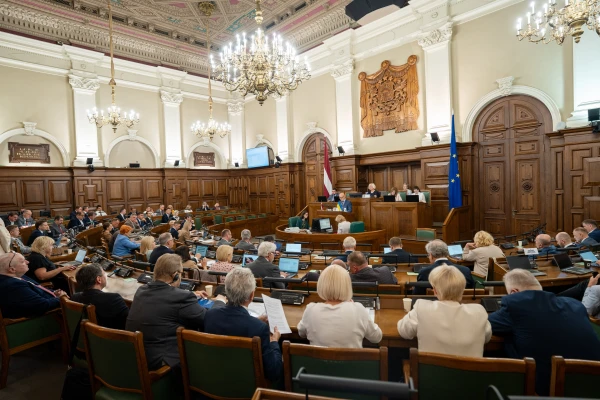
It is precisely from the regulations of Brussels that the Minister of Communications Aitis Shvinkas ("Progressives") derives the "national position No. 1" of official Riga, which he put forward last week: "On the progress achieved in implementing the European Declaration on Cycling."
Dresden's 75 Percent
Such an extreme ceiling for the population moving on two wheels was proposed by the East German city. It is expected to be achieved, however, only by 2035.
Danish Aarhus aims to have 50% of its population using bicycles on a daily basis by 2030. West German Münster builds streets only in accordance with bike paths, while Italian Bologna has reached an agreement with 55 surrounding municipalities on planning bicycle transport in the agglomeration.
Budapest is introducing initiatives like "Bike Bus" and "Bike to Work." In Germany, there are more than 2 million rental bikes, with their number increasing by a quarter over five years. The small Lithuanian town of Tauragė has become famous for its 86 km of bike paths!
The capital of our Eurocountry, Brussels, has gone the furthest — there, one can receive a subsidy from the municipality of 4000 euros for a cargo bike and 2000 euros for a bike trailer.
Billions on Two Wheels
Regulation EU 2024/1679 has introduced a LEGAL REQUIREMENT for 431 cities in the Old World — to adopt "Long-Term Urban Mobility Plans." These plans implement the "last mile" principle, meaning that residents exclusively use electric public transport, and then get to work and home on a bike that they keep at the station.
As part of the international "Transport Community," Brussels' plans have attracted countries that are not yet part of the EU, such as Albania, Bosnia and Herzegovina, Kosovo, Montenegro, North Macedonia, Serbia, as well as observers like Georgia, Moldova, and Ukraine.
In the current financial planning period of the European Union (2021-2027), 4.5 billion euros have been reserved for bicycle transport, of which 3.2 billion comes from the EU budget itself, and 1.3 billion from the states. This funding is intended to lay down 12,000 km of new or improved bike paths.
And here's the interesting part: the latest paths are being laid where... former railways used to be! In other words, the deindustrialization of the 1990s and 2000s will be covered by "multimodal connections, as well as active transport." According to high-ranking circles, all this is supposed to ensure the attractiveness of rural areas in the EU.
And within the framework of the Social Climate Fund, "additional financial opportunities" are available, such as transport vouchers for shared bike usage or charging stations for electric bikes. Even such not-so-rich EU countries as Portugal have splurged — distributing 20,000 bicycles in 1000 schools.
Growth Driver
According to estimates from the European Commission, bicycle transport generates 21 billion euros in gross domestic product (more than Latvia's budget), with about 1000 enterprises involved in value-added chains.
Each year, around 20 million bicycles are sold in Europe, of which 5.5 million are electric. More than three-quarters of bicycles are assembled in the EU, although the share of components from our countries is only 45-50%, with the rest, predictably, coming from China.
The number one producer today is Portugal (1.8 million), followed by Romania (1.5 million) and Italy (1.2 million). The EU exports bicycles worth about a billion euros, while importing twice as much.
Judging by the recently concluded free trade agreements with Latin America and India, the bicycle trade deficit will soon become even more pronounced. Will the remaining "screwdriver assembly" enterprises in Latvia survive under such conditions?
I must admit, since the time of the "Rubik's bike path," which ran from Imanta to Jūrmala, I have not pedaled in Latvia. In the Netherlands, where I found myself in the early 1990s, I rode to a flower farm even to another town, but not for pleasure, rather out of necessity.
Bicycle Thieves
However, my mother, who rode a bicycle until she was 75, had two stolen within two weeks. This interrupted her quarter-century hobby and negatively affected her health overall. Interestingly, both bicycles were parked with a lock and chain in a wooden booth in the yard with a coded lock gate. What can one say about the proposed intercept parking lots at mobility points — they could simply become free supermarkets for thieves in Latvia.
To combat bicycle theft, France introduced mandatory marking of new bicycles in 2021, and now there are more than 7 million bikes with individual tags in the country. In Belgium, the MyBike identification system was introduced in 2024.
Through Storms and Fog
The temptation for criminals is, first of all, the high cost of modern bicycles. While in the late USSR, products like "Ukraine" could be bought for an increased student scholarship — i.e., about 50 rubles, and "Minsk" or "Desna" for ten rubles more, today a bike assembled in Latvia from imported components costs as much as the minimum wage "in hand."
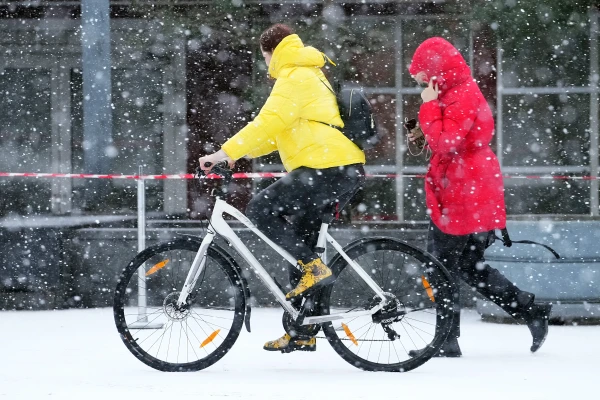
... And the most significant counterargument against a massive bicycle expansion in Latvia is, unfortunately, our climate. Especially this winter — the frosts and snowdrifts have once again proven that our everyday life is nothing compared to Southern, Western, and Central Europe, which has the decisive word in the so-called bicycle policy.
However, we still have our meteorological brothers, the Scandinavians. They have equally, if not more, severe synoptic conditions — yet their cycling activity is an order of magnitude greater.
RISK
Statistics from the European Union indicate that pedestrians, cyclists, and users of other small mobility means account for 70% of fatalities in urban traffic accidents.








Leave a comment