
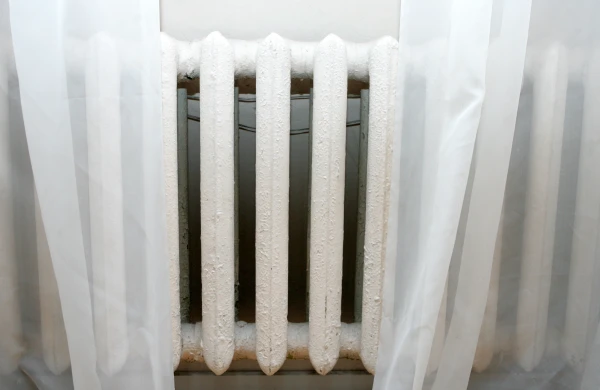
The last time the government provided substantial assistance in paying bills was for households during the heating season of 2022/2023.
Latvian Television's Panorāma reports this evening that there are still no specific decisions on who and what benefits will be available in this heating season. Officials emphasize that this time assistance is expected only for specific groups of society — those who need it the most, rather than for everyone.
January of this year was significantly colder than December — the average temperature dropped by about ten degrees. This has also affected the consumption of thermal energy. Calculations from the industry association show that a one-degree drop in temperature leads to a five percent increase in consumption. This means that in January, heating costs could be approximately fifty percent higher than the previous month.
The President of the Latvian Association of Heating Enterprises, Ina Berziņa-Veita, said in an interview with LTV: "But we have very good news — the cost of energy resources for heating has not increased. Yes, of course, electricity is more expensive for those who use it, but I am talking about centralized heating. And some tariffs have even decreased, but mostly they have remained stable because there is no change in fuel prices; there is no crisis as such."
Higher energy consumption will, of course, mean higher bills. In this regard, the issue of government support was discussed today at the Ministry of Climate and Energy.
The last time state-level support was provided during the heating season was in 2022 and 2023, when energy resource prices sharply increased, and the government introduced broad compensation for almost all households.
This time, support will likely be more targeted and intended only for specific groups of the population.
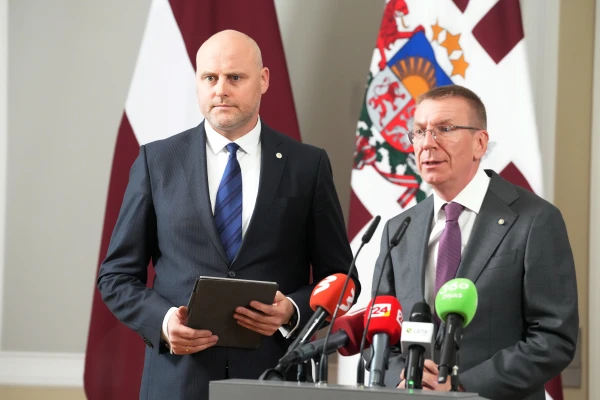
The Minister of Climate and Energy, Kaspars Melņiks (Union of Greens and Farmers), explained: "Right now, we are saying that prices are stable. We are saying that bills have increased. But they are very different. This is probably very important — that we need to forecast, which we are doing, communicating with both local government and heating enterprises about the current situation. And if any further needs arise, we are trying to address them urgently."
According to the minister, the main state tool for assistance may be housing benefits. These are provided individually, assessing both income and housing expenses.
The advisor to the Latvian Association of Local Governments (LSS) on health and social issues, Ilze Rudzīte, noted that "this [benefit] is uniform across Latvia, and therefore the criteria by which people can qualify for this benefit are also uniform in Latvia. There is a certain income threshold — how much a person should have left after paying housing expenses. Depending on this, people can apply for housing benefits. Housing benefits can also be received by people who do not have the status of a needy or low-income person."
Considering that January has just ended, and people have not yet received new bills, it is currently impossible to predict how much funding for support may be needed.







Leave a comment