"Nav labi, draugi!" – the catchphrase of A.K. Kariņš comes to mind when looking at the map of the ecological state of the rivers in our republic.
High-quality water resources are scattered like small blue spots across remote areas, while near the largest metropolitan agglomeration — the lower reaches of the Daugava are turning red. The "very poor" state of hydrological resources in the Riga region serves as a warning to everyone who swims, fishes, or simply drinks from the tap.
Lay Me a Bottom
Not to say that everything is in disarray. The Latvian State Center for Geology and Meteorology (LVĢMC) is "working on water assessments" and preparing a plan for 2028-2033. Amendments to the Law on Water Management Services have been developed in connection with EU regulations on wastewater.
Fortunately, the EU project LIFE GoodWater is also helping. Cleaning and straightening riverbeds is combined with the construction of new wastewater and stormwater systems. As part of this initiative, last year the Slocene River was cleaned, and an artificial wetland was created at Slokleja. All of this is intended to create a common biotope with the famous Lake Kanieris. To reduce harmful nitrogen compounds entering water bodies from fields where mineral fertilizers are used, Latvia has begun using bio-reactors on wood chips, which have been installed in the Skede, Bens, and Penkule parishes.
In Latvia, not only traditional land reclamation is being applied, but also nature-friendly sedimentation reservoirs — this is the process of settling solid particles, liquid droplets, or gas bubbles from a liquid or gaseous medium under the influence of gravity or centrifugal forces. For example, near the Mazupite River, which flows into the Gulf of Riga near Roja in the Talsi region, there are three reservoirs lined with special geotextile fabric.
Time to Lay the Stones
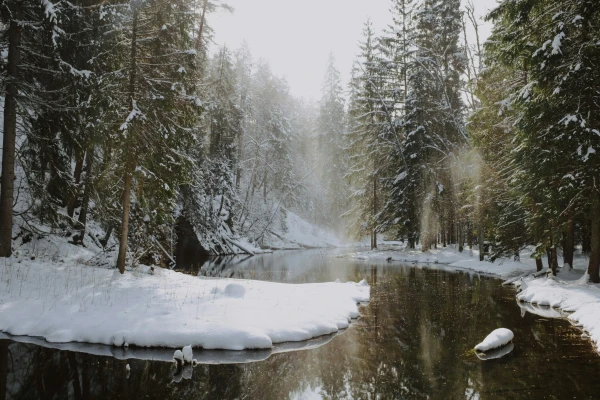
There are many willing to help the country's aquatic environment — last year, 10 clean-up events took place on the rivers Mergupe, Auce, Age, and Vershupite... For instance, in the picturesque tributary of Venta — the Zane — stones were laid, around which the formation of natural biotopes is now expected.
As reported by LVĢMC at a recent meeting of the Saeima Commission on Long-term Development, scientists are trying to convey to rural workers possible ways to reduce the impacts of agriculture on river quality, "and are also preparing video materials." Unfortunately, almost every spring, the flooding of the Daugava, Gauja, and Lielupe inevitably leads to pollution in their basins, as well as in the Gulf of Riga. It is quite likely that this current, very snowy and frosty winter will again result in flooding in a couple of months. For now, hydrologists are only planning flood modeling.