
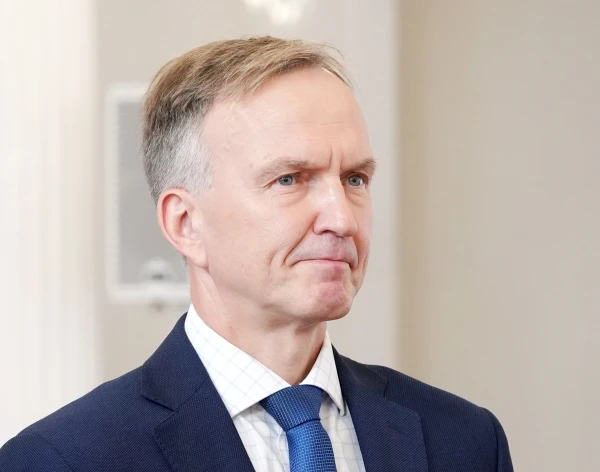
The situation in Kyiv remains extremely difficult. This was stated in an interview with Neatkarīgā by Latvia's ambassador to Ukraine Andrei Pildegovich. Along with the constant attacks of Russian troops with missiles and drones, the harshest winter in recent years has added to the challenges. Failing to achieve success on the front, Russia is deliberately destroying unprotected civilian facilities, including Ukraine's energy infrastructure.
According to the ambassador, the current period is one of the most difficult times in the entire war. "In the fourth year of the war, this winter has become the harshest. For the last ten nights, the temperature has dropped to -15 degrees, and in the suburbs, it has reached -20. During the day, temperatures range from -12 to -15 degrees, and forecasts do not promise any warming," he said.
As a result of Russian attacks, two of Ukraine's largest heat and power plants, CHPP-5 and CHPP-6, have been severely damaged. They no longer generate electricity, and the volumes of heat supply have decreased by almost half. An energy crisis has been declared in Kyiv. The central, eastern, and northern regions of the country are living under strict electricity supply restrictions: in some areas, there is no electricity for up to 16 hours a day, a third of the capital is facing serious outages, and many places lack water supply.
Nevertheless, the city continues to live and function. "Transport is running, shops are open, although they have to adjust to the electricity supply schedules. Schools have partially switched to remote learning. The priority is hospitals and children's institutions," noted Pildegovich. In government institutions, the temperature often does not exceed +13 degrees. According to him, it is especially difficult in megacities, where it is impossible to use stove heating.
Against the backdrop of the frost, authorities are urging residents to seek alternatives. "Kyiv Mayor Vitali Klitschko recommended a few days ago that those who have the opportunity should wait out the winter at their dachas or with relatives," the diplomat said. He added that mutual assistance is actively manifesting in the city: neighbors share generators and provide shelter for each other at night. Some embassies have allowed their staff to sleep in official premises if there is no heat and light in their apartments.
"Such cold is indeed life-threatening," he emphasized.
The work of trade is also adapting to the crisis. Some shops are switching to cash payments, while others are operating on a "floating" schedule. The rules of the curfew are being revised to ensure the round-the-clock operation of vital services.
A separate problem remains high-rise buildings.
"In Kyiv, there are buildings with 24–30 floors. The elevators are not working, and this is a serious challenge for elderly people, people with special needs, and pet owners," noted Pildegovich.
Municipalities are handling food deliveries, and resilience centers have been created where schoolchildren and students help the elderly carry their purchases. According to the ambassador, there is no food shortage in the capital.
Amid the attacks, the transport infrastructure is also suffering: trains are regularly delayed, and in recent weeks, railway lines have been attacked by drones. "This is a new threat," the diplomat acknowledged.
Speaking about the responsibility for what is happening, Pildegovich did not hide his emotions: "This is genocide and a crime against humanity. Deliberate strikes on civilian facilities and power plants... This can only be compared to the blockade of Leningrad carried out by Nazi Germany."
He emphasized that Russia's actions are the largest crime in Europe in the 21st century and thanked the people of Latvia for supporting Ukraine — from supplying weapons and energy equipment to helping Ukrainian children. "The psychological rehabilitation of children is very important," the ambassador noted.
According to him, the coming weeks will be critical: as long as the temperature does not rise to at least zero, repairing the energy infrastructure is extremely difficult.
Pildegovich also noted the European Union's involvement in helping Ukraine. He reminded that European Commission President Ursula von der Leyen presented a support plan worth 90 billion euros for the next two years, of which 60 billion is intended for military assistance. Among other measures to pressure Russia, the diplomat mentioned sanctions and the fight against the "shadow fleet," whose vessels have begun to be detained in recent weeks.
Talking about the work of the embassy, Pildegovich noted that diplomats are also facing outages:
"For several days, we worked at a temperature of about +14 degrees, and there were problems with water. We are using generators."
He reminded that Latvia has provided Ukraine with a large number of generators and spare parts for them.
Concluding the conversation, the ambassador emphasized the main point: "Giving up is not allowed. And Ukrainians are not going to give up."



Leave a comment