
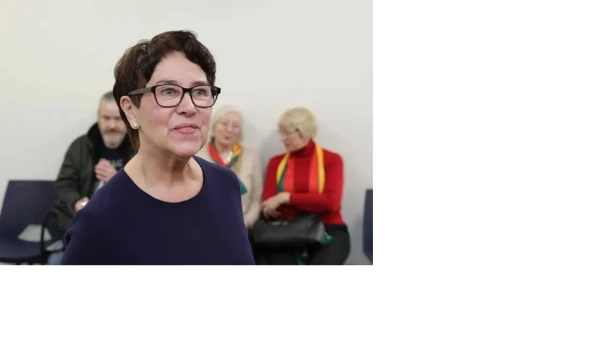
Lauchene, by her own words, was judged for the words 'stupid,' 'rogue,' and for the thought that the Lithuanian nation is more educated than the Russian one.
The Vilnius District Court acquitted Alina Lauchene, who was accused of inciting against Russian speakers due to an article about people of other nationalities living in Lithuania who do not learn the Lithuanian language.
As announced by Judge Evelina Petraityte, Lauchene was acquitted because she did not commit a crime.
"Not every act according to the Criminal Code is considered a crime, but only one that is dangerous and unlawful," the judge noted.
A group of Lauchene's supporters observed the announcement of the verdict.
The Vilnius District Prosecutor's Office initiated a pre-trial investigation based on statements from two people of other nationalities living in Lithuania, although the police had previously refused to start such an investigation several times.
"An overly sensitive reaction from people of other nationalities to any public criticism cannot be the basis for criminal liability... Moreover, the article does not speak of intolerance towards nationalities, but of intolerance towards behavior that contradicts the laws of Lithuania. It is the behavior of people of other nationalities, their unwillingness to learn the language that is condemned and criticized, not the nation or nationality itself," Judge Petraityte explained, clarifying the motives for the acquittal.
"The article merely calls for compliance with the requirements of the Constitution of Lithuania and the Law on the State Language of Lithuania," the judge summarized.
It was previously reported that during the closing arguments, Prosecutor Darius Chaplikas from the General Prosecutor's Office requested the acquittal of the accused, although his colleague Sharunas Shimonis from the Vilnius District Prosecutor's Office had previously sought to bring the woman to criminal responsibility.
After the acquittal was announced, Prosecutor Chaplikas reiterated his arguments: "In this case, it has not been established that the act possesses such a degree of danger that criminal liability could be applied."
In court, Lauchene was congratulated by the chairman of the National Union, Vytautas Radžvilas.
"If you remain silent and whimper, asking: ‘Please learn a few words in our language,’ then you will constantly and increasingly receive the response: ‘We do not understand your dog language, speak in a human language,’" said the party chairman.
"This is Lithuania. Here, we speak Lithuanian. The Lithuanian language is the state language. And we will continue to speak in a very beautiful, the most beautiful language in the world," Lauchene said in court after her acquittal.
She called this case political. Lauchene, by her own words, was judged for the words "stupid," "rogue," and for the thought that the Lithuanian nation is more educated than the Russian one. According to the woman, the assertion that the Lithuanian nation is more educated is justified by the fact that Vilnius University was founded in 1579, while the first university in Russia appeared only 200 years after that date.
"I proved that 'stupid' does not mean 'feeble-minded.' 'Stupid' means incapable of learning, talentless. If foreigners were born here, have lived here for 40–50 years, and cannot say hello... Just recently, a Russian told me that it is her principle not to speak Lithuanian. So, maybe we also have principles not to speak with them?" Lauchene recounted.
In the opinion of the acquitted, the case was ordered, but she did not name the clients.
"I did not hold a candle. I don’t know. But Prosecutor Sharunas Shimonis concocted this case. But there were sober-minded, very honest people. I mean Prosecutor Darius Chaplikas. He had to do a very hard job. He had to clean the Augean stables of Prosecutor Sharunas Shimonis. Therefore, today I boldly say that the esteemed Darius Chaplikas is Hercules," Lauchene said.
The former teacher, an active member of the National Union, 72-year-old Lauchene was accused due to her article written in 2023: "Lithuanian, your country is in danger! Foreigners are taking over! Open your eyes!" The accusation states that the publication humiliates Russian speakers living in Lithuania.
Linguistic expert Samantha Ketite from the Lithuanian Center for Forensic Expertise wrote in her conclusion that Lauchene's article expresses an offensive and contemptuous attitude towards Russians, Jews, Poles, and other Russian speakers.
However, another linguistic expert, Laimutis Laužikas, who also examined the mentioned article, said that it criticizes the unwillingness to learn the Lithuanian language and adapt in Lithuania, and the text should not be considered degrading or calling for the discrimination of a group of people.
According to the expert, the text expresses a desire to encourage the integration of foreigners, not discrimination. In Lauchene's publication, in his opinion, one can see a rise in national self-awareness and the glorification of patriotism, and there is no contempt for people of other nationalities.
In March of last year, the court granted the prosecutor's request and returned the case to the prosecutor's office, which justified this request by the deficiencies in the indictment and the need to "assess the danger of the act."
Suspecting that the case in the prosecutor's office might get stuck to avoid public scrutiny and possible acquittal, the accused's lawyer Tomas Januskavicius filed a complaint with the Vilnius District Court requesting to return the case to court.
The higher court satisfied the complaint — canceled the decision to return the case to the prosecutor and instructed to continue its consideration in court.
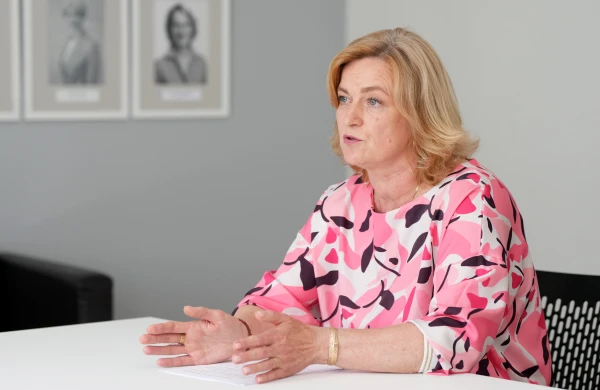
The fact that the prosecutor requests the court to acquit the accused was called normal practice by General Prosecutor Nida Grunskene.
"It was instructed to the prosecutor of the General Prosecutor's Office, who specializes in such cases, to check this pre-trial investigation. And after reviewing the findings of his inspection, it was still decided to change the prosecutor and assign the support of the state prosecution to the prosecutor of the General Prosecutor's Office," explained the General Prosecutor.
"He decided to ask the court to return the case for further investigation. The court agreed, the higher court canceled (...) and the prosecutor supporting the state prosecution requested acquittal," she added.











Leave a comment