
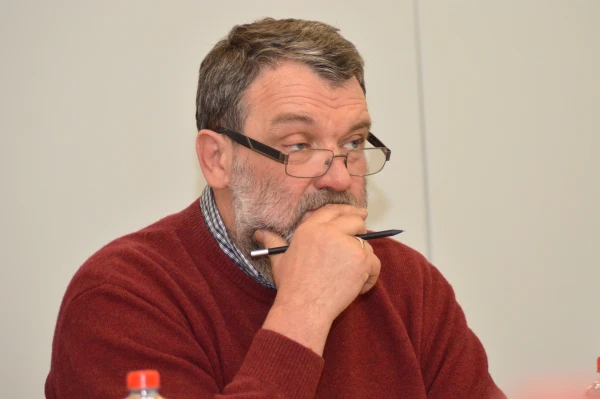
The current ruling coalition is likely to continue its work until the next parliamentary elections, as being in opposition at this moment is disadvantageous for political forces, said political scientist Juris Rosenvalds to the LETA agency.
In his opinion, the internal disagreements within the coalition, which have become evident in recent months, will not disappear; however, all three coalition parties - "New Unity" (NE), "Progressives," and the Union of Greens and Farmers (SZK) - judging by the adoption of the budget, have set a common goal to maintain cooperation. "New Unity," according to Rosenvalds, plays the role of a mediator and will continue to seek to reduce tensions.
The political scientist noted that there are few options for an alternative government majority. A government formed by the opposition, even with the participation of SZK, would be a minority government unless the party "Latvia First" (LPM) joined it, which, according to Rosenvalds, could create reputational risks. At the same time, the participation of the "Stability" party is practically excluded. He also emphasized that any new government would have to operate based on the already adopted budget.
Rosenvalds believes that the most realistic scenario remains the preservation of the current government while avoiding sharp political initiatives and issues that could provoke new conflicts - thus, the government could operate until the next elections.
Assessing the ratings of political parties, the political scientist pointed out that a decline in popularity has been recorded for all political forces represented in the Saeima that participated in the recent political disputes, including those surrounding the so-called Istanbul Convention.
According to Rosenvalds, these conflicts have intensified voters' disappointment in politics in general, as evidenced by the increase in the number of those who do not know whom to vote for. He suggests that this may deter parties from taking excessively sharp actions in the future.
Speaking about the possible impact of the situation surrounding the Istanbul Convention on the Saeima elections, the political scientist pointed out that human rights issues generally do not hold as much significance for Latvian voters as, for example, in Western Europe. However, in his opinion, the rhetoric used by part of society has raised concerns about a possible change in the political course, similar to what previously occurred in Hungary or Russia. This is evidenced, according to Rosenvalds, by protests, including the action in Dome Square, which involved people of different ages.
As previously reported, last autumn the LPM party submitted a bill to the Saeima for the denunciation of the Istanbul Convention, which was supported not only by other opposition parties - the National Alliance, the "United List," and "Stability" - but also by the coalition member SZK. "New Unity" and "Progressives" opposed the denunciation. The bill was passed by a majority vote.
A significant portion of society expressed dissatisfaction with this decision, and Latvian President Edgars Rinkēvičs returned the law to the parliament for reconsideration.
The Saeima sent the bill rejected by the president to the Foreign Affairs Committee, establishing a one-year deadline for proposals. This effectively means that the issue of exiting the convention will be considered by the next parliamentary convocation.
Most experts and non-governmental organizations working in the field of violence prevention oppose exiting the convention, expressing concern that it could weaken the protection of victims and negatively affect Latvia's international image in the eyes of Western allies.
In Latvia, the Council of Europe Convention on preventing and combating violence against women and domestic violence, known as the Istanbul Convention, came into force on May 1 of last year. This international agreement obliges participating states to develop coordinated policies for the effective protection of women from all forms of violence, as well as women and men from domestic violence.
Among other things, countries are required to provide comprehensive assistance and protection to victims, establish crisis centers, 24-hour hotlines, specialized support services for victims of sexual violence, and protect and support children who have witnessed violence.






Leave a comment