
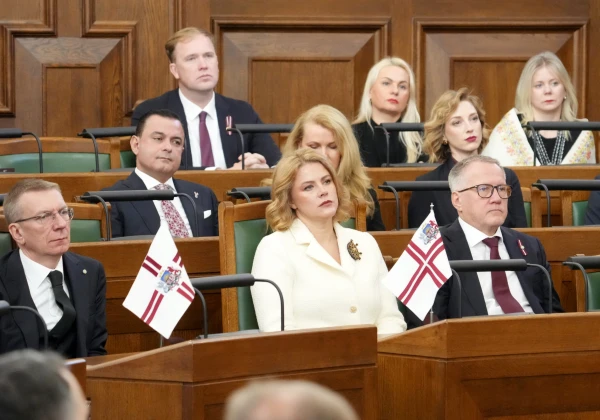
Immediately after the successful adoption of the budget-2026, Prime Minister Evika Siliņa stated that she personally noticed "signs of unity" in the coalition.
Perhaps these are some invisible signs to others, as in reality nothing has changed — and after the budget was adopted, the partners continued, excuse me, to bicker with each other, while the "green peasants" did not change their autumn habit… of voting on separate issues together with the opposition.
United or Opposed?
Moreover, it seems that the chaos in power is only increasing. The president contributed to this process by sending the amendments to the Road Usage Fee Law back to the Saeima. As the LTV-1 De facto program claims, the prime minister and other leaders of "New Unity" were very angry with Edgars Rinkēvičs because of this.
Let us recall the latest episodes of "unity" as the head of government would put it. The "green peasants" proposed amendments to the law regulating the construction process. One of the amendments stipulates that individuals who decide to build a house or another property on their own, at their own expense, will not need to prove the legality (origin) of these financial resources for construction. This was an attempt by the "green peasants" to disavow the recently adopted rules by the Cabinet, which require individuals to prove the legality of the funds they plan to spend on building a house. Of course, this raises the question: why did the ministers from the Union of Greens and Farmers initially support these Cabinet rules, and now their party members in the Saeima are trying to "correct the mistake"? Apparently, it is a consequence of retrograde Mercury, which, they say, is still hanging over Latvia.
In any case, the coalition partners in the form of "New Unity" and the "Progressives" did not support this amendment from the "green peasants", but it still received conceptual support from the opposition votes! And now "New Unity" has promised during the discussion of the bill in the final reading (the bill has been given urgency and is being considered in only two readings) to ensure that this amendment from the "green peasants" is struck out! This is what true "unity" of the coalition looks like!
"Green Peasants" on the Side of the Opposition
The "green peasants", meanwhile, did not stop at what they had achieved and at the last plenary session warned their government partners that they would not support their proposal to exempt from criminal liability those caught a second time for drug use. As a result, "New Unity" realized that the proposal would not pass and removed the amendment from the agenda — until agreements are reached in the coalition. Whether they will be is a big question!
It is obvious that as the elections approach, disagreements and chaos in power will only increase. I would say they will increase with each new popularity rating of political parties. The latest SKDS rating showed that if elections to the Saeima were to take place in November this year, the "green peasants" could count on 5.6% support from voters. This political union has not seen such a low rating for a long time! The reason is obvious — the inability to maintain a principled position on key issues! Just judge for yourself.
And Where is the Result?
Initially, the Union of Greens and Farmers supported the opposition amendment to the Constitution stating that the state recognizes and protects the family consisting of a man and a woman. The amendment was ultimately sent to the committee and… was successfully buried there.
Then the "green peasants" voted for the opposition bill to withdraw from the Istanbul Convention. But again, there was no result — the president returned the bill to the Saeima and the "green peasants" did not object to the bill being frozen until the next parliament takes office.
Before the budget was adopted, the "green peasants" threatened their partners that if additional funds for regional passenger transport were not found in the budget, then… there would be no government either. However, no miracle happened here either — the "green peasants" ultimately voted for the budget without additional allocations for passenger transport.
A logical question arises: will the "green peasants" be able this time to insist on their amendment freeing Latvians from the need to prove where they got the money to build a house on their own?
Meanwhile, the head of state decided not to stay aside from the legislative process and the chaos in the ruling coalition. As we mentioned earlier, he returned the amendments to the Road Usage Fee Law for revision. The amendment was adopted virtually in secret, as part of the budget package, and shocked those affected by it. Let us recall: it provides for the introduction of a vignette, that is, a fee for commercial vehicles with a total weight of 3 to 3.5 tons starting from January 1. Until now, only trucks starting from 3.5 tons were subject to the fee. The amendment would have hit the farmers and all other carriers of not the largest cargoes hard. After a wave of outrage and protests, the Minister of Transport, Aitis Švinkas ("Progressives"), promised to review this bill and the coalition approved a quick revision.
Rinkēvičs Enters the Game
However, the president outpaced everyone and returned the bill to parliament without coordinating this step with the government coalition, which angered representatives of "New Unity". But, on the other hand, the president is not obliged to coordinate anything with anyone — the Constitution states that the president is not politically accountable for his actions and also has the right to determine for himself whether to sign a particular bill or, if there are justified objections, to send it back to the Saeima. What complaints can there be against Rinkēvičs? Moreover, it should not be forgotten that the president has already clearly sided with "New Unity" and the "Progressives" once by returning the bill on withdrawal from the Istanbul Convention to parliament.
Therefore, as an experienced politician, he needed at some point to also play along with the opposition: the powers of the current Saeima expire in 11 months and Rinkēvičs needs to start thinking now about who in the next Saeima will be ready to vote for his re-election for a second term. It is obvious that no leftward turn in Latvian politics will occur, and thus without the support of conservative forces, Rinkēvičs will not see a second term. Additionally, the president needs public support — the story with Levits showed that if you are an extremely unpopular president in society, you have little chance of being re-elected for a second term.
This entire situation with government instability plays into the hands of the opposition: they can both increase their popularity and, most importantly, use the chaos to push through the Saeima some important initiative. In any case, it will not be boring, and the situation is becoming more and more unpredictable.





Leave a comment