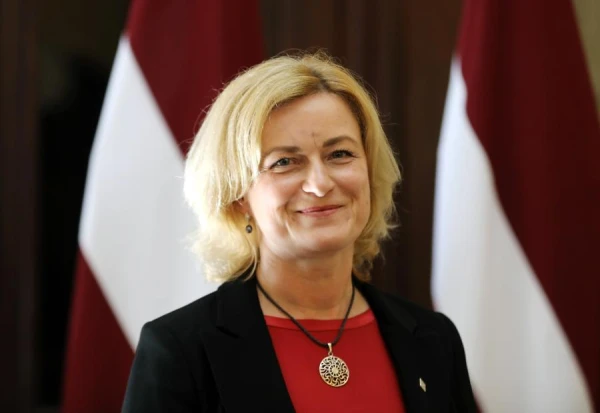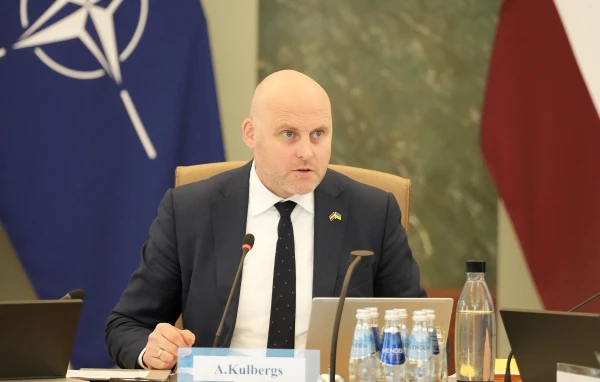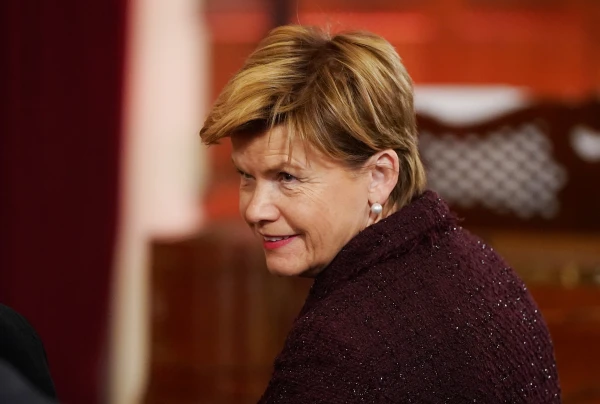
The chair of the Saeima Foreign Affairs Commission Ināra Mūrniece (National Alliance) fell ill, and therefore the Foreign Ministry's report on its completed and planned international activities turned into a showcase for the party “New Unity,” from which both the deputy chair of the commission Irma Kalniņa and the head of the foreign ministry Baiba Braže were present. Unfortunately, many deputies neglected such an important event – although it was supposed to be combined with the European Affairs Commission.
“We do not see changes in our priorities”
The document that the Foreign Minister will present in January 2026 is currently not available to the public: “It is restricted access, as it is undergoing a process of broad consultations.”
Therefore, only what B. Braže said on record in the Saeima is publicly available:
– It is important to hear the thoughts of the deputies. The most significant thing we have done is consult with the Council of Experts on Foreign Affairs, with non-governmental organizations, with business associations, and cooperation partners. They are also preparing their comments. The draft has been sent to sectoral ministries and both commissions of the Saeima.
Thus, from what B. Braže said, it is evident that our foreign policy is the result of public discussion… However, “the most important thing is that we do not see changes in our priorities”:
– Strengthening security, defense, deterrence capabilities, transatlantic unity. The second block – economic growth and prosperity. And the third – caring for people and involving society in politics. The Minister emphasized that “the presence of allies in Latvia is strong; it has increased; there are signals that the presence of the USA will not decrease.”
– There are very good relations with American colleagues, for which I want to thank the deputies within their competence, – continued B. Braže on the American line. – Also, thank you for active cooperation at the level of the Baltics and Nordic countries, and cooperation with the Turkish parliament. All of this is important for us.
The new message also highlighted cooperation with the United Kingdom of Great Britain and Northern Ireland, especially in the field of security: “Both within various exercises and everyday cooperation in consultations on sanctions.”
Regarding the latter, B. Braže mentioned the so-called “shadow fleet.”
– We support Ukraine, – she characterized the nature of relations between London and Riga. In the policy of His Majesty's government – “the accents have changed,” noted the minister.
“The UN Security Council is no longer a goal for us, but an achievement”
The fact that Latvia will sit as a non-permanent member of the Security Council next year not only provides new opportunities for communication with the USA but also “opens interest in Latvia.”
– We have already noticed this, felt it, and we will take it into account for the next two years. And, as the Ukrainian Foreign Minister emphasized when I was there on a visit – this is also their success. Ukraine sees us as a representative of its interests in the UN Security Council, and this is, of course, very important.
Another section of the Foreign Ministry's message is dedicated to new technologies and innovations, “where we have invested a lot of effort.” “Both the embassies and the central apparatus. This is related to cooperation with universities, the coordination council, and entrepreneurs. This is an area where Latvia still has a lot to do – technology transfer. It is not the direct responsibility of the Foreign Ministry, but it needs to be made a priority. The same goes for the defense industry…”
“Almost 10,000 returned to us last year”
As B. Braže noted, the budget of the Foreign Ministry in 2026 has decreased by 5.5 million euros.
– Which means – less for cooperation grants, other projects. This, of course, does not please either experts or business organizations. But that is the reality.
The Foreign Ministry is actively engaging with society:
- this includes consular assistance (“we evacuated people from distant countries and regions”);
- work with non-governmental organizations – for example, on preventing human trafficking;
- cooperation with the diaspora (“Latvian language and cultural values”),
- as well as utilizing the opportunities of economically active compatriots abroad, from students to financiers. The latter are attracted to the Latvian entrepreneurs' forum.
The Latvian Foreign Ministry also interacts with think tanks and opinion leaders abroad, journalists, and commentators who are interested in our republic.
And of course, it is encouraging to see representatives of the diaspora returning to Latvia – here the minister announced a truly significant figure, 10,000 people for 2024.
– We see from the information from embassies that people want to return due to the economic growth here and the increase in wages, – explained B. Braže.
Energy achievements
Deputy Jānis Vucāns (Union of Greens and Farmers) promised to give a new impetus to the work of the Parliamentary Assembly of the Baltic Sea – it recently met in Kiel (Germany). “The Germans actively discussed the clearing of the sea from munitions from the First and Second World Wars. They are doing a lot, but international cooperation would also be needed.”
Mr. Vucāns thanked Ms. Braže for successfully hosting the November session of the foreign ministers of Latvia, Lithuania, and Estonia in Riga.
The opposition deputy, together with colleagues from the Baltics, discussed in a working group the need for mandatory domestic energy generation. So far, there is no such strategy.
– The achievement is already that we joined continental Europe, separating from the BRELL network, – noted J. Vucāns.
“Russia's interest is to restore the USSR”
Secretary of the Foreign Affairs Commission Juris Vilūms said:
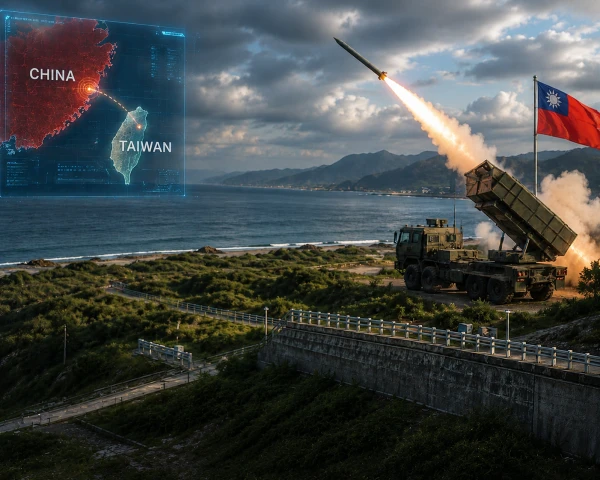
– The report broadly addresses our attitude towards Russia's war against Ukraine, but… China covertly or even openly supports this aggression.
The deputy proposed to adjust the position towards the PRC, making it “more precise and sharper.”
Andris Gobinš, head of the “European Movement in Latvia” society, drew attention to the long-term strategic vision of national diplomacy. He is also interested in “indicators by which we measure the success of our policy.” The public figure also wished for the Foreign Ministry to assist Latvian organizations in participating in EU network projects: “We are all, to some extent, ambassadors.”
As shortcomings of the Foreign Ministry's draft document, A. Gobinš mentioned the mention of Russia's interests, including restoring its influence on the European security architecture.
– Russia's interests are to restore the USSR. Diplomatic language may be different from what I just said.
“The EU's external border is at a slightly different level”
For her part, Baiba Braže spoke on the topic of closing the border with the Russian Federation:
– There is, of course, a history in three degrees. One – everything related to military infrastructure. The second – what relates to the border itself and its protection. The third – concerning communications through border points. Regarding civil transport, the government has clearly decided to close these irregular transports. 80 percent of the passing transport is cargo going not to Latvia, but to other EU countries. Therefore, this issue must be coordinated – both with the Baltics and with Poland.
By the way, B. Braže reported that, for example, Chinese supplies to Germany pass through the Latvian-Russian border. “These are matters that colleagues have long debated. What relates to closing the EU's external border is at a slightly different level. This is not only the Foreign Ministry or my opinion on one thing or another. This has consequences for all of Europe. These are the aspects of closing the border.”
– However, what the service has done is control the implementation of sanctions, – the minister spoke about the role of Latvia's diplomacy. – Implementation, strengthening, export licenses – all this part relates, of course, to us. It has been significantly strengthened. In this, as far as we were concerned, we have done our job.
China “has become Russia's largest supplier”
Thus, the head of diplomacy characterized the role of the Middle Kingdom. Although there is no information that Beijing supplies military equipment, the State Secretary of the Latvian Foreign Ministry, Andžejs Vilūmsons, raised this topic during his visit to China.
– Ukraine itself has talked about this, and other states have initiated it. And at the moment when specific information about Chinese companies trying to circumvent sanctions appears, they are included in the general list of European Union sanctions.
Despite such problematic partners, Latvia has neighboring countries with which relations are excellent. With a satisfied laugh, B. Braže said that she could prepare a separate message about cooperation with Lithuania and Estonia. This is more than just diplomacy: “Our internal policy, everything that happens, is also reflected there.”
Recently, significant changes have also occurred in the broader Baltic Sea region – namely, with Sweden and Finland joining NATO, “ensuring that we are all together in the strongest alliance in the world.”
Learning from Ukraine's experience
Now, in our region, there is a strategic turnover of information, involving decision-making by both the Baltic states and Poland (currently chairing the Council of Baltic Sea States), Germany, and Scandinavia. “Coming up with specific initiatives both within NATO, such as the creation of two missions – “Baltic Guardian” and “Sea Guardian”, in the air and at sea. Attracting the United Kingdom and other states.”
– We are also working a lot with the USA on information exchange, position coordination, and support for Ukraine, – shared Ms. Braže. Joint negotiations have also taken place between the American Secretary of Energy and the relevant structures of the three Baltic states. The experience of the fighting ally is being studied:
– What is happening now in Ukraine – decentralization, de-electrification. Their defense forces no longer want to be dependent on large energy hubs, as they are vulnerable to Russian attacks. This creates sustainability risks. I know that the commander of our Armed Forces is working to understand, for example, how we will solve such issues.
Who is slowing down the European Union
Since 2007, the minister reminded, unified Europe has lived under the shadow of the Lisbon Treaty – the basic document under which the decisions of European parliamentarians have direct effect. A kind of triangle has formed, two other vertices of which are the European Commission and national states. “Unfortunately, this often slows down the processes that we would like to implement faster,” – complained the Foreign Minister.
– For example, deregulation, simplification of all issues. Under the leadership of Mr. Dombrovskis, the European Commission has come up with a number of good proposals that we fully support, there are a total of 6 areas. But today the European Parliament has its own process and the decisions have not yet come into force. So there is tension… In the EU, meanwhile, there remain “nationally sensitive issues”: migration, external borders, including the Eastern border. The latter issue, believes B. Braže, should be considered in the context of Latvia's competitiveness. For their part, Southern European states are prioritizing migrants at sea.
Similarly, during trade negotiations with the USA, each EU state dealt with its own “protected sectors,” and the European Commission then had to make ends meet.
Forecast: what will happen next
As for modeling possible developments, according to the minister, “Russia will remain a long-term threat to our security. And this is something we recognize together with our NATO colleagues. This means prioritizing this issue in the daily work of both the central apparatus and all embassies.”
Baiba Braže emphasized the need for growth in Latvia's gross domestic product so that there is something to allocate 5% for defense needs. Based on this, the Foreign Ministry actively defends Latvia's economic interests in negotiations with America, supports EU-MERCOSUR agreements (South America), and other free trade agreements: “We will benefit from this.”
– The only area where we are constantly in the red is trade with China, – noted the minister. – Because China, of course, protects its domestic market, and there are problems for all EU states.
The Latvian Foreign Ministry is constantly in contact with local producers – the Metalworking Association, startup associations. Businessmen, for their part, participate in Latvia's activities in Ukraine. The organization “Entrepreneurs for the World,” the society “MARTA,” locally monitor the restoration of hospitals, shelters.
– This is invaluable assistance, – said B. Braže. However, the deputy chair of the Foreign Affairs Commission I. Kalniņa pointed out that “there are still many unanswered questions.” So the contact between deputies and the Foreign Ministry will continue.
As for peace negotiations around Ukraine, Ms. Kalniņa noted, “I quietly hope that we have a plan B.” In particular, the deputies of the Saeima continue consultations with colleagues from the US Congress. The deputy herself heads the inter-parliamentary groups of the Saeima with America and Canada and intends to publicly urge the leaders of other cooperation groups to explain the position of the Latvian Foreign Ministry to their colleagues from other countries.