
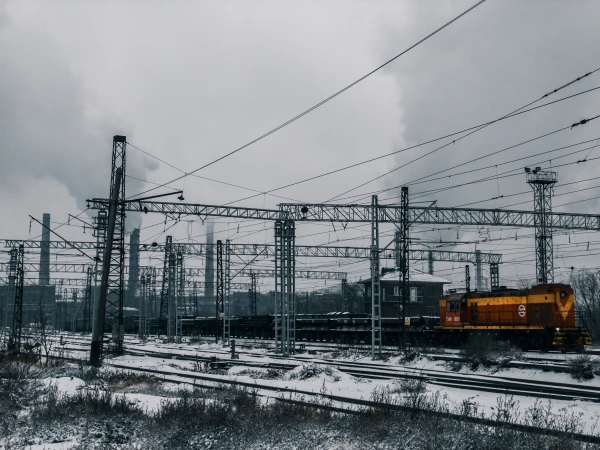
Should the tracks towards Russia be dismantled? This question was discussed this week on the TV3 show "Spēles noteikumi." The arguments of the participants included possible scenarios of how Russian troops might use the railway.
The author of the blog "Vara bungas" Martiņš Verdīņš modeled a possible scenario: "From the Pskov Airborne Division, soldiers are loaded onto about 60 platforms – that’s one train. Passenger cars can accommodate 400 soldiers, and at least 100 units of equipment can be transported on the platforms. A whole battalion with equipment moves at an average speed of 80 kilometers per hour – that’s very fast. The length of the train is kilometers."
He was countered by a discussion participant, former head of the Freeport of Riga and member of the board of the Latvian Association of Stevedoring Companies Leonid Loginov, who pointed out: such a train "can be blown up." He also asked the question – what is the goal of the Russian troops?
"What is their goal? Will these Russian soldiers run to Dome Square?" Loginov stated.
In turn, Verdīņš said: "The goal is to occupy territory. Not immediately, but that is their goal. As one high-ranking official said – I don’t have a crystal ball. Neither you nor I have a crystal ball to say – whether it will happen or not. But the situation as a whole pushes towards modeling even without a crystal ball."
Should the railway tracks towards Russia be dismantled? This is a question that concerns military experts and economists. The National Armed Forces (NAF) believe that every railway line physically connecting Latvia with aggressor countries poses a risk. The railway is a support for the Russian army, as evidenced by the war in Ukraine. Drones and artillery are a serious threat, but it is by railway that infantry units arrive to seize territory.
The Russian army has special railway units capable of laying tracks in a matter of hours. Therefore, effective dismantling requires tearing up embankments and taking other measures to restrict movement in the border area.
But is the time already right? There is currently no consensus in parliament and the government. Perhaps there is a lack of information. By the end of the year, working groups from the Ministries of Economics, Finance, Interior, and Foreign Affairs are to present their assessments, weighing all the "pros" and "cons."
The NAF already wants to reduce risks, but "Latvijas dzelzceļš" points out – dismantling the tracks will stop transit cargo.
Rail freight volumes in Latvia have decreased from 11.5 million tons in 2024 to 7.6 million tons in the first ten months of this year. Imports and transit from Russia and Central Asia accounted for a third of all freight in 2024.
Thus, dismantling the tracks towards Russia will affect certain cargo flows, but not the railway as a whole. For "Latvijas dzelzceļš," this will be a significant loss.
Proponents of dismantling point out: the railway is a support for the Russian army, allowing for the rapid transport of equipment and people. Security experts and the NAF state unequivocally – security must be more important than narrow economic interests.
Proponents of the opposing position note: dismantling will completely stop transit cargo not only with Russia and Belarus but also with Central Asia. This decision will have long-term economic consequences – even if the security situation in the region changes in the future.







Leave a comment