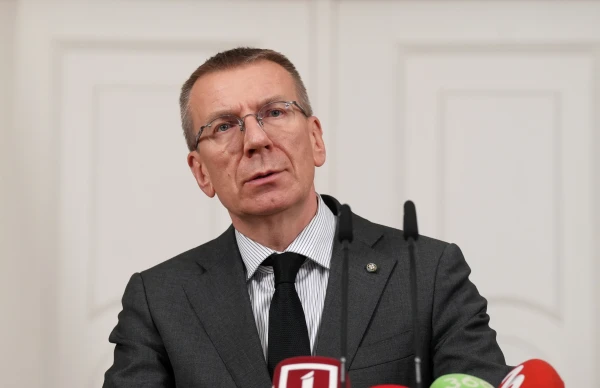
If the majority of Saeima deputies make the corresponding decision, the state budget for next year could be approved by the end of the week, said Latvian President Edgars Rinkēvičs at a press conference on Tuesday after a meeting at the Riga Castle with the Speaker of the Saeima, Daiga Mierina.
The President emphasized that the budget for the upcoming year clearly reflects three priorities he has been discussing since the beginning of the year: funding for security and defense, additional resources for demographics, and education. Rinkēvičs also highly appreciated the plans to allocate additional funding to address urgent issues in healthcare.
According to the president, the adoption of the budget is important for the state to start working with a new financial plan from January 1. Rinkēvičs mentioned that he discussed with the Speaker of the Saeima both the tasks that the parliament needs to accomplish by the end of the year and the work scheme for the first months of the next year - including the traditional foreign policy debates at the end of January and the bills that have sparked wide discussions, such as amendments to the labor law.
Mierina reported that 585 proposals have been submitted to the state budget bill: 481 from Saeima deputies, 89 from ministers, and 15 from the Cabinet of Ministers. The budget consideration will begin tomorrow, December 3, at 9:00 AM. However, given the volume of proposals received, the debate time will likely be reduced, she noted.
The Speaker of the Saeima emphasized that the parliament has made significant amendments to the budget draft, and among the proposals, important issues for the healthcare sector are now represented. Mierina particularly highlighted the Saeima's initiative to allocate 48 million euros for the construction of an oncology center - this amount has already been approved by the government, allowing the center to conclude a contract and continue the planned work. At the same time, she stated that it is necessary to additionally find another 12 million euros for equipment, as well as to provide funding for the outpatient department in the clinic, which is not included in the current budget draft.
Mierina noted that the government has committed to reviewing and reducing its own expenses in the medium term. According to her, the work on optimization will continue even after the budget is adopted, including an analysis of other state programs. The Speaker of the Saeima also pointed out that a proposal has been submitted to the parliament for the introduction of a so-called "zero budget," which implies a complete review of all state expenditures. In her opinion, this approach could be an important step towards more effective budget planning. Mierina emphasized that it is extremely important to assess whether the funded programs are achieving the goals that were originally set.