Sometimes it is hard for us to imagine the everyday life of people with disabilities, doomed not even by an unfortunate accident, but by fate itself, from birth — to be different. And age — it does not come alone, but with a bouquet of the most unimaginable diseases and sufferings.
As a member of the Social Committee of the Riga City Council, I visit specific institutions monthly, where only relatives of the residents usually come from the outside. Of course, if they have any — as it happens, a resident of the shelter may find themselves alone in the whole world...
A new kind of dormitory
But not everything is so gloomy, especially if the indefatigable mayor Viesturs Kleinbergs is leading the opening of the social house. In the previous council, he headed the Social Committee, and thus the honor of opening another investment project rightfully fell to him. What is, cannot be taken away — the mayor has specialized as a politician in social issues, moving on to a new level.
In this specific case, the cost of the built infrastructure is 2,425,840 euros, of which 2,061,964 was financed by the European Social Fund. Of course, it was not built in a vacuum — the location is well-known, on the border of Teika and Purvciems, where there used to be a local DGI for many years, and your author stood there in the 1990s for the first Latvian passport. I remember how I later rode on the trolleybus along Bikerņieki, looking at a wonderful color photograph where a red-white-red rim accidentally appeared near the sweater.
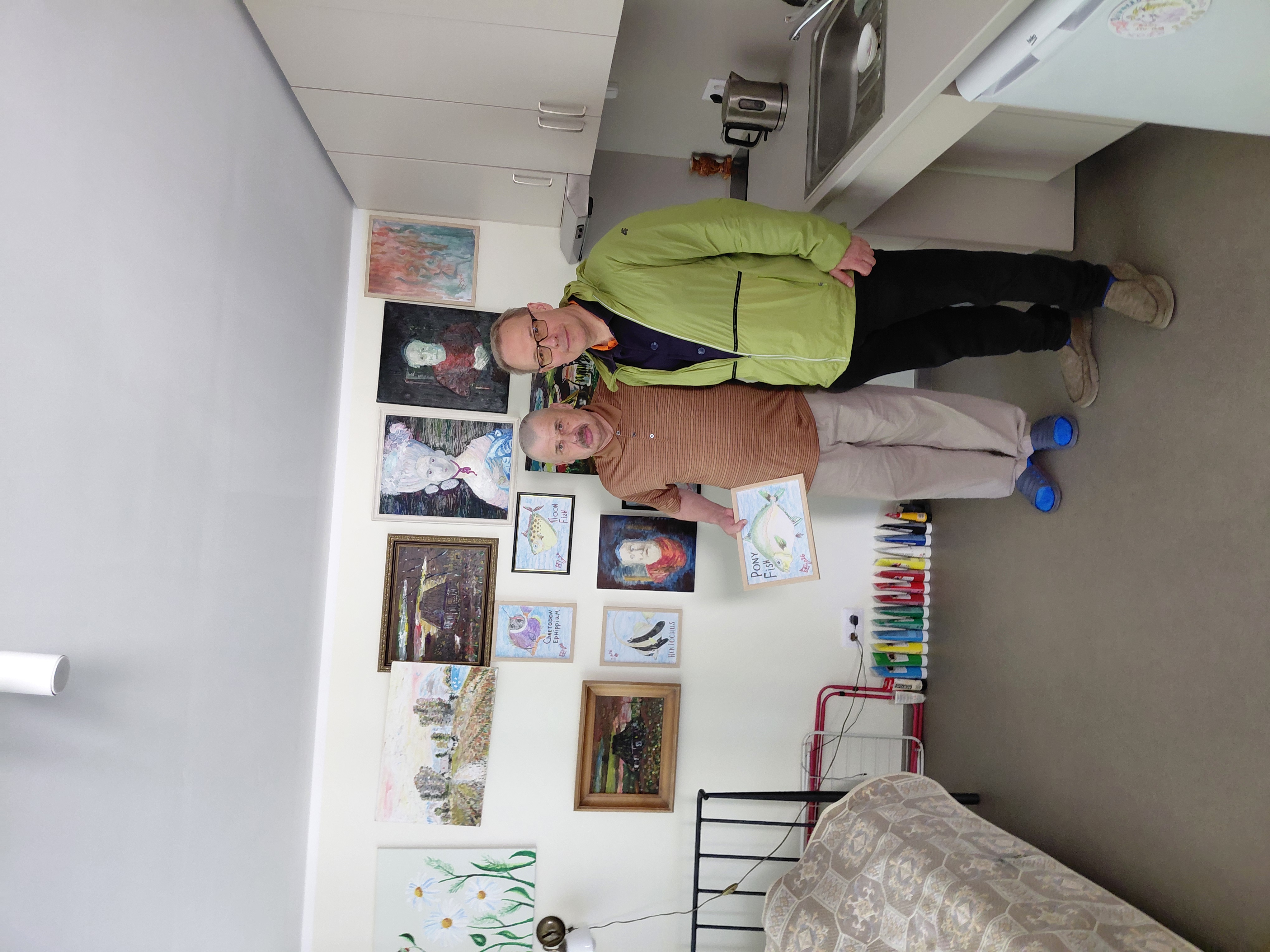
Igor paints pictures according to his mood, apparently good. Photo by the author.
Well, that’s the lyric, but in general, by the third decade of the 21st century, the former dormitory came in a literally shabby state — according to current workers, when they started the renovation, it was scary to enter, the floors sagged. They ended up tearing down everything except for the load-bearing structures. The result turned out to be splendid, right at a world level. Such a thing has not been seen in the Riga social sphere until now.
Again, it should be noted that the residents only settled here in April, and everything is still quite fresh. It doesn’t even smell like a person, there’s a scent of new materials and furniture everywhere. Yes, the head of the Welfare Department Inara Kondrate was right — it’s time to remove the stigma, the curse, from a person who does not look like us.
– We are all in the same boat, – she noted at the opening. – We are all human.
And as if to confirm this, from the opposite side of the street, a group of schoolchildren, who apparently were in a great mood at the end of the school year, shouted in unison, “Hooray!” This spontaneous display of feelings delighted everyone, it was almost a picture of “Lenin and the children.” Words of gratitude were also expressed to the bank that became the sponsor. In short, this log was carried by all of Riga.
It all starts with a stroller
It is immediately clear that you are not entering a nursing home by the entrance to the hall – there is a spacious room with a dozen strollers. This is because one of the target groups of the new center is young mothers. This function has been outsourced to the Latvian Evangelical Lutheran Church, which has a diaconate – a separate society, and the staff there are all highly educated, with excellent knowledge of the Latvian language, preferably Russian at a conversational level, as well as English or German. And the salary is 1,550 euros gross per month. The staff I saw were mostly young, modern people. With tattoos!
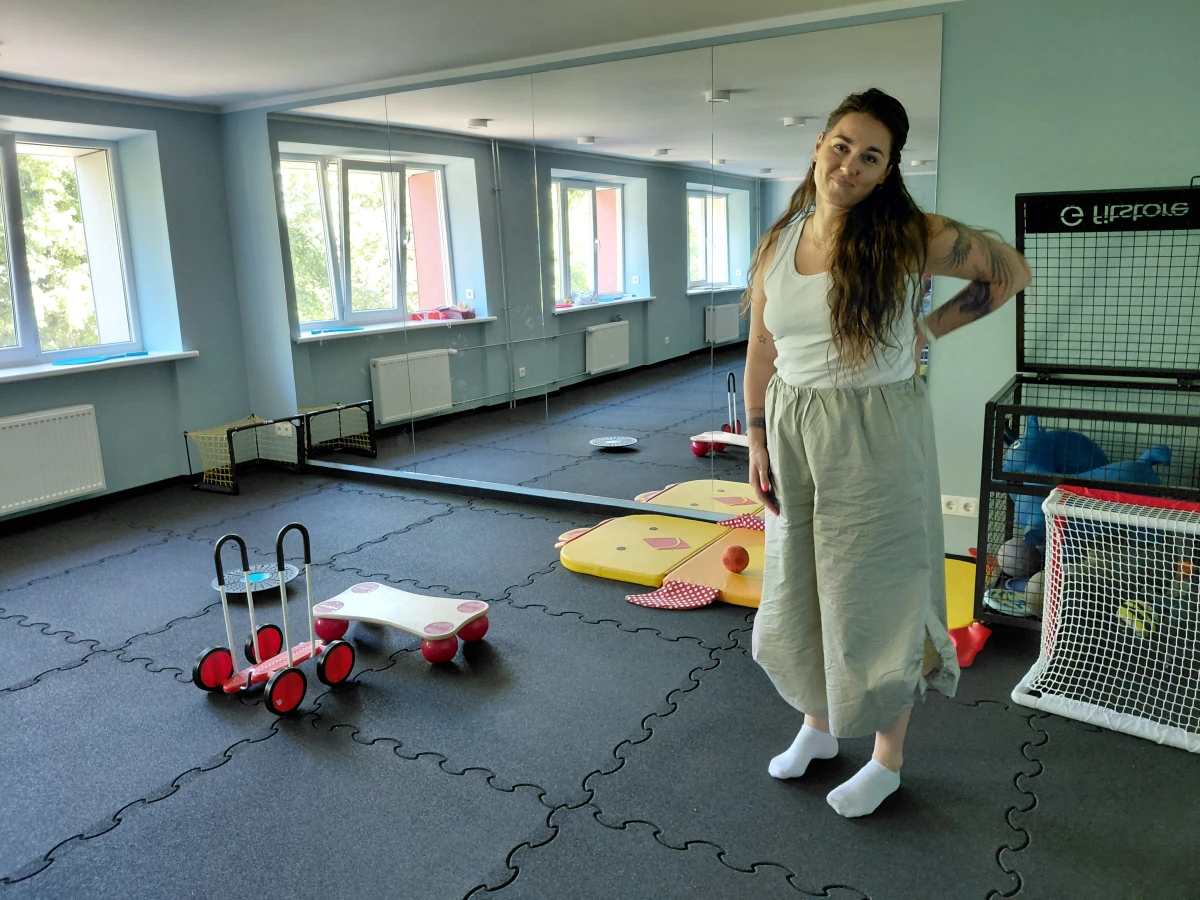
For mothers and babies, group and individual classes are organized here; just while I was there, a lovely Aiga was doing therapeutic exercises with a little boy – it was unethical to photograph him, so I took a picture of the social work honors student. There are about fifteen people working here, roughly one for each resident. The staff is present in the building on a 24/7 basis.
In the same building is the crisis center Burtnieks, owned by the Latvian Red Cross. Its clients are families with children, pregnant women, and single people who have found themselves in a difficult life situation. They provide psychosocial support, offer a safe environment, and if necessary – shelter.
The Red Cross helps in the most unusual dramatic cases: domestic violence, divorce, fire, leaving home without essential belongings. Unfortunately, all this can happen daily, statistically speaking, in a large city... For those who, unfortunately, are destined from birth to live only with the help of other people — the Red Cross assists in the most mundane skills, from cooking to handling a credit card.
Corridor system
Still, you cannot escape the original architecture of the building — these long corridors with doors on both sides... However, they have been mixed with excellent ornaments and drawings in the form of graffiti, only good-natured ones.
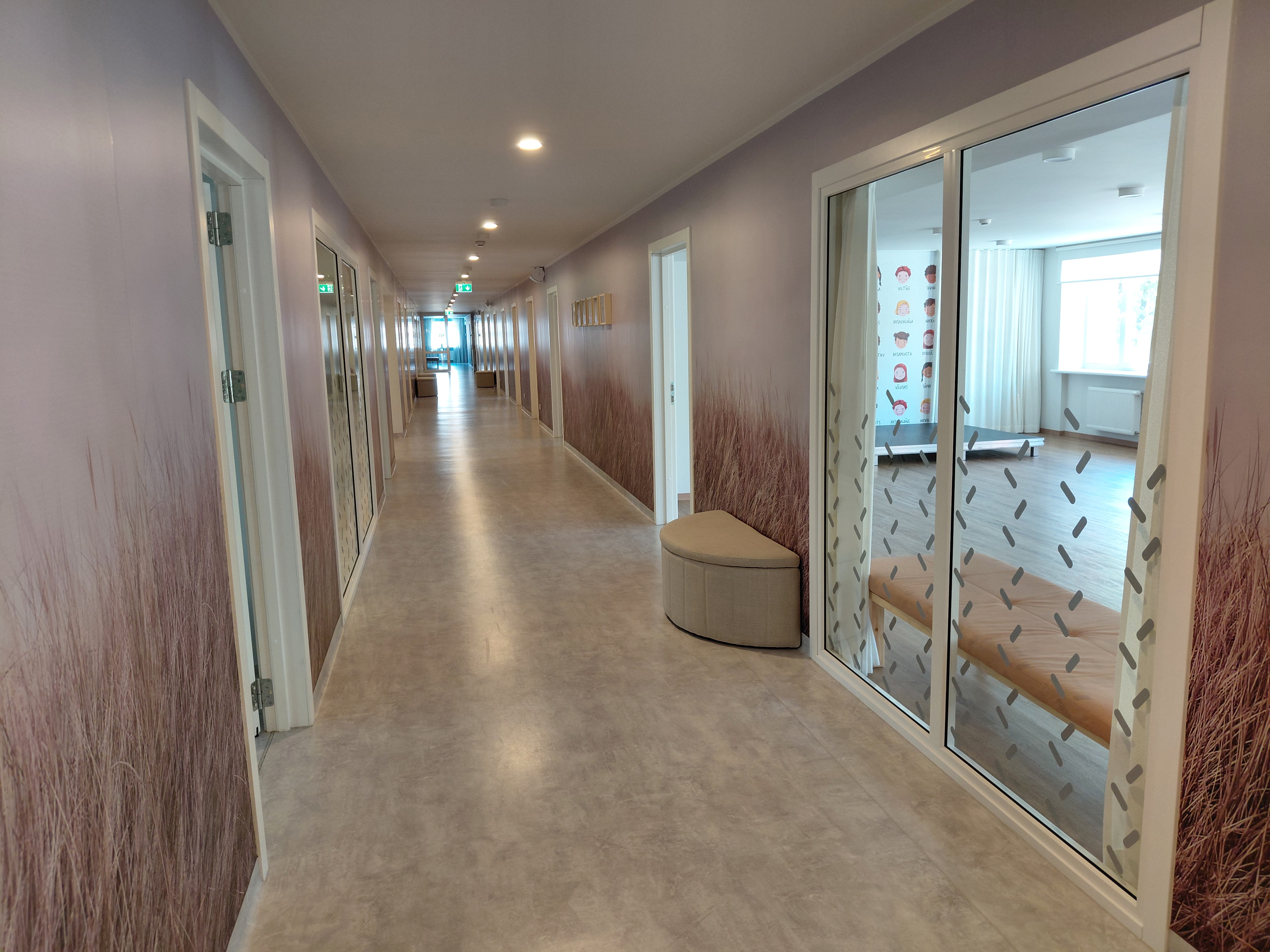
Modern comfort. Photo by the author.
The new appearance of the residents of the group housing is also emerging. If Kirill, who invited us to his “cell” (with modern furniture, a separate bathroom, and a luxurious television the size of half a wall with a game console), can be compared to a primary school student at his apparent thirty years, then Oswald, approaching retirement age, already resembles his peers in every way. He has a musical synthesizer in his dwelling. At the end of the corridor is the most colorful — Igor, a naive artist. He has very nice intelligent fish on neat canvases. As he explained to me, he did not graduate from any academy or school — he paints as he sees. A self-taught artist!
As the head of the Riga Social Service Maris Moors told me, all the residents of Burtnieku 37 — about 12 people — are legally competent individuals, have documents, and some even work officially. Under the “Inclusive Employment Activities” program, which is scheduled until June 2028, Latvia has allocated 43.5 million euros from EU funds for subsidized jobs. The target audience is the employment of the unemployed, people with disabilities, and economically inactive residents.
The former premises of the immigration office have been transformed into glazed recreation areas. There are common spaces for games, reading, and gymnastics. And outside, they also have a modern physical activity area in the fresh air.
After leaving the bright house in a good mood, I went back on the trolleybus. At the stop, a group of notorious Latvian homeless people was passing around a 0.7 – not even suspecting that nearby social problems are being solved thanks to modern scientific achievements and funds from Brussels. However, the queue for this institution can still be 18 years long – and unfortunately, there are currently no free places.