Recently, a call circulated in the media that resonated in the soul of your correspondent as a beautiful but distant echo of the past. It was then, in the early 90s, at the dawn of the establishment of an independent state, that we, like other media, actively promoted the slogan 'Choose Latvian products.' Then, consumer patriotism was subtly replaced by consumer globalization: the local market was literally flooded with imported goods — varying in quality, but very often more advantageous in terms of price.
And now, years later, the familiar call has sounded again; it was voiced by the chief economist of Citadele Bank, Karlis Purgalis, and picked up by many media outlets: if residents choose local products, it will benefit both the state budget and our common well-being.
Interestingly, Citadele Bank itself is owned by Americans. Perhaps economist Purgalis should have started with himself and chosen a Latvian bank? And only then advise the population to buy local cucumbers and tomatoes?
However, let’s return to his patriotic appeal:
"Residents of Latvia spend about 2.9 billion euros on food each year, and this amount continues to grow every year. However, data for 2025 shows that products from local Latvian producers accounted for only about 1.2 billion euros of this amount, which is less than half. (…) By buying local food products, money stays in the Latvian economy — businesses pay salaries, invest in development, and create new jobs. This is a 'smart choice,' as the buyer receives a fresher product with a shorter logistics chain, while ensuring that money stays in the Latvian economy rather than flowing to foreign companies."
According to the calculations of this homegrown economist, such product patriotism could bring an additional 330 to 570 million euros to the Latvian economy each year, while simultaneously creating up to 13,000 new jobs and replenishing the state budget by 78–136 million euros.
Well, the guideline is set: I head to one of the well-known supermarkets, grab a basket, and enter the sales floor...
This is from Sweden, and this is from Greece...
The first thing on my path is the shelves with non-food items. I approach the stand with socks (not food, but still necessary). The selection is huge, and the ratio of manufacturers is as follows: Turkish — 6 names, Latvian — 5, Italian — 3, Portuguese — 1, Chinese — 46. Despite my pangs of conscience, I choose imported ones — due to the variety, I manage to find what I need among them...
Flowers are not needed at the moment, so I just glance at the price tags, which indicate the country of origin. Here, the undeniable leader is the Netherlands, though with some products from Poland. I only notice Latvian flowers in the distance, in tiny pots. Perhaps somewhere Latvian flowers are presented in all their beauty and splendor, but here, if you need a bouquet — for some festive event, for example — consumer patriotism will not manifest even with a very strong desire...
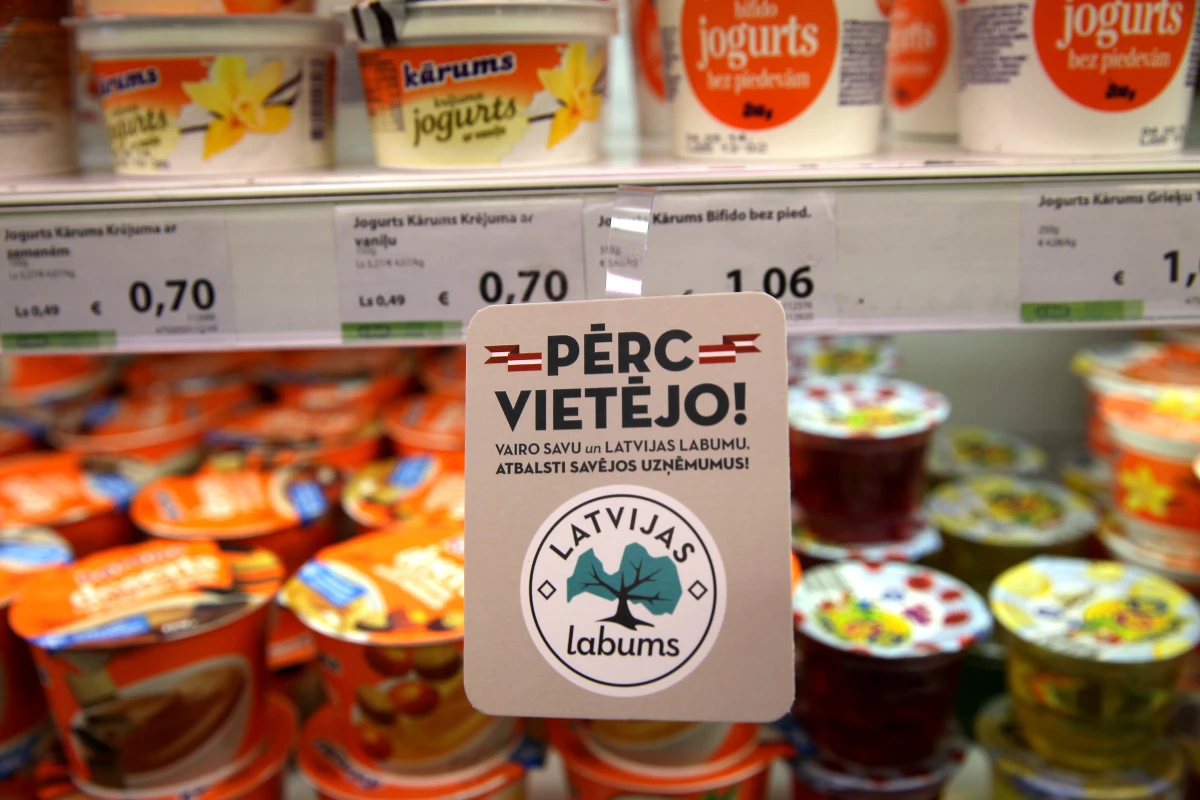
The next destination is the dairy section: here, Latvian producers successfully compete mainly with Estonia, Poland, and Lithuania. It is striking that prices for the same product are more or less the same — moreover, some imported products are offered on sale, making them cheaper. That is, a product produced abroad and brought to Latvia (and transportation these days is not cheap), for which all taxes have been paid, can even cost less than our domestic product. However...
The meat section, on the other hand, is pleasing to the eye — here it is indeed not difficult to choose Latvian products (although there is plenty of imported goods, some even cheaper due to sales). But we are patriots, right? — a pack of locally produced chicken fillet goes into the basket...
The vegetable section. So, what do we need here? Tomatoes? Here they are — red, yellow, even black, on the vine and off, packs of “cherry” — my eyes are racing. Among the producers, the “palm of victory” clearly belongs to Spain, with the Netherlands in second place. I also notice Belgian and Moroccan tomatoes... And finally, here are our Latvian ones! Only if the ones produced in the Netherlands are offered on sale for 2.29 – 3.99 euros per kg, ours are priced at 5.99. Guess what a consumer with an average or lower income will choose?
The situation with fresh cucumbers is simpler: here, as they say, the balance is clearly in favor of Latvian producers (which is pleasing). However, with potatoes, there is a problem: Latvian ones are cheap, but the quality... I choose young Greek ones, even though they are several times more expensive.
Carrots: according to the information on the price tag, they are imported from Egypt. There are young and beautiful ones, packaged — from Italy. It puzzles me that this product seems not to be exotic: carrots can grow in our regions. Why is it profitable to plant them far away, bring them to Latvia, and sell them — already slightly wilted and sprouting some white whiskers — instead of producing this quite in-demand product locally and keeping it until the new harvest? The same question arises next to a stall filled with apples: why, in a country with so many apple orchards, does trade offer us nothing but imports for years?
...So what do we have for dessert? On the shelves with cookies and wafers, Latvia is represented quite well, but the undeniable leaders here are Poland, Lithuania, and Ukraine. Less frequently, but there are treats from the Czech Republic, Finland, and even from distant Vietnam.
In the candy section, I am greeted by a surprise bordering on a trick: on the magnificent stylish boxes of chocolate candies, I see our native brands “Laima” and “Prozit,” but the price tag indicates Estonia as the place of production! That is, if you want to benefit the economy of Latvia specifically, you also have to consider such possible “underwater rocks”...
I conclude my mini-tour of the sales floor in the bakery section. Well, here everything is simple: the selection of Latvian products is wide and varied. Glancing at Polish and Swedish delicacies, I patriotically settle on a local loaf...
How much does patriotism cost
It should be noted that there is a clear predominance of imported goods (specifically food products — this is what we are talking about) observed in the stores of almost all retail chains that I visited not just as a consumer, but specifically as a consumer aimed at choosing Latvian products.
Further study of the issue — already at a higher level — only confirmed: if we consolidate what has been published at different times by various respected institutions — such as the Competition Council (market analysis of food products by prices and differences between local and imported goods) — the problem boils down to the following. Despite the fact that Latvian food products are not inferior to imported ones in quality (tasty, fresh, without “chemicals”), in terms of cost, they seriously lag behind not only large producers from Poland, Germany, Turkey, or China, but often even from our Baltic neighbors.
A small market and limited production scale, expensive energy, a heavy labor tax by the country’s standards, and other factors — all this significantly reduces the competitiveness of Latvian products, forcing local consumers — especially those living paycheck to paycheck — to choose products based on cost rather than patriotism or even quality.
So, calling on consumers to choose Latvian products can be done and probably even needs to be done. However, until Latvian producers receive real support, until conditions are created in which it will be profitable for them to produce what can be produced in Latvia in principle, and for consumers to buy exactly what is produced in the country rather than a similar imported product — these calls will most likely remain just calls...