
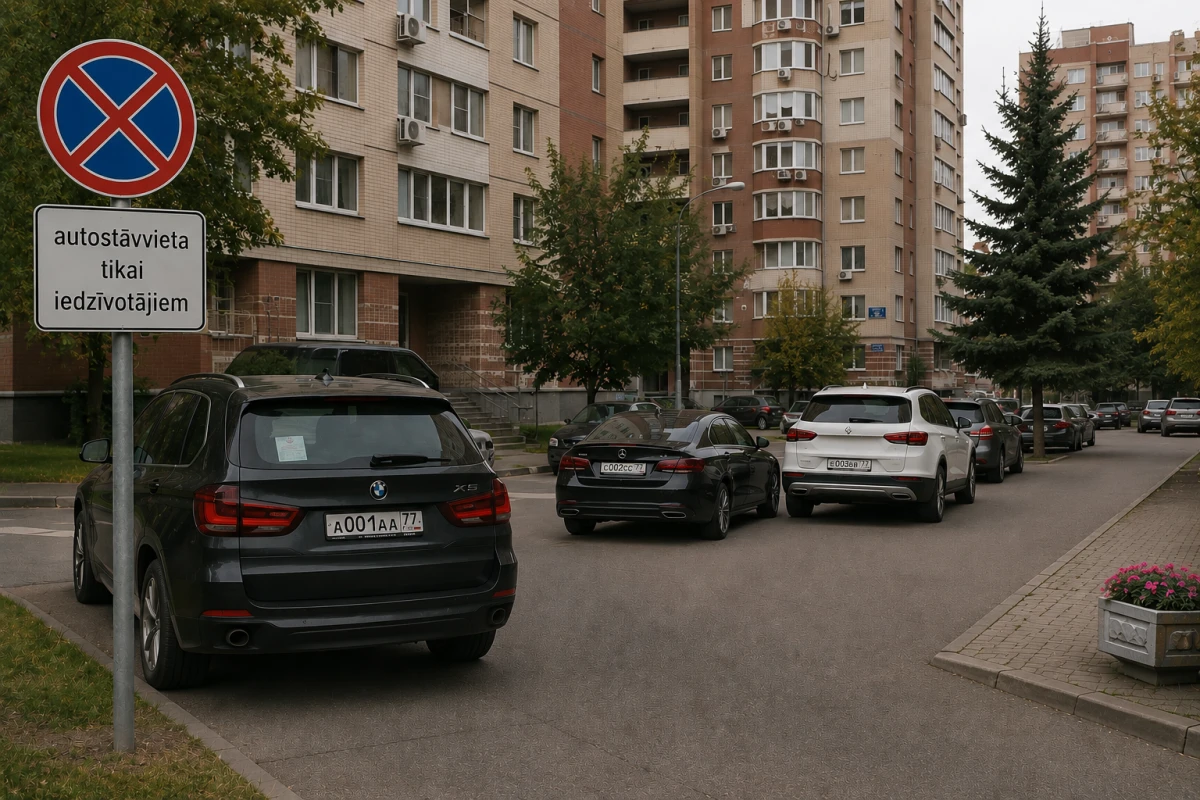
“In due time, a sign was installed in the yard of our house, which is serviced by the Riga house management "Rīgas namu pārvaldnieks" (RNP), at the initiative of the residents, allowing cars to be parked here with special permits. There were two types of permits — for a specific number and simply with the inscription "Viesu" (Guest), which the apartment owner could give temporarily as needed - for example, to a person visiting, a technician called to repair household appliances, etc. Such a permit had a validity period of one year.
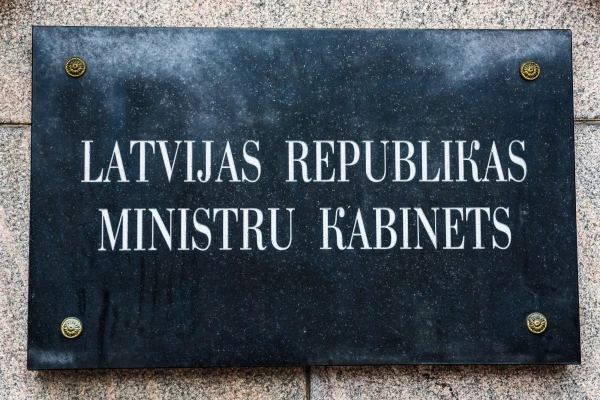
Recently, I went to extend the guest parking permit at my Ziemel’s branch of RNP, but I was told that guest permits have been canceled, and now only permits issued for a specific vehicle with a license plate are valid. The employees themselves agree that this is absurd — however, this is the order prescribed by the new Cabinet of Ministers' rules.
It turns out that if before your guests could easily leave their car under your windows and simply place a "Viesu" permit under the windshield without any worries, now the police can arrive at any moment and fine them as violators?! Why were guest permits canceled? A reader of the bb.lv portal.
Answers from the head of the marketing department of "Rīgas namu pārvaldnieks" Anniya Laizane:
– Indeed, the changes are related to the new rules of the Cabinet of Ministers, which stipulate that parking permits must be tied to a specific vehicle license plate. Until now, the police checked whether there was a valid parking permit issued by RNP under the windshield of a parked car in the yard. From March 31, the police no longer check for such permits — instead, they check whether information about a specific vehicle license plate was previously provided.
Thus, universal "guest permits" that could be used for different cars no longer comply with the new procedure and cannot be used in their previous form.
At the same time, we understand that guest permits are important for our clients, so we are currently continuing discussions with the relevant institutions about possible solutions so that this approach could be maintained in Riga in the future. In our opinion, this decision should determine the general order applicable throughout Riga and the industry as a whole, so it is important to create a unified model.
Since the amendments were adopted on March 24 of this year and came into force on March 31 without a transitional period, RNP did not have enough time to fully prepare for the new order and coordinate solutions with all stakeholders.
From the editorial team: At the end of the comment, the RNP representative noted that the municipal police check cars parked in the yard only at the request of residents, not on their own initiative. However, let’s imagine a situation: in an apartment building, a guest arrives at apartment owner A and parks in the yard, while the other apartment owners in the same building do not know whose car it is: there is no guest permit under the windshield, it is unknown whose car it is and on what grounds it is parked here. They call the police, and the guest of resident A receives a fine… How to avoid such situations? And how will the police now determine who is a truly "legitimate guest" and who is a violator?
The chief communication specialist of the Riga municipal police communication group Ieva Lukaza-Apalupa provided the following clarification:
– If the guest parking permit is placed in a visible location inside the vehicle (on the dashboard), the police will check whether it is indeed valid, as before. Conversely, if there is no such permit physically in the vehicle, the algorithm of actions will be the same as in situations when the police receive a call regarding parking permits issued to residents of a specific building. Specifically: it will be the police's obligation to prove that such a permit is indeed absent.
This can be proven in the following cases:
-
The manager is present at the call site — in this case, a representative of the management company responsible for issuing permits, who confirms in writing that the specific vehicle does not have a parking permit (for example, by providing relevant testimony);
-
The building (or road) manager has previously provided the municipal police with a list of specific vehicles and their state registration numbers that have been issued parking permits for a specific location.
If this information is not provided to the police, the violation cannot be proven — accordingly, the fine is not applied.
However, it is important to understand that it is impossible to foresee all situations in advance. Thus, if other evidence is provided as a result of clarifying the circumstances, or the totality of circumstances clearly indicates that there is indeed no parking permit (i.e., a violation does occur), a corresponding decision is made. A single action plan for each situation cannot be predetermined in advance.
At the same time, the municipal police are already working to ensure that a clear requirement for displaying the parking permit in a visible location inside the vehicle is enshrined in the regulations.








Leave a comment