The end of April brought the first spring mushrooms to lovers of quiet hunting. Many of them fall into the category of conditionally edible and can pose a serious threat even after culinary processing. In some cases, families of cap mushrooms can cause severe poisoning, even leading to death. How to avoid a fatal "catch"?
“Fugu fish” in the world of mushrooms
Mushroom pickers rejoice at their full baskets of forest gifts. In spring, wrinkled caps appear in the meadows — morels, which city dwellers go out to hunt. For Italians and French, these mushrooms rank second after truffles, and in the USA, they sell for $150 per kilogram. However, despite the special interest in them, many are unaware that, in addition to their unusual aroma and taste, they may contain dangerous toxins.
“They contain a substance called gyromitrin — a poison that causes convulsions, damage to the kidneys and spleen, as well as disturbances in oxygen transport to tissues and the development of hypoxia. The toxin can be destroyed with proper thermal processing: well-washed mushrooms should be boiled at least three times,” says gastroenterologist Maria Abakarova.
If this is not done, the first symptoms of poisoning will appear ten hours after consuming the delicacy. And although morels usually do not lead to fatal poisoning, they can cause dizziness, vomiting, and various allergic reactions. In severe cases, loss of consciousness and jaundice, which indicates liver damage, are possible.
“For some people, morels are dangerous even when cooked. For example, those with gastrointestinal diseases, pancreatitis, kidney failure, low hemoglobin, and poor blood clotting should avoid consuming these mushrooms. Restrictions also apply to pregnant women and children under five years old,” the doctor adds.
According to the expert, to help the digestive system cope better with the load, it is recommended to consume no more than 200 grams of morels per day.
“Despite their drawbacks and nuances in preparation, these mushrooms have a rich chemical composition. They contain polysaccharides that stimulate the production of white blood cells to fight infections. Morels also contain potassium and magnesium, which can strengthen joints and blood vessels. Antioxidants, which slow down cell aging and protect them from damage, are also beneficial. Additionally, consuming these mushrooms is good for the visual system. Due to glucose, rhamnose, and N-acetylglucosamine, metabolic processes improve, the eye muscle strengthens, and lens clouding is prevented,” says Abakarova.
The beneficial properties of mushrooms are also noted in pharmacology. For example, extracts from morels are used to make medications for cataracts, glaucoma, myopia, and hyperopia.
A stranger among their own
The spring forest delights mushroom pickers not only with morels. Earlier than them, strogons appear on the edges — their short-legged “twins.” Lovers of quiet hunting often confuse these species due to their external similarity. It is also difficult to distinguish them because they grow in practically the same places.
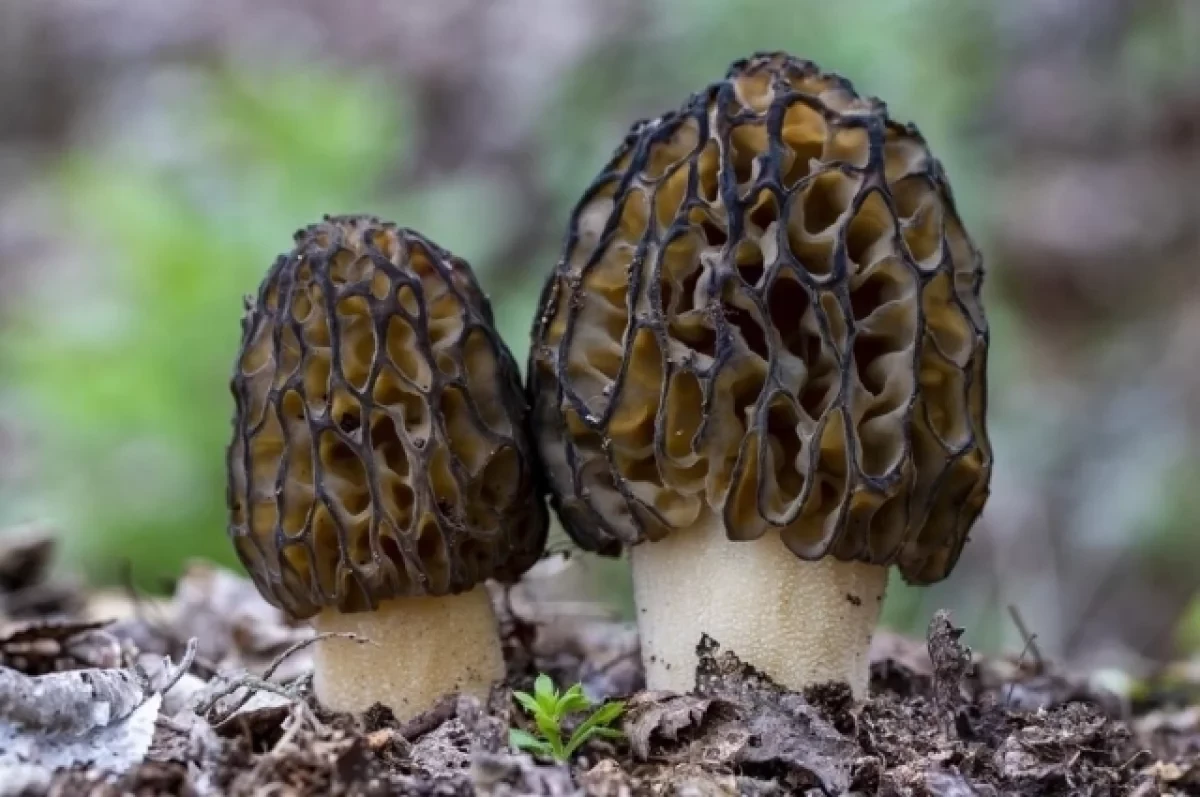
“They often grow in groups. You can find them in young aspen groves, on old burn sites, clearings, and areas with high humidity: ravines, ditches, and former peat bogs. In their raw form, strogons are lethally poisonous, and even processing does not make them completely safe, so experienced foragers avoid them. To avoid confusing these species, pay attention to the mushroom stems: strogons have short stems, sometimes barely visible, while morels have cylindrical stems, slightly widened at the base,” says mushroom picker Nikolai Vasilyev, who has seven years of experience.
The surface of the caps also serves as a guide: strogons have a wavy, convoluted surface resembling a walnut. The cap of a morel resembles an egg with uneven, wavy cells. Its color is brownish, occasionally gray.
“Ash-colored morels grow in areas of forest fires. In cross-section, such a mushroom is distinguished by its meatiness, but due to the rarity of the species, it is not recommended to use it as food,” shares Nikolai.
By the way, boiled morels often become a seasonal item on restaurant menus. Typically, they are used to make sauces, mushroom caviar, various soups, and fillings for pies. Lovers of quiet hunting often dry or freeze them for the winter.