
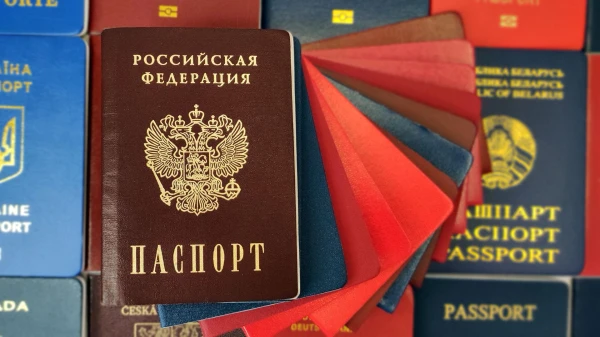
20 years ago, my young wife received both a Latvian passport and a marriage certificate. And prior to that, she renounced her Russian citizenship, which she had taken "from non-citizens"—to study at a university in Moscow.
Although in the first decade of the 21st century nothing indicated a large-scale war in Eastern Europe, we already had an incident in Vilnius airport after a fun flight from Tenerife. The flight was simply delayed for several hours, and the transit Lithuanian visa for one day expired. My future wife had to spend several hours in the airport's isolation area while I proved that she was not an undesirable foreigner, but was actually heading home to Riga...
The Ministry of the Interior is tracking passport trails
The fact that a conflict between Moscow and the West is inevitable sooner or later has always been an a priori reality for me. Because of this, I sent the future mother of my son to naturalize—not out of greater patriotism, but simply for convenience. To avoid multiplying unnecessary troubles beyond our control.
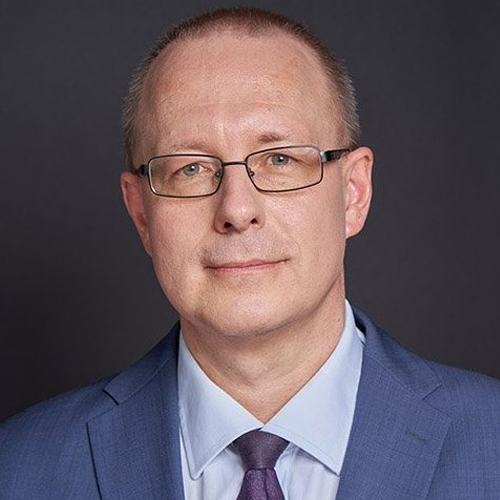
However, due to various life circumstances, thousands of residents of our republic now hold passports from both Latvia and Russia. Recently, the issue has concerned a subcommittee of the Saeima on internal security. It is led by a very concerned citizen—Edvins Šņore, elected to parliament from the National Alliance.
The chairman initially noted: some of our "dual citizens" hide this fact! A representative of the Latvian Ministry of the Interior, for his part, indicated that law enforcement has its methods for identifying such individuals. But he also showed some secrecy, stating that the methods of detection would only be discussed in a closed part of the meeting...
Every year, there are more of them!
Of course, primarily, those who hold citizenship of another state alongside Latvian citizenship are those connected by life to NATO ally countries—Great Britain (over 13,000), the United States (over 10,000).
The attitude towards Israel is somewhat less clear-cut now, as about 6,000 people hold its passport alongside the Latvian one. And Russia! It would seem that the interstate climate does not contribute, but here’s the paradox: while in 2014, 1,309 people had dual Latvian-Russian citizenship, by 2026, this number had risen to 4,231 (which is more than those who simultaneously hold passports from EU countries such as Germany, Ireland, Canada, and Sweden).
The Ministry of the Interior believes this can be explained by the choices of parents who provided their child with dual citizenship. The motivation can be very diverse and subjective! Upon reaching the age of 25, these individuals must choose which country's citizenship they wish to retain. Failure to comply with this requirement may lead to the loss of Latvian citizenship.
Accounting and Control
Currently, 2,436 individuals with dual Latvian and Russian citizenship reside permanently in our republic. In the age group from 1 to 17 years, there are 1,483 individuals, and in the group from 18 to 25 years—510 individuals. This opportunity arose in October 2013—one could say, at the sunset of the "reset" in bilateral relations.
There are 1,038 individuals with dual Latvian and Russian citizenship living abroad who are under 17 years old, and 288 individuals aged 18 to 25. This is also the largest group of individuals with dual Latvian and Russian citizenship living abroad.
In 2014, 129 individuals renounced their Latvian citizenship and acquired only Russian citizenship, in 2017—200 individuals, and in 2025—15 individuals. In turn, Latvian citizenship was revoked by our state in 23 cases in 2014, in 116 cases in 2017, and in 166 cases in 2025.
Would be happy to serve
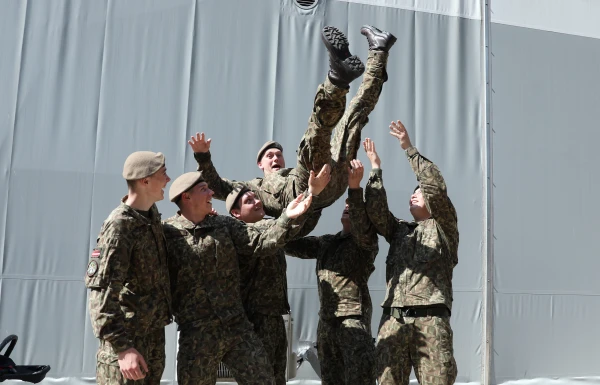
A separate question is how to protect the Latvian army from Russian citizens?
Parliament member Jānis Dombrava (National Alliance) expressed interest in the Ministry of Defense's plan to allow a deferment of military service until the age of 24 instead of 26, as it has been until now. He expressed concern that some individuals would intentionally choose dual citizenship—to avoid military service! Kristers Grauze, director of the Defense State Service Department, acknowledged that he "understands the concerns." But he reassured: the proposal is not related to citizenship issues but is based on experience with military service deferments. Specifically, a conclusion was made regarding the ineffectiveness of the initially established age limit.
He noted that until now, there has only been one case where a conscript was denied after selection (which is done by random sampling) because he also held a Russian passport. Mr. Grauze explained that in the two previous selections, the proportion of individuals with dual Latvian and Russian citizenship was approximately 0.55%.
A stranger among their own
However, even with "single" Latvian citizenship, there may be cases where a young person has ties to Russia, such as studying and attending courses, or visiting relatives. Upon receiving such information, the Military Security Service conducts an assessment. Over the past two years, there have been six such cases, and in all these cases, it was determined that the young person "does not meet national security interests"...
When sending summons to young people, military authorities carefully check all data, the Ministry of Defense official emphasized again. "If we find that an additional address in Russia appears—that's one signal. The second is when the summoned individual informs us during communication."
– We have a Law on the Circulation of Weapons, and there are no exceptions, – Edvins Šņore mused aloud. – You are a dual citizen, with a Russian passport, you can act with a weapon in hand. In my understanding, this contradicts...
The parliamentarian from the National Alliance expressed the opinion that the ownership of weapons for dual citizens should be reconsidered. This would be "quite adequate." Meanwhile, the current practice of the Ministry of the Interior suggests an individual assessment of "weapon bearers," and an individual may not receive the corresponding permit if something about their identity appears suspicious.
However, this also applies to individuals who only have one Latvian passport—even those elected as deputies! Where will they shoot?
In general, the Ministry of the Interior believes that if necessary, the principle of equality before the law may be limited—but there must be compelling reasons for that. Obviously, in the opinion of law enforcement, it is still too early to smear all citizens of Latvia who also hold a Russian passport. In any case, as was said at the meeting—"a debatable issue"...
Moreover, in civilian circulation, we have self-defense weapons as well as hunting weapons—not automatic ones.
In any case, Edvins Šņore clearly remained dissatisfied with the privileged position of those citizens of Latvia who are also Russians—who do not have to serve in our army. But there is another catch: the draft is up to 27 years old. So, Jānis Dombrava noted, it is possible that a former dual citizen may be called to serve. However, the Ministry of Defense does not see major problems here.
SERVICE IN RUSSIA
Citizens of Russia who also hold Latvian citizenship are called to the Russian army on general grounds. In Russia, they are considered exclusively as citizens of Russia, and having a second passport does not exempt them from military duty if they reside in Russia. Mandatory service in another country also does not exempt them from service in Russia.






Leave a comment