
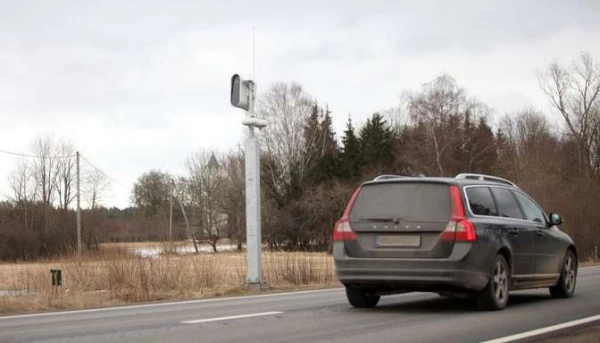
Since April, new traffic control devices have appeared on the roads of Latvia next to photo radars — these are stationary video cameras installed at 23 different road sections.
Similar to the familiar speed control radars, these devices will now record violations such as lack of insurance or technical inspection, reports TV3 News.
One of the areas where the new camera has started operating is the Riga ring road. It is installed in a location where a road meteorological station already operates. The camera itself is small in size, so it is not easy to notice, however, a warning road sign — "Control Device" — is placed in front of each of them.
For a driver who follows traffic rules and has, so to speak, "all documents in order," these video cameras will not change anything. However, forgetful or negligent drivers, coming into the view of the cameras, risk receiving penalty notifications.
These cameras do not record speeding, but they identify and automatically impose fines for other administrative violations.
This includes the absence of an OCTA policy, lack of a valid technical inspection, use of a vehicle not registered in accordance with the established procedure, as well as the absence of a vignette on sections of the roads where it is mandatory.
The head of the Road Traffic Safety Management Bureau of the State Police, Sabine Irbienieca-Cesle, explained:
"The placement of technical devices is aimed at increasing road traffic safety by disciplining drivers. The locations for installation are not chosen randomly — they are determined based on statistics, traffic safety data, and traffic flow intensity. These are the main aspects."
In total, new control devices are installed on 23 road sections, covering all regions of Latvia and roads of varying significance. This means that avoiding responsibility, for example, when driving without OCTA or a technical inspection, will become more difficult. At the same time, the cameras can also assist in investigating other offenses. The police also emphasize that alongside stationary photo radars, these devices facilitate their work, allowing more resources to be directed towards road patrolling.
"Accordingly, we can direct personnel to traffic control — identifying drivers under the influence of alcohol, ensuring speed compliance, as well as aggressive driving," noted Irbienieca-Cesle.
It should be reminded that if violations are recorded by technical means, the fines are quite high. For example, for the absence of an OCTA policy, if detected by a radar or video camera, a fine of 350 euros is automatically applied. Last year, immediately after speeding, driving without insurance was the most common violation recorded by radars — over 7,000 such cases were registered.













Leave a comment