
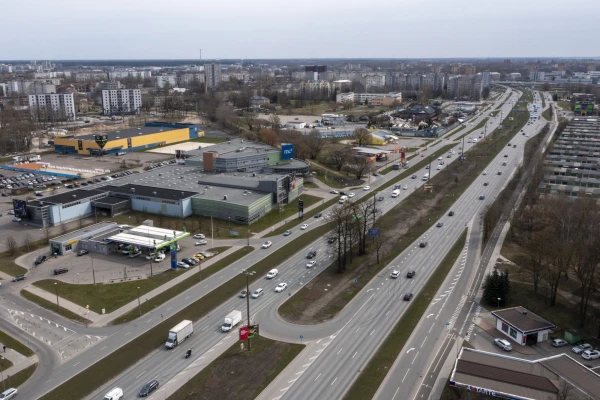
Driving on Krasta Street causes some confusion for many — especially in places where two streams seem to converge at one point. From the outside, it looks simple: one wants to turn left, the other — right, but the question remains — who has priority?
In fact, such places are designed for smooth traffic flow, not for someone to necessarily 'win' and go first, reports the Zebra program (TV3).
There is a so-called 'lightning principle' in effect here. Initially, traffic is regulated by a solid line — as long as you are in front of it, there is no discussion, you cannot cross the line. When both vehicles are behind this line, everything transitions to a normal lane change mode. And there, the classic rule applies — the one on the right has the advantage. But in practice, it is not so straightforward, as often both drivers move simultaneously.
Therefore, in practice, what matters is not 'who is right', but how both drivers play out this situation. A good principle, which Zebra calls the 'quick lightning' — is not to drive closely side by side, but to leave space, slightly adjust speed, and allow the other to merge into the flow. Then the movement becomes smooth, without sudden braking and unnecessary stress. As soon as someone starts to stubbornly press the gas just to get through first — that is when problems begin.
Interestingly, a similar logic works in other places as well, for example, on narrower streets where there is formally one lane, but in fact, traffic moves in two rows. There, it is also based on a simple principle — when changing lanes, yield to the one who is already next to you.
Ultimately, it all boils down not so much to the nuances of the rules, but to the culture of driving. If everyone thinks not only of themselves but also of the overall flow, even the most complex sections can be navigated calmly and without unnecessary stress.










Leave a comment