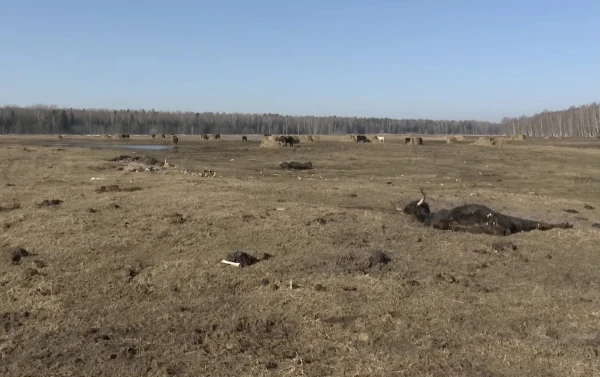
79 dead animals have been found in Kemeri National Park. Some public activists blame the Kemeri National Park Foundation for their deaths. Foundation leader Andis Liepa rejects these accusations and claims that most animals died of natural causes.
In an interview with nra.lv, Liepa pointed out that a significant portion of the animals died of old age, while some perished due to the harsh winter.
"In the autumn, there were about 230 aurochs and horses in the meadows. Severe frosts intensified the natural process of animal deaths. Short-term cold does not harm the animals, but prolonged and severe frosts are dangerous for them," he explained.
He also noted that a conflict has arisen around the situation between activists and the foundation's management.
"There is a group of activists who obviously want to sink the foundation. They follow me, travel behind me, but do not specifically say what they want. Publicly, there are only accusations that I allegedly do not help the animals," said Liepa.
According to him, the care for the animals is carried out according to a program developed initially. The animals are regularly fed, and hay and silage are delivered to the meadows. "Yes, this year the hay was not of the same quality as in other years because the summer was cold and rainy. But the silage, although more expensive, was very good," he noted.
Liepa explained that dead animals are usually not removed from the area as they serve as food for predators.
"As a rule, we leave the fallen animals in place — they are eaten by wolves and eagles. It is currently being discussed whether such a number needs to be removed. But it is difficult to get there now: the meadows are washed out by spring waters, and the equipment may damage them," said the foundation leader.
He added that previously dead animals did not cause public resonance as they were behind a fence and hidden from visitors.
"Now people specifically crawl through the fences to photograph the dead animals," noted Liepa.
He separately pointed out the long-standing conflict surrounding hunting in the national park. According to Liepa, hunting collectives rent the territory of Kemeri National Park. "The entire national park is divided among hunting collectives, and hunting activities are conducted intensively. Visitors complain that it is impossible to walk in the park because hunting is taking place there," he stated.
Currently, seven to eight collectives are hunting in the national park. According to Liepa, some hunting grounds even extend into the territory of Jūrmala.
Historically, the territory of the Kemeri marshes housed a model state hunting economy during the Soviet era, where representatives of the authorities and diplomats hunted. After the restoration of independence, hunting was discontinued, and when Kemeri National Park was established in 1997, it was intended that it would not resume there.
Andis Liepa was the first director of the park. Later, the Kemeri National Park Foundation was created — a non-governmental organization operating under the park administration.
According to Liepa, the situation surrounding the dead animals may also be related to a broader conflict regarding the future of the park. He insists that Kemeri National Park should remain a protected natural area, not a hunting ground.
"I have been saying for many years that there should be no hunting here. This is a national park, a protected natural area," he emphasized.