
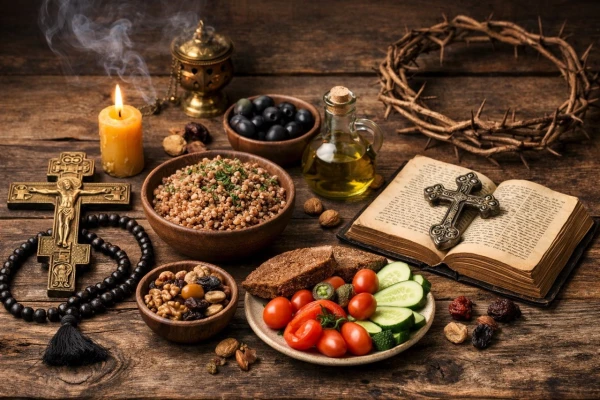
The Cheese Week or Maslenitsa precedes Great Lent. During this week, believers refrain from meat, which helps them gradually enter a fasting diet.
Great Lent has begun: how to properly spend the time of spiritual purification
For the uninitiated, Great Lent is sheer torment. Meat, milk, fish, eggs – all are taboo. Cakes and pastries are also forbidden.
However, ask any Christian about their attitude towards Lent, and they will answer without hesitation that they await it with great joy that nothing can replace. Why is that? Let’s try to unravel this riddle.
The Beginning and End of Great Lent in 2026
Great Lent, which precedes the feast of the Bright Resurrection of Christ – Easter – began on February 23 and will last until April 11, 2026.
The History and Essence of Great Lent
There is an opinion that Great Lent was established in memory of Christ's fasting, who, after His Baptism, spent 40 days without food and water in the desert.
However, there is another version. In the early days of Christianity, before Baptism, future members of the Church were instructed to pray and fast diligently. Baptisms took place several times a year, and only on major holidays, one of which was Easter. Those wishing to be baptized were called catechumens. Thus, in solidarity with them, baptized Christians also observed fasting and fervently prayed for the salvation of the whole world. The fast was not established all at once; the practice and experience of fasting were acquired over many years. Even now, the modern rule obliges members of the Church to fast for 47 days.
The fast consists of two periods: Holy Lent and then Passion Week.
Holy Lent – the days when we move towards God. Through food restrictions, prayer, and repentance for sins, we gradually prepare ourselves to meet the Risen Christ.
Passion Week – the days when Christ Himself comes to us through His last sermons, the Last Supper, Golgotha, and the Resurrection. Thus, together with God, we meet the most important Christian holiday – Easter.
Nutrition and Intimacy During Great Lent
The strictest weeks of Lent are considered to be the first week and Passion Week. Devout Christians during these days sometimes do not consume anything more substantial than a piece of bread and water. But this feat is not within everyone's reach.
Approaching food during Lent should be done wisely. Under no circumstances should you listen to others' advice or scour the Internet. Rely on your own strength, health, and the blessing of the priest with whom you confess. He knows and feels your spiritual state better than anyone else.
Fasting is not a diet. If you cannot live without meat – eat meat. If you cannot live without milk – drink milk. The goal of Great Lent is not in the prohibition of cottage cheese or sausage, but in repentance.
Regarding marital intimacy, the responsibility lies with the spouses themselves. If both are fasting, they usually limit themselves in intimate matters as well.
If only one spouse is fasting, and the other does not even think about fasting and demands the fulfillment of marital duties from the fasting one, then that duty must be fulfilled. The Apostle Paul also said about this: "But, to avoid fornication, let every man have his own wife, and let every woman have her own husband" (1 Cor 7:1-7). Moreover, the goal of Lent is not to destroy peace in the family, but to strengthen it.
How to Properly Observe Great Lent
The spiritual aspect of fasting was simply and concisely explained by Archpriest Vladimir Vigilansky. No one could say it better.
- Learn to pray. Add something to what you already have.
If you do not pray at home at all, then create at least a brief but regular prayer.
If you perform morning and evening prayers, then start reading the Psalms or a chapter from the Gospel daily.
If you only go to church on Sundays, then add at least one more day during the week.
- Learn to fight against sins. I suggest choosing the smallest of all recurring sins and trying to overcome it. For example, the habit of expressing dissatisfaction with everything you see or hear. Or discussing third parties with a close friend. Or using swear words in conversation.
Or holding a grudge against a relative (boss, teacher, neighbor, etc.). How to overcome this? Pray for them daily.
-
Learn to repent. Choose from the list of sins the most secret ones – those hidden from the eyes of others and for which you feel particularly ashamed. Go to confession and ask the priest how to deal with them. The priest is an experienced person, and he will surely advise what is necessary.
-
Learn to do good deeds. "For I was hungry, and you gave Me to eat; I was thirsty, and you gave Me drink; I was a stranger, and you took Me in; naked, and you clothed Me; sick, and you visited Me; in prison, and you came unto Me" (Matt. 25:35-36).
Every evening, examine your conscience: what good deed did I do today? Whom did I comfort, whom did I help, whom did I spend time with, etc.? If there was none, realize that you have lived the day in vain.
- Learn to rejoice. In the beauty of God's world. In the gifts and talents bestowed upon people. In manifestations of love, compassion, and mercy. In the discovery of meanings, logic, harmony, and truth. In short, in everything that brings us closer to God.
Frequently Asked Questions and Answers
Fasting imposes many prohibitions regarding food and behavior. However, gastronomic restrictions are merely assistance to a person in their struggle against passions.
Why is the first week of Great Lent considered the strictest?
The first week – the beginning of Lent – has the strictest restrictions. The Church wants to lead believers to God through prayers, showing that the true path requires work on oneself and overcoming one's limitations, hence the main focus is on the theme of repentance.
What services are held in churches during the first week of Great Lent?
The beginning of the Lenten services is dedicated to lengthy penitential prayers that prepare Christians for the meeting of Easter.
During the first week, churches perform "Eternal Memory" – a special hymn for the solemn commemoration of deceased Christians.
From the first day of Great Lent, priests read the Gospel during the hours (this is the name of a special service), and on special days, they perform the Anointing and the commemoration of the Passion of Christ.
On Tuesday, they read the stichera of the Lenten Triodion, on Wednesday they conduct the Liturgy of the Presanctified Gifts, and on Sunday – the Liturgy of Basil the Great, which concludes with a prayer for the Triumph of Orthodoxy over heresies.
What is forbidden to eat during the first week of Great Lent?
During the first week of Lent, believers are forbidden to eat meat, milk, butter, fish, eggs, rich pastries, and any strong drinks.
In Greece, where shrimp and seafood are considered light and inexpensive food, they are allowed even during Great Lent. In our country, such food is permitted only on certain days of the fast.
We also remember that during these days, it is undesirable to hold celebrations at home, receive guests, or visit entertainment establishments.
Yuri POZHIDAEV.















Leave a comment