
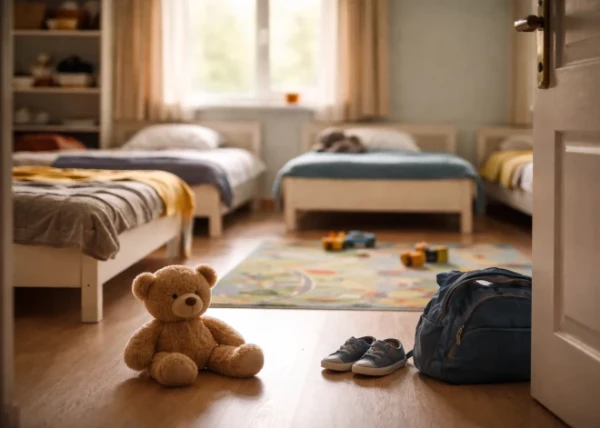
In Riga, the only crisis center for minors is almost full. In just a month and a half, 36 children have already been placed there. As its director says, the situation is getting worse every year: the number of children removed from families is increasing, while there are no available places in long-term care institutions. What does this mean for children for whom the crisis center becomes a temporary home for months instead of weeks?
The crisis center is the first institution where children arrive after being removed from their families. They are supposed to stay here only for a short time while the situation is resolved, but increasingly, 'this short time' turns into months, reports TV3 Ziņas.
Currently, the youngest resident of the crisis center is a two-year-old boy. He does not fully understand where he is, but he knows for sure that his mother is not nearby. The only crisis center of the Riga municipality for minors is now almost full: out of 30 places, 27 are occupied. Although the situation changes daily, the overall trend is becoming more alarming.
Anita Veretjanova, head of the Riga municipality crisis center:
"The statistics are only getting worse. The number of children is increasing. Last year, 240 children were removed from families; today, it’s already 36. And this is just the beginning of the year."
Most often, they arrive here in emergency situations at night when children are brought in by police officers. These are minors from families where unsanitary conditions, alcohol, and drugs prevail.
"What is this related to? Perhaps families are becoming poorer. The economic situation in the country," says Veretjanova.
But the problem does not end with the removal from the family. As the center's director notes, Latvia lacks places in long-term social care institutions. This means that children who do not return to their biological families or do not enter foster families remain in crisis centers much longer than intended.
"It is an abnormal situation that there are no places in long-term care, that there is nowhere to send these children. We are purchasing many places outside of Riga - in Ikskile, Bauska region, Valmiera, and Graši. But even there, only a few places are allocated for Riga. This does not solve the problem," says Veretjanova.
Reinis Uzulnieks, Minister of Welfare: "I think this is a problem for Riga because in the regions, these children can be found a place in an institution. I spoke with Riga - the municipality needs to cooperate and think about where to place these children."
"Ten years ago, there was a concept that Latvia would be without orphanages. We were moving towards this, and at the state level, many solutions were sought. The foster care sector was developing. Now we are rolling back on statistical indicators, and it is clear that places in institutional care are overcrowded. This is not just a Riga issue - it is throughout Latvia," says Liga Tetere, head of the social services department for families and children at the Riga City Council Welfare Department.
Currently, 17 minors have been in the Riga crisis center for a long time, and responsible officials predict that their number will only grow.
"We are taking steps in all directions where we see how we can help children enter a favorable environment for them, including long-term care: we are creating small, family-type places," says Tetere.
Three such homes operate in the capital, and this year, another one is planned to open, where 20 children can live for an extended period. Funding for foster families has also been increased, as their number has been decreasing in Latvia in recent years. "Our statistics are noticeably going down; the number of foster families is not increasing. And adolescence is a challenging age. That’s why children remain in crisis centers," notes Tetere.
Meanwhile, the center's director observes that children's love for their families is boundless. They protect their parents fiercely, hide their pain, and despite having experienced severe violence, they want to be close to their mom and dad.






Leave a comment