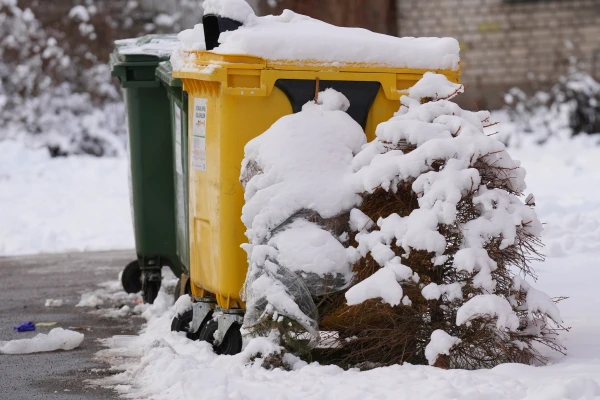
The Riga City Council has decided to take a radical approach to sorting household and other waste. Now paper, plastic, and metal will have to be separated into yellow containers, while food scraps – organic biological waste – will have to be thrown into brown containers.
No one has explained yet which kitchens in apartment buildings are equipped to accommodate half a dozen different bags for various types of waste. Practically nothing will be left of the kitchen... But residents have already started receiving fines for throwing one type of waste into a container designated for another.
In addition, organic waste can also be buried right in the yards, both of private houses and apartment buildings. How this will look in reality and what smells will be spread is not reported anywhere. However, a container for biological waste must be installed at every residential building.
The question arises, why were large underground containers for various waste built during the previous term, where not only residents of a dozen apartment buildings bring their waste, but also someone drives up in the evenings and throws trash from their trunks into these containers?
It is unnecessary to mention that residents have started paying less. The bills show figures of over 8 euros "per person." Meanwhile, residents of Zadvina north of Kalnciema Street pay "flatly" more than those in the southern part of Zadvina. Logically, the residents of the former Latgale suburb should pay the least, as it is the closest to the "Getlini" landfill.
From the perspective of utility services, residents of Kengarags do not pay more for sewage services than residents of Bolderaja, even though it is closest to the treatment facilities. Therefore, the rate for garbage collection should be the same for everyone. But in this case, "they play by different rules."
At the same time, the city held a competition for the right to provide garbage collection services, dividing the capital into four "zones," each with its own contractor. Residents cannot change their "service provider." Therefore, the city should have established a unified rate for garbage collection for the entire capital and then conducted settlements with the "garbage trucks." But it turned out that residents became "serfs" of the garbage collection companies.
The new tightened rules are set to come into effect on March 1, 2027.