
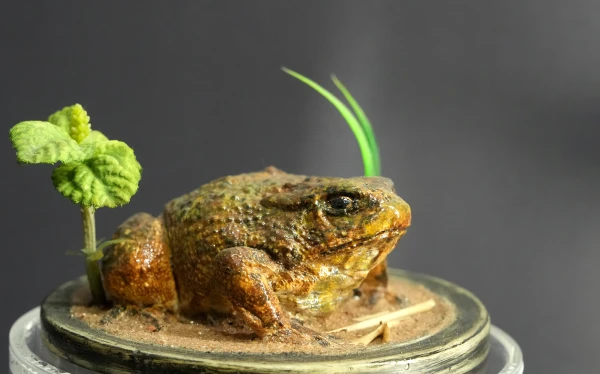
The Latvian National Museum of Nature has chosen the common toad as the animal of 2026 — a species of amphibians widespread throughout Latvia, the museum's communication department reported to LETA.
Due to the seasonal migration characteristic of toads in spring, as they head to breeding sites, they often cross roads and are at risk from traffic. If the toad survives, its lifespan can reach up to 40 years.
As museum specialists explain, the common toad is one of the largest amphibians in Latvia. The body length of an adult toad ranges from 6 to 12 centimeters, and in rare cases, up to 13 cm. Females are usually larger and bulkier than males. The legs are short and robust, more adapted for slow crawling than for jumping. The skin is dry, rough, with pronounced warty growths — this is one of the main distinguishing features that sets the toad apart from the frog. The coloration varies from yellow-brown and grayish to dark brown, with a lighter belly. On the sides of the head are large oval parotid poison glands that give a bitter and unpleasant taste to other animals.
The common toad spends most of its life on land — it can be found in deciduous and coniferous forests, meadows, shrubs, garden areas, and green spaces in cities. It is nocturnal, hiding during the day in cool, damp, and dark places, such as under fallen trees, stones, in dense vegetation, or cracks in the soil. It becomes more active in the evening and during rainy weather. The common toad is a cold-blooded animal, so its body temperature depends on the surrounding environment. It hibernates in shelter, entering a state of dormancy, the museum specialists explain.
Although toads lead a sedentary lifestyle, in spring they embark on seasonal migrations to breeding sites, often crossing roads and facing danger. They begin to move as soon as the snow melts and it becomes warm enough — usually in March-April. Breeding occurs in calm, shallow waters with abundant vegetation — ponds, ditches, lakes, and old riverbeds. In nature, the common toad can be recognized by its characteristic slow and heavy movements, and in spring — by the long ribbons of eggs in the water. In summer, its presence is indicated by a muted "crackling" sound made in moments of alarm.
A display dedicated to the animal of the year will be exhibited throughout the year at the zoological exhibition of the Latvian National Museum of Nature.
The animal of the year has been chosen for over 20 years. In 2000, it was the stag beetle, in 2001 — the common pearl mussel, in 2002 — the tower snail, in 2003 — the Eurasian lynx, in 2004 — the harbor porpoise, in 2005 — the dormouse, in 2006 — the common flying squirrel, in 2007 — the marsh toad. In 2008 — the long-nosed seal, the following year — the brown bear, in 2010 — the otter, in 2011 — the European bat (a species of bat), in 2012 — the common slowworm, in 2013 — the European marsh turtle, in 2014 — the gray wolf, in 2015 — the wild boar.
In 2016 — the badger, in 2017 — the river eel, in 2018 — the common squirrel, in 2019 — the moose, in 2020 — the common beaver, in 2021 — the brown hare and the white hare, in 2022 — the weasel, in 2023 — lizards, in 2024 — the roe deer, and in 2025 — the hedgehog.















Leave a comment