
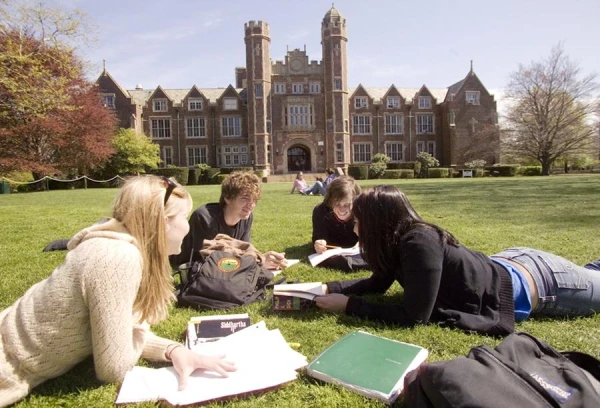
Latvia remains attractive to foreigners, but more and more graduates of local schools are going abroad for diplomas. According to LTV journalists, there are currently more than 5,000 young men and women from Latvia studying outside the country, and this number is growing.
There are 48 higher education institutions in Latvia, and this academic year, about 75,000 people are studying in universities of all levels and programs. The largest universities are the University of Latvia, Riga Technical University, and the P. Stradins Riga University: they account for more than half of the students.
At the same time, the flow of foreign students is increasing. Over the past 20 years, their number has grown almost eightfold: from about 1,500 in 2005 to more than 11,000 this year. Almost a third of the newcomers are from India, followed by students from Uzbekistan and Sweden. The most sought-after fields among foreigners are medicine, technology, and business management, and this is an important source of income for Latvian universities.
Exact data on the departure of Latvian graduates for studies abroad is lacking: those leaving are not required to report. A few years ago, UNESCO estimated the scale at about 5,000 people, or approximately 7% of Latvian students.
"It is not always possible to say that any foreign education at any university will be unequivocally of higher quality than the educational opportunities available to us in Latvia. This is not the case," said Alexandra Ryabachenko, head of the Latvian branch of Kalba, on the LTV program "Aizliegtais paņēmiens" ("Forbidden Method").
Among the reasons for choosing foreign education, an expanded selection of programs and instruction in English are often mentioned. After Brexit, British universities lost ground, and one of the most popular destinations became the Netherlands: according to data from that country, about 1,400 Latvians study there. Tuition for EU citizens costs about 2,500 euros per year, but students cite housing as the main problem - it is difficult to find and expensive.
Denmark attracts students with free education and support for working students: with employment of at least 12 hours a week, one can receive a scholarship of nearly 1,000 euros per month. Finland is also free for students from Europe, with costs mainly for living expenses. A 2021 survey showed that about 17% of high school students in Latvia would like to study abroad, and a 2024 study noted that graduates of Riga gymnasiums with math scores above 75% more often choose foreign universities.
"Things are good in Latvia - I just chose a path that provides me with more stability and more opportunities in the future," said a student studying in Denmark.











Leave a comment