
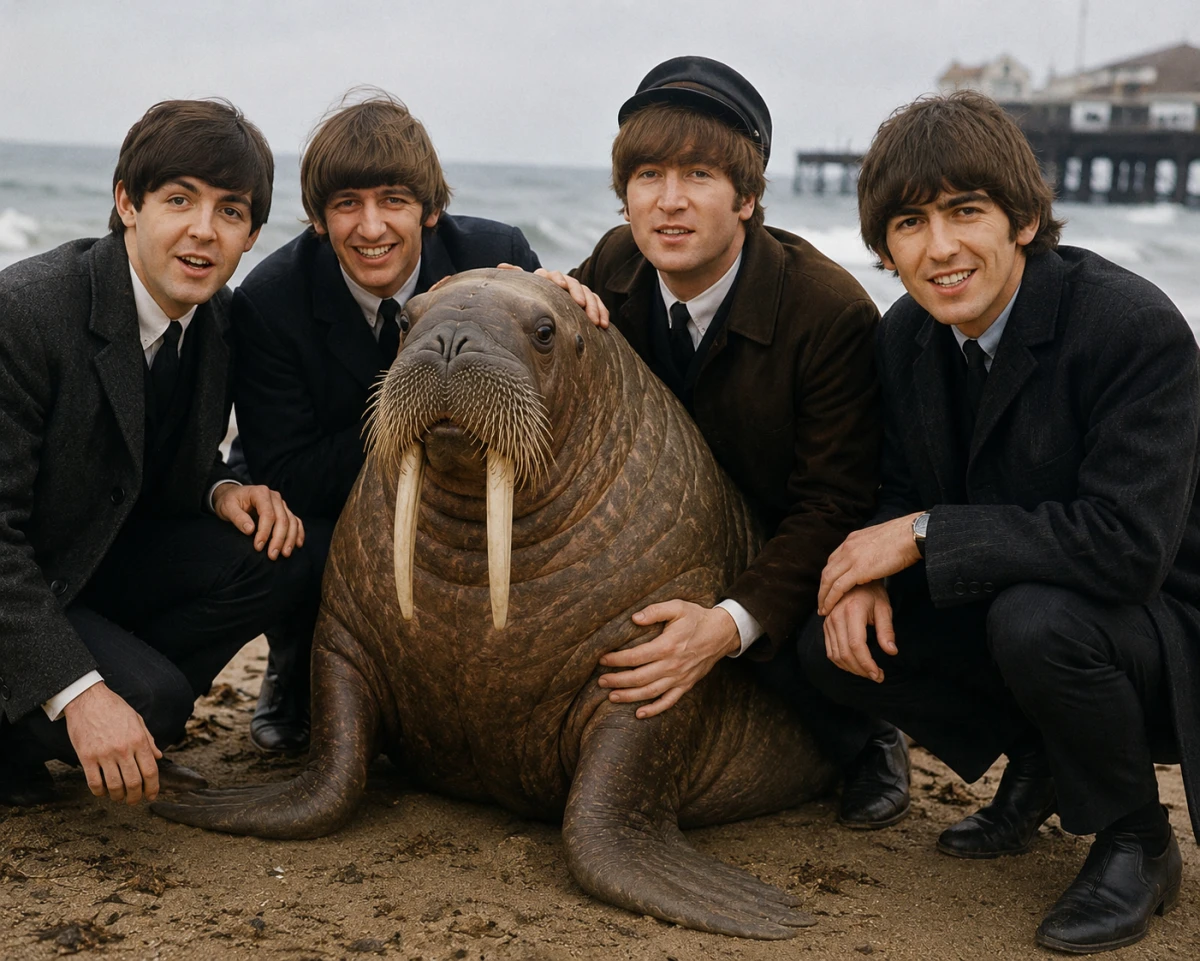
On the first-ever Global Beatles Day, we explore one of the most enduring mysteries surrounding this legendary group...
Today marks the first official Global Beatles Day — a date finally recognized officially by The Beatles and Apple Corps Ltd.
On June 25, 1967, John Lennon, Paul McCartney, George Harrison, and Ringo Starr entered the One studio of London’s Abbey Road and performed their favorite song "All You Need Is Love" as part of the first international satellite television broadcast.
In honor of this official debut, Euronews Culture recalls one of the most enduring mysteries surrounding the Liverpool quartet, a riddle that has left many music lovers pondering the same question: who was the walrus in their classic 1967 song "I Am The Walrus"?
Before revealing the truth, a bit of background...
The song, written by Lennon, was partly inspired by Lewis Carroll's 1871 poem "The Walrus and the Carpenter," and, reportedly, by two of his LSD trips. Later, Lennon lamented that he realized too late that in the poem the walrus is the villain.
He said nothing similar about psychedelics.
The composition was included in the soundtrack of their television film Magical Mystery Tour and is notable for being banned from BBC airplay due to the last two lines in the fourth stanza: Yellow matter custard / Dripping from a dead dog’s eye / Crabalocker fishwife, pornographic priestess / Boy, you’ve been a naughty girl / You let your knickers down.
As can be easily understood from this short excerpt, "I Am The Walrus" is literally packed with vivid surreal images: there’s "sitting on a cornflake," "egg man," and "elementary penguin singing," and even a cheeky reference to Edgar Allan Poe.
The song has been interpreted as containing elements of Indian philosophy, analyzed as a critique of blind religiosity, and explained as a targeted strike against capitalism.
In reality, Lennon wrote it solely to confuse listeners.
He did this after receiving a letter stating that a teacher had begun analyzing The Beatles' songs in class and attributing serious academic interpretations to the band's lyrics. This annoyed him, and he consciously decided to confuse everyone desperately searching for hidden meanings in his words by stuffing the text with as many abstract images as possible.
And now we come to the main question: who was that walrus?
A hint later surfaced in the band's discography. In their 1968 double album "The Beatles" (better known as the "White Album"), there is a song "Glass Onion," in which John cheekily sings: "The walrus was Paul."
It seemed like the answer. At least, that’s what the fans thought...
The situation became complicated in 1970 when Lennon released "John Lennon / Plastic Ono Band" — his first solo album after The Beatles broke up. In the piercingly bitter song "God," he declares: I was the Dreamweaver / But now I'm reborn / I was the walrus / But now I'm John / And so, dear friends / You'll just have to carry on / The dream is over.
G’goo goo g’joob G’goo goo g’joob AP Photo - Canva
So, was the walrus Paul or John?
And what does it even mean? Is it good to be a walrus? Or is it an insult, if we remember that the walrus in Carroll's tale deceived a trusting group of anthropomorphized oysters and then devoured the defenseless bivalves with relish?
The answer eludes all these questions because any attempt to find solutions fundamentally misunderstands the essence of "I Am The Walrus" and its psychedelic playfulness. As mentioned, this is a deliberately nonsensical song, a precious specimen of verbal gibberish to which literal logic cannot be applied.
Think of it as the musical equivalent of the meme "The curtains were blue: what the author meant / what your literature teacher thinks the author meant."
The teacher confidently states: "The curtains symbolize his profound depression and loss of will to live."
And what the author meant: "The curtains were just, like, blue."
Sometimes it's not worth searching for a deep subtext in every word. It’s better to enjoy the incredibly liberating feeling that not everything has layers to peel away one by one. Sometimes it’s just a glass onion.
G’goo goo g’joob.
Happy Global Beatles Day!













Leave a comment