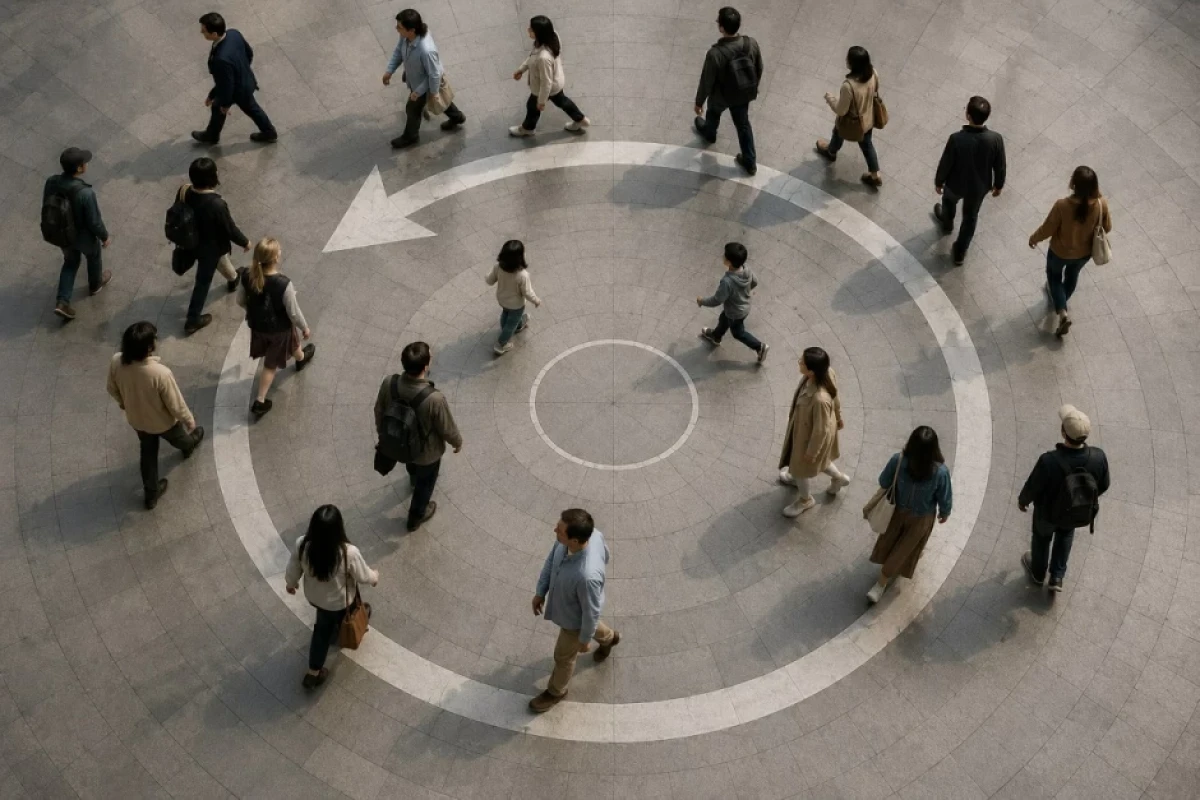
In a group, these deviations accumulate and form a general movement.
A new study has shown that most people instinctively prefer to move to the left, that is, counterclockwise, during calm walking. Researchers from the University of Navarra in Spain discovered this pattern accidentally during the pandemic. While analyzing video recordings to assess safe distancing in public places, they noticed that people in enclosed spaces most often move counterclockwise.
Intrigued by this effect, the researchers conducted a series of experiments with individual participants and small groups. The results again showed a consistent tendency to move left. To check if this was related to cultural features, the scientists involved colleagues from Japan. However, the same pattern was observed there as well.
The effect persisted regardless of the participants' gender and was particularly noticeable in children. The researchers suggest that each person has a slight individual tendency to deviate in a certain direction, and in a group, these deviations accumulate and form a general counterclockwise movement. The exact reason for this behavior remains unknown. Scientists have tested various hypotheses, including the influence of body biomechanics and spatial perception characteristics. They also conducted experiments in virtual reality and modeled different movement conditions, but so far, no convincing explanation has been found.
According to one version, natural asymmetry in the human body and brain may play a role. Since most people are right-handed and have a dominant right leg, this may influence the direction of movement. Similar preferences are observed in some animals: for example, studies have shown that stone ants are more likely to turn left when exploring new nests. Understanding this phenomenon could have practical significance. More accurate models of human movement could help improve the design of public spaces, evacuation systems, transport hubs, museums, and shopping centers.