The admirers of the star born 100 years ago were both Kennedy brothers.
An actress, singer, model, and sex symbol of the 1950s, she lived only 36 years. Marilyn left in the prime of feminine beauty, remaining eternally young on screen and in the hearts of her fans. Almost 65 years have passed since her premature and largely mysterious death, yet films and books are still dedicated to her, her image is used in advertising, and her style is copied by new stars. Most importantly, viewers enjoy watching and rewatching films featuring her.
Norma Jeane Mortenson (her birth name) decided to become an actress at the age of five. She did not yet know that such a profession existed; she simply imagined and played out her life in other, much happier circumstances, seeking to escape the gray reality. Her childhood was remarkably joyless. She did not know her father, her mother drank heavily and was often institutionalized with a diagnosis of "schizophrenia."
In her childhood and youth, Norma Jeane spent time in half a dozen orphanages, where she had to wash dishes, bathrooms, and toilets. She also lived in foster homes, where she often played with empty whiskey bottles instead of children's toys and was subjected to sexual abuse several times. All of this could not pass without a trace for her psyche. And it bitterly echoed at the peak of her fame. But at the beginning of her journey, these trials only hardened her character.
During World War II, Monroe worked at a military factory. Lacking a proper education, she stood on the assembly line and riveted parts for airplanes. In a work jumpsuit that concealed her blooming figure, she stood out little. Everything changed with the arrival of a military photographer in the factory, who took propaganda photos to boost the morale of fighting soldiers.
Photos of the young blue-eyed worker, highlighting the smooth curves of her figure, created a sensation among the public. Her image spread across magazines, calendars, and advertising posters.
Photographers noted the "delicate subtlety and striking mobility of her face," framed by chestnut hair. Having signed a contract with a modeling agency, Marilyn began actively searching for her style: from a brunette, she transformed into a platinum blonde with black eyebrows, a prominent beauty mark on her left cheek, and lips painted in bright, seven layers (!). Norma Jeane, who married a simple worker at 16 to avoid returning to the orphanage, was left in the past. A free and dazzling Marilyn Monroe was born.
Her first roles in films, however, were minor: waitresses, dancers, nurses, secretaries. In some films, the budding actress was not even credited. But Marilyn had a strong will and a desire to become a star. Working as a model, including posing nude, she took singing and dancing lessons, attended auditions, and gained experience. Monroe's breakthrough came in the early 1950s. After supporting roles in the films "The Asphalt Jungle" and "All About Eve," her efforts were recognized. The director of "Eve," Joseph L. Mankiewicz, noted that Monroe had "a certain sensuous innocence" and "something that takes men's breath away."
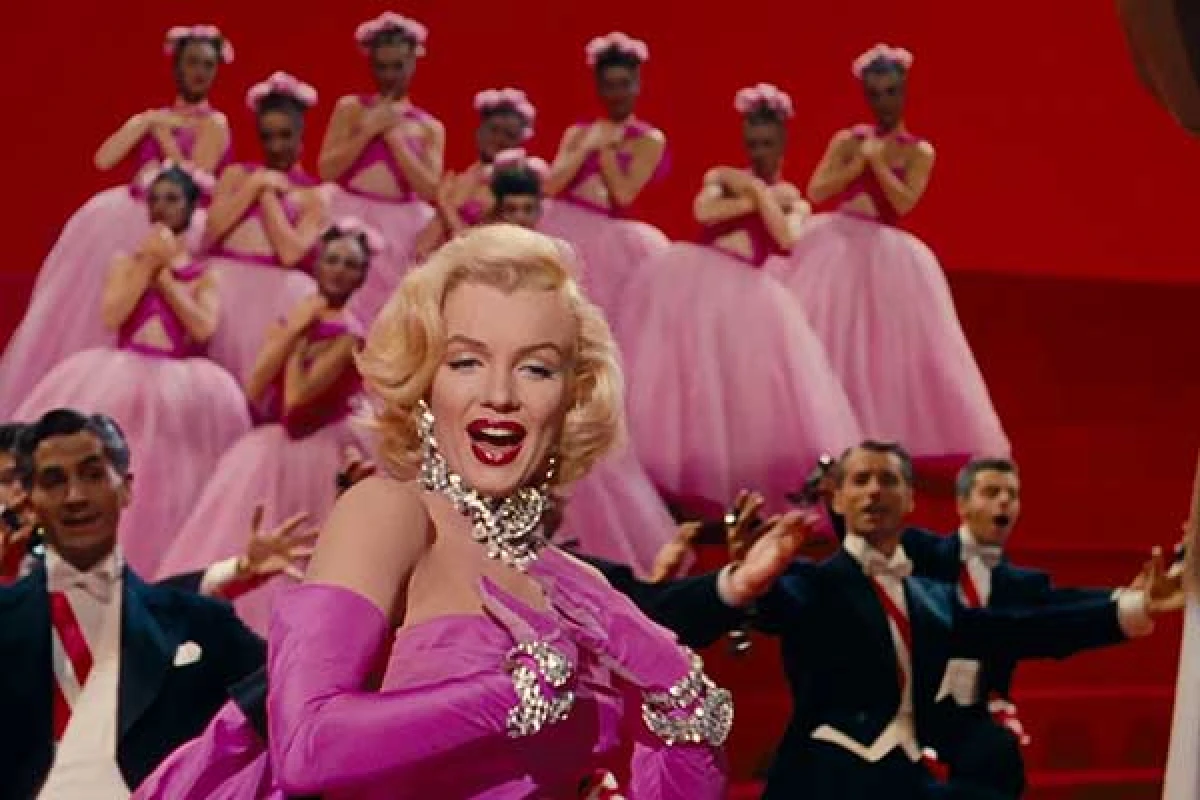
This allure, to use today's language, was noticed not only by Mankiewicz, and in 1953, Marilyn appeared in three of her trump card films — "Niagara," "Gentlemen Prefer Blondes," and "How to Marry a Millionaire." These films not only brought her to the forefront of Hollywood divas but also cemented her role as a charming, sexy, but somewhat dim-witted blonde with a "horizontal walk" (a reference to her seductive hip sway in the film "Niagara"). She was paid several times less than, say, Elizabeth Taylor and Audrey Hepburn, who had a reputation as serious dramatic actresses.
Marilyn fought, as best she could, against the stigma placed on her snow-white skin. She was not a dumb blonde, as the gossip suggested. Monroe read a lot: her library contained over 400 books, including works by Joyce, Proust, Hemingway, Fitzgerald, Steinbeck, Beckett, Camus, Rilke, Whitman, and Freud's writings. Her IQ, by the way, was higher than Einstein's. The great scientist admitted after meeting the actress that she understood the theory of relativity better than his assistants. How about that for a "dumb blonde"?
For several years, Monroe took acting lessons from the outstanding actor and teacher Michael Chekhov. With him, she rehearsed roles of Cordelia from "King Lear," Elena Andreyevna from "Uncle Vanya," and Grushenka from "The Brothers Karamazov." It was Grushenka that she dreamed of playing in a film, provoking laughter from her colleagues. Later, Marilyn attended the famous acting classes of Lee Strasberg, who practiced the Stanislavski system. The teachers convinced Monroe that she had real talent and that she needed to stop playing the sex bomb and become a great, serious actress.
Despite the opposition from Hollywood bigwigs, in 1954, after difficult negotiations, Marilyn signed a contract with 20th Century Fox that not only provided for a significant increase in her fees but also allowed her to participate in project selection, influence role interpretations, and not be a submissive puppet in the hands of producers. She then created her own film company, which was unthinkable for a Hollywood actress at that time. Thanks to the new opportunities, she managed to play several complex roles in the films "Bus Stop," "The Prince and the Showgirl," and "The Misfits." Monroe managed to prove, and even the most venomous film critics acknowledged this, that she was not a glamorous diva but a real actress. But she had almost no strength left to consolidate and develop her success...
A heavy inheritance from her mother and constant gossip swirling around her name had long deprived the actress of sleep. To keep up with her demanding acting schedule, Monroe drowned herself in alcohol and barbiturates. Because of this, she was late for shoots, poorly remembered her lines, and sometimes fell asleep during makeup. A number of scenes in Monroe's most famous film — the comedic masterpiece "Some Like It Hot" — had to be reshot dozens of times due to her occasional disorganization or, conversely, excessive demands. But the result, the film's director Billy Wilder acknowledged, was worth it!
Her mental health was undermined by unsuccessful marriages as well. Marilyn's second husband, baseball legend Joe DiMaggio, was not interested in her work — he demanded that she become a housewife and was wildly jealous of every lamppost. After the famous scene in the film "The Seven Year Itch," where her white dress billowed up, exposing Monroe's thighs and white panties, he hit her. Their marriage lasted less than a year, although DiMaggio later cared for her and came to her aid in difficult times.
Her third marriage to renowned playwright Arthur Miller, for whom she converted to Judaism, lasted five years. Journalists joked: "The leftist intellectual married an hourglass." Marilyn sincerely loved Miller, wanted a child from him, but several pregnancies ended in miscarriages. Ultimately, the balding Miller, who was 11 years older than Marilyn, left the most beautiful actress in the world for a masculine-looking female photographer, with whom he was happy until the end of his days.
Marilyn's short-term romances did not bring her happiness either. Among her admirers were billionaire Howard Hughes, actors Yves Montand, Frank Sinatra, Paul Newman, Marlon Brando, and finally, the Kennedy brothers. All of them wanted to possess her perfect body (although, as it turned out later, Monroe had undergone chin correction and breast augmentation), but they were frightened when she spoke of marriage. "I didn't turn out to be a woman," Monroe once confessed. "My men, because of the image of a sex symbol created by them and by myself, expect too much from me. So much that I cannot meet their expectations. After all, my anatomy is no different from that of other women."
The last months of her life were filled with nervous breakdowns, conflicts with producers, and the cancellation of filming for a movie with the prophetic title "Something's Got to Give." Monroe withdrew into herself, communicating only with her most trusted friends and assistants. The actress's appearance in a form-fitting "naked" dress while singing "Happy Birthday, Mr. President" at John F. Kennedy's birthday in May 1962 became her last triumph. On the night of August 4–5, the actress was found dead in her apartment in an unnatural position with a telephone receiver in her hand.
The official cause of death was an overdose of sleeping pills, although no traces of the drugs were found in her stomach; they were only detected in her blood. Numerous theories about the involvement of the Kennedy brothers or a murder ordered by the FBI or CIA have not found documentary confirmation. The mystery of the famous actress's death remains unsolved to this day. Just as all the twists and turns of her remarkable life, which took an orphan from an orphanage to the heights of global fame, remain unraveled.