
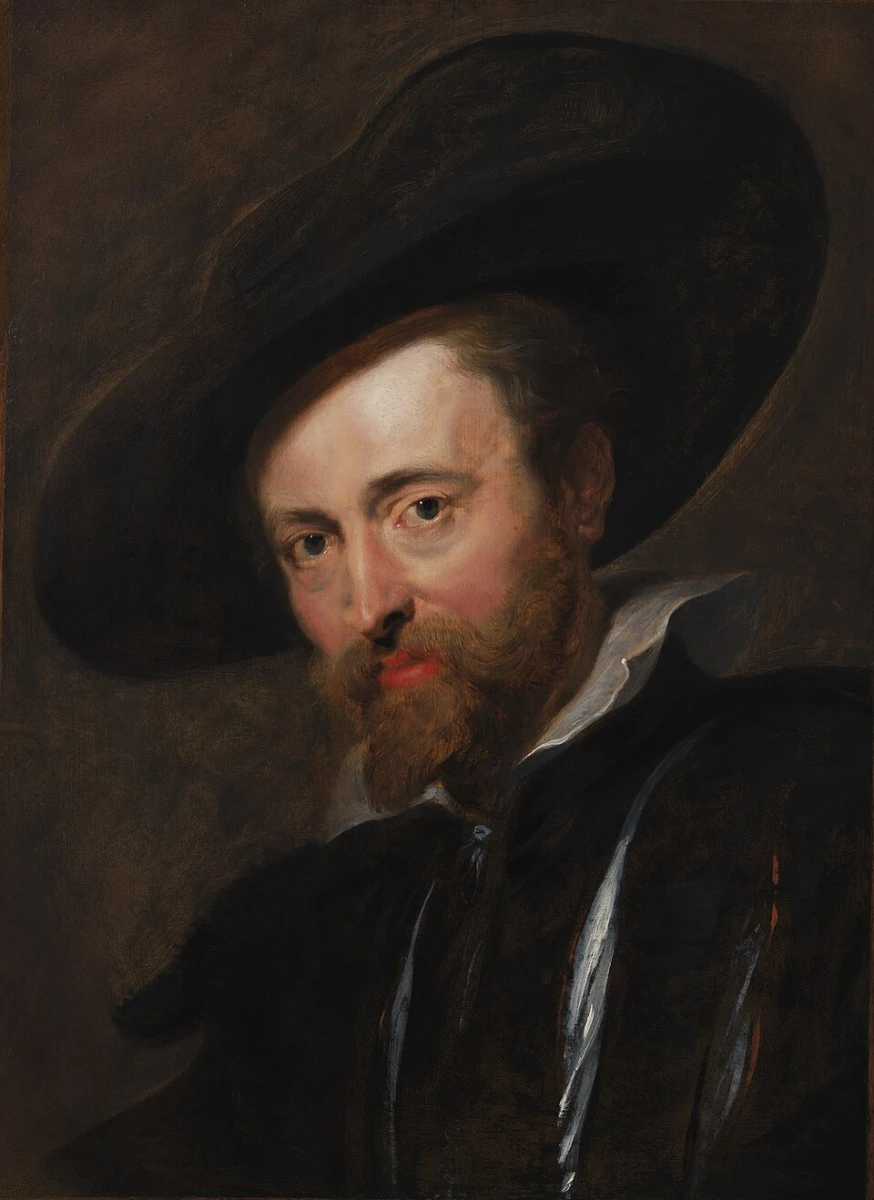
Very few works by the artist have survived to this day in his homeland.
More than 400 years ago, a young Rubens walked the streets of Rome, sketching works of the Renaissance that he saw in the city's churches and palaces. The artist lived in Rome from 1601 to 1608 with his brother Philip near the Spanish Steps.
Now, one of the sheets from that period has found its way into the collection of the Rubens House (Rubenshuis) in Antwerp – the artist's hometown. This month, it was presented to the public for the first time.
On one side of the sheet, a quick sketch in brown ink has been preserved. It depicts three men in ancient clothing. Researchers suggest that these are apostles. At the top of the sheet, several uneven thick lines are visible – likely how the artist tested his pen before working.
However, experts have not been able to link the drawing to any known work by Rubens. Therefore, it is still unclear whether the artist invented these characters himself or copied a composition he saw in Rome.
On the reverse side of the sheet, an unfinished draft of a letter to the Italian artist Cristoforo Roncalli has been preserved. It is dated September 1607. At that time, 30-year-old Rubens was working as a court painter at the court of the Dukes of Mantua.
In the letter, Rubens addresses Roncalli on behalf of their mutual patroness – Eleonora Medici, Duchess of Mantua. The Italian artist was supposed to paint a picture for her private chapel. Rubens politely inquires about the progress of the work.
"In this draft of the letter, he is literally trying to find the right words and the appropriate tone. It is important for him to be diplomatic, not to offend the Italian artist, but at the same time to make it clear that the painting needs to be checked for the duchess and that time is running out," noted the curator of the Rubens House, Ann Van Camp.
According to her, the handwriting in the letter is quite careless, and the text shows numerous corrections. Rubens was trying to find the right words.
"This letter is particularly interesting because it allows us to see Rubens as an emerging diplomat," emphasized Ann Van Camp.
Later, the artist would indeed become a notable diplomatic figure. From the early 1620s, he increasingly participated in political negotiations and carried out commissions from the authorities of the Spanish Netherlands and the Spanish crown.
Rubens negotiated with England and France and took part in attempts to establish peace between Spain, England, and the Netherlands. At the same time, the artist often used his art as part of diplomacy. He painted portraits of monarchs and influential aristocrats, which helped strengthen ties between courts and support negotiations.
For the Rubens House, the discovery of this sheet is of particular significance. Currently, its collection holds only two drawings and ten letters from Rubens, all of which pertain to a later period in the artist's life.
The sheet can currently be seen at the interactive exhibition Rubens Experience, which is taking place in Antwerp near the Rubens House. It is planned to later move to the museum itself, which is currently closed for extensive renovation. It is expected to reopen no earlier than 2030.
Very few works by the artist have survived to this day in Belgium. Many of Rubens' paintings ended up in Madrid and Vienna. They were taken by Spanish and Austrian rulers who controlled the territory of modern Belgium at different times. Additionally, in the 18th and 19th centuries, the master's drawings were actively purchased by collectors from England and France, causing his legacy to be scattered across different countries.
The sheet had long been in a private collection in the United States. When the owner decided to put the work up for sale, it was acquired for Belgium by the King Baudouin Foundation – a Belgian charitable organization that supports cultural, scientific, and social projects.
Initially, the sheet was priced at 145,000 euros, but the American owner agreed to lower the price to 110,000 because the work was to be transferred to the museum and made accessible to the public.
Rubens hurriedly left Italy in 1608 when he learned of his mother's serious illness. However, he did not manage to see her before her death. Upon returning to Antwerp, the artist soon began receiving large commissions and quickly became one of the most famous masters in Europe.
Nevertheless, the Italian period remained special for him forever. Until the end of his life, he continued to sign as Pietro Paolo Rubens.
Missing Italy, the artist transformed his home in Antwerp into a true palazzo, inspired by the architecture of Ancient Rome and the Renaissance.







Leave a comment